Η Αστρονομική Εικόνα της Ημέρας από τη NASA
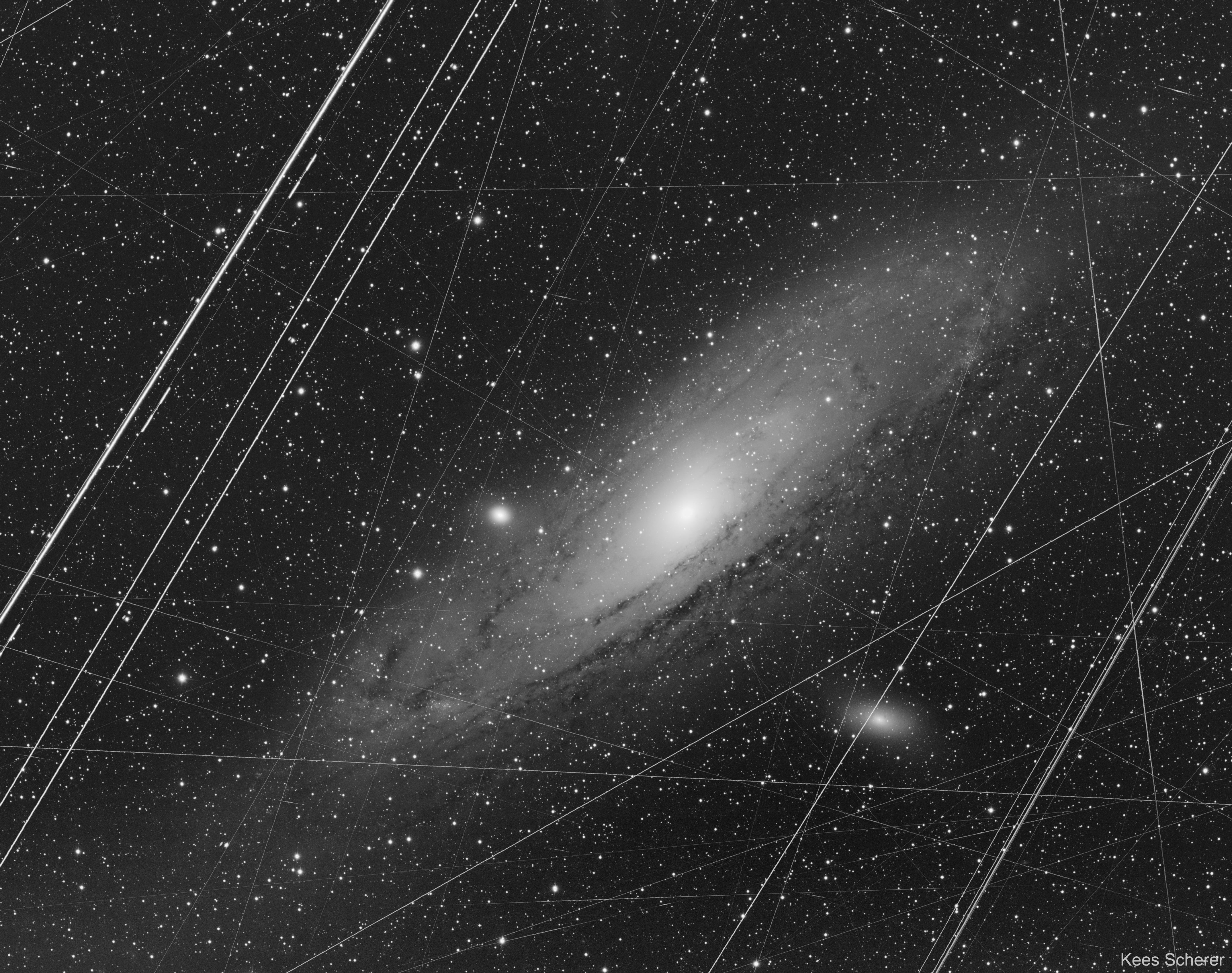
Andromeda before Photoshop
27/09/2026
What does the Andromeda galaxy really look like? The featured image shows how our Milky Way Galaxy's closest major galactic neighbor really appears in a long exposure through Earth's busy skies and with a digital camera that introduces normal imperfections. The picture is a stack of 223 images, each a 300 second exposure, taken from a garden observatory in Portugal during 2019. Obvious image deficiencies include bright parallel airplane trails, long and continuous satellite trails, short cosmic ray streaks, and bad pixels. These imperfections were actually not removed with Photoshop specifically, but rather greatly reduced with a series of computer software packages that included Astro Pixel Processor, DeepSkyStacker, and PixInsight. All of this work was done not to deceive you with a digital fantasy that has little to do with the real likeness of the Andromeda galaxy (M31), but to minimize Earthly artifacts that have nothing to do with the distant galaxy and so better recreate what M31 really does look like. APOD's email for image submissions has changed. Please see: APOD Submissions APOD's main NASA site is moving: From apod.nasa.gov to science.nasa.gov/apod
Copyright: NASA
Προηγούμενες Αστρονομικές Εικόνες της Ημέρας από τη NASA
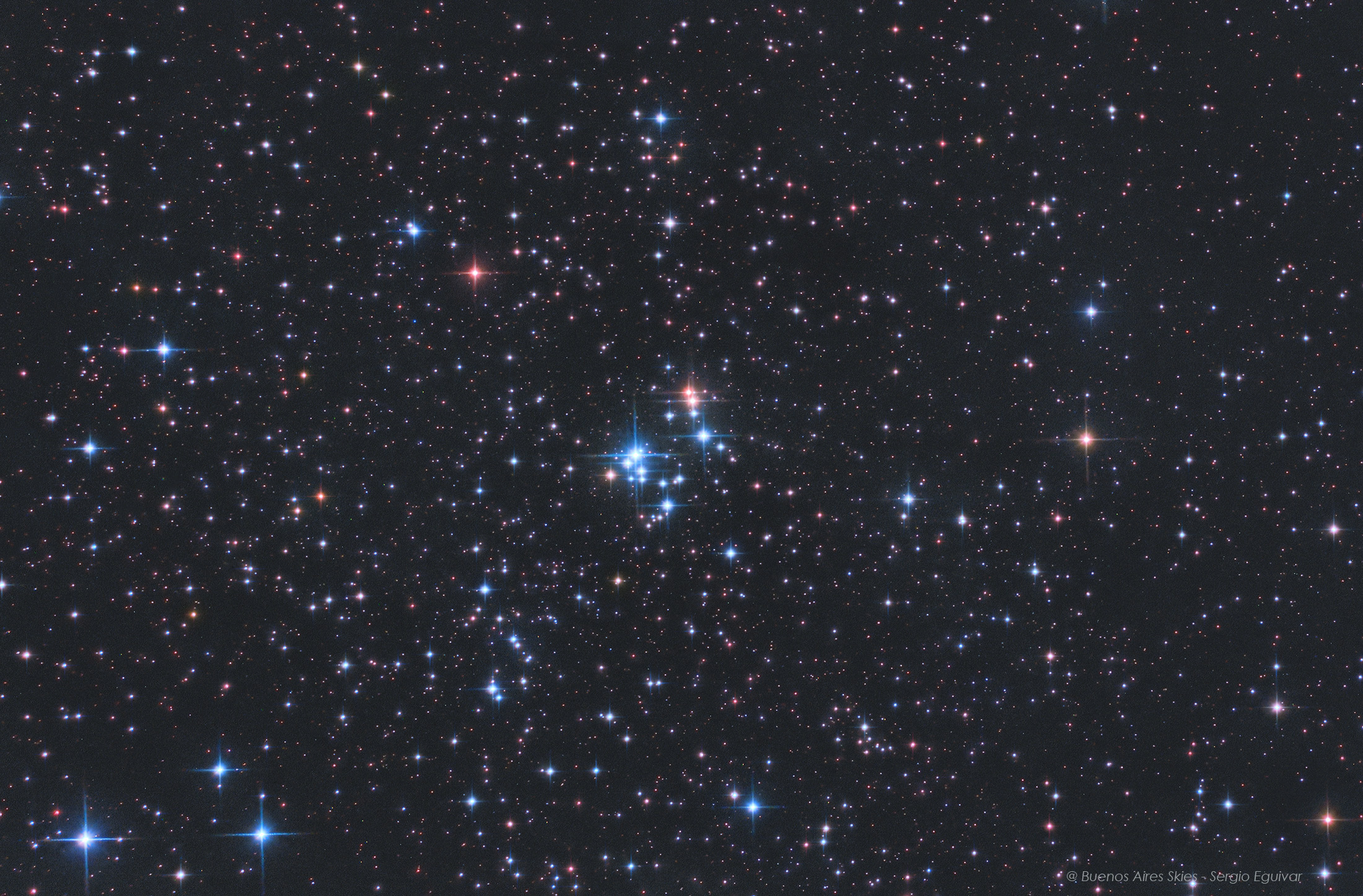
The 37 Cluster
14/05/2024
For the mostly harmless denizens of planet Earth, the brighter stars of open cluster NGC 2169 seem to form a cosmic 37. Did you expect 42? From our perspective, the improbable numerical asterism appears solely by chance. It lies at an estimated distance of 3,300 light-years toward the constellation Orion. As far as galactic or open star clusters go, NGC 2169 is a small one, spanning about 7 light-years. Formed at the same time from the same cloud of dust and gas, the stars of NGC 2169 are only about 11 million years old. Such clusters are expected to disperse over time as they encounter other stars, interstellar clouds, and experience gravitational tides while hitchhiking through the galaxy. Over four billion years ago, our own Sun was likely formed in a similar open cluster of stars. Gallery: Earth Aurora from Solar Active Region 3664
Copyright: Sergio Eguivar
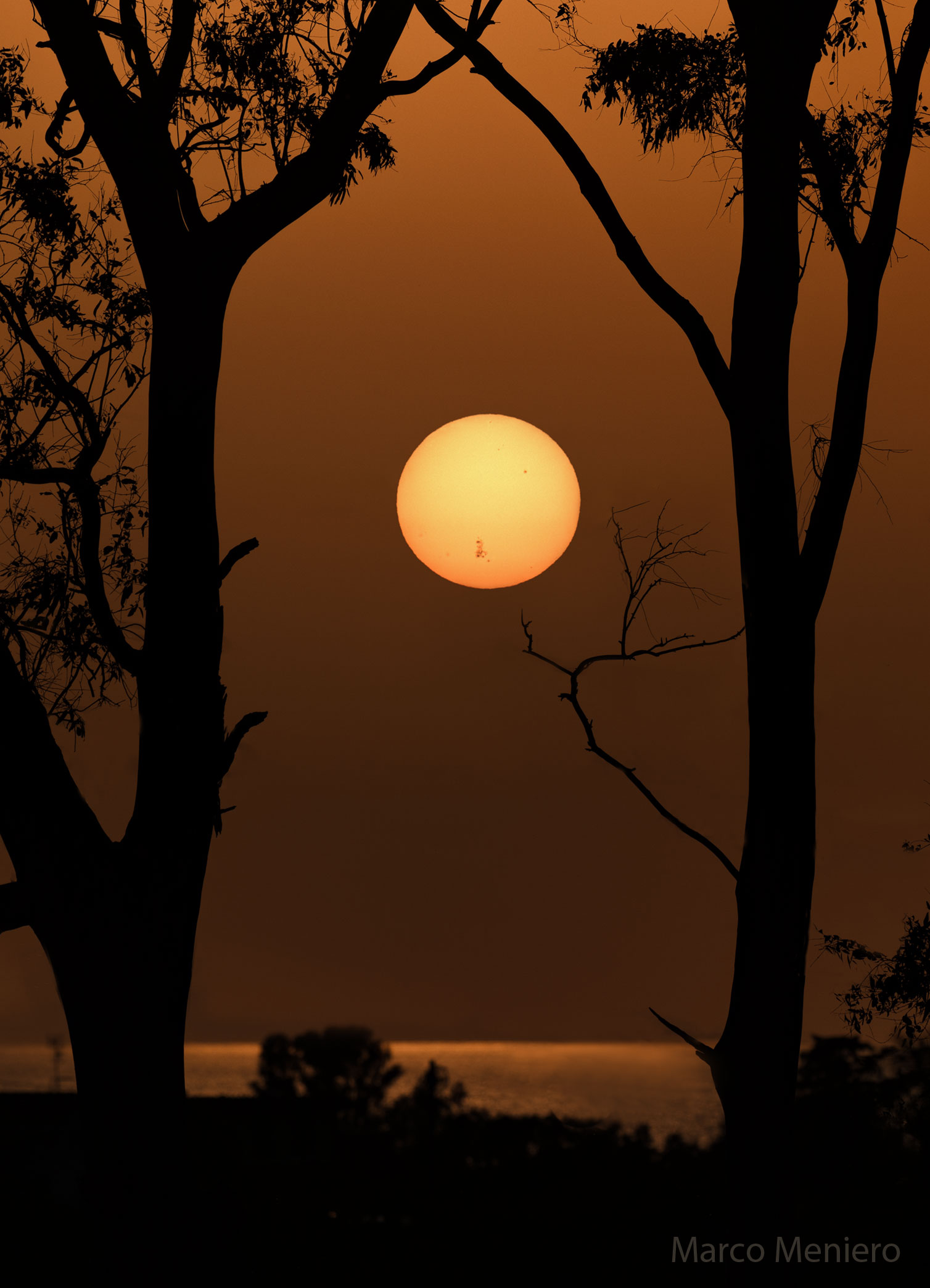
AR 3664 on a Setting Sun
13/05/2024
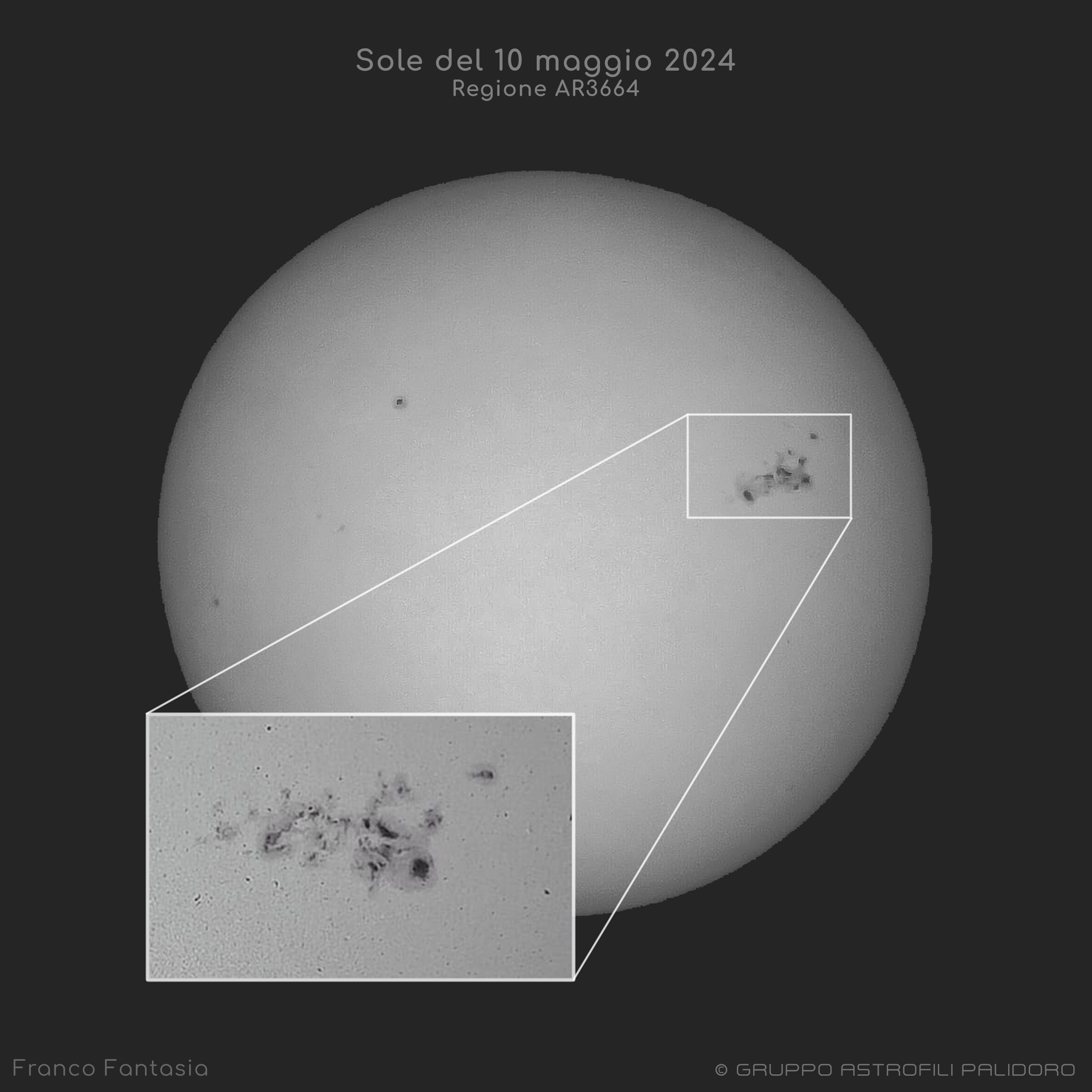
It was larger than the Earth. It was so big you could actually see it on the Sun's surface without magnification. It contained powerful and tangled magnetic fields as well as numerous dark sunspots. Labelled AR 3664, it developed into one of the most energetic areas seen on the Sun in recent years, unleashing a series of explosions that led to a surge of energetic particles striking the Earth, which created beautiful auroras. And might continue. Although active regions on the Sun like AR 3664 can be quite dangerous, this region's Coronal Mass Ejections have not done, as yet, much damage to Earth-orbiting satellites or Earth-surface electrical grids. Pictured, the enormous active region was captured on the setting Sun a few days ago from Civitavecchia, Rome, Italy. The composite image includes a very short exposure taken of just the Sun's surface, but mimics what was actually visible. Finally, AR 3664 is now rotating away from the Earth, although the region may survive long enough to come around again. Gallery: Earth Aurora from Solar Active Region 3664
Copyright: Marco Meniero
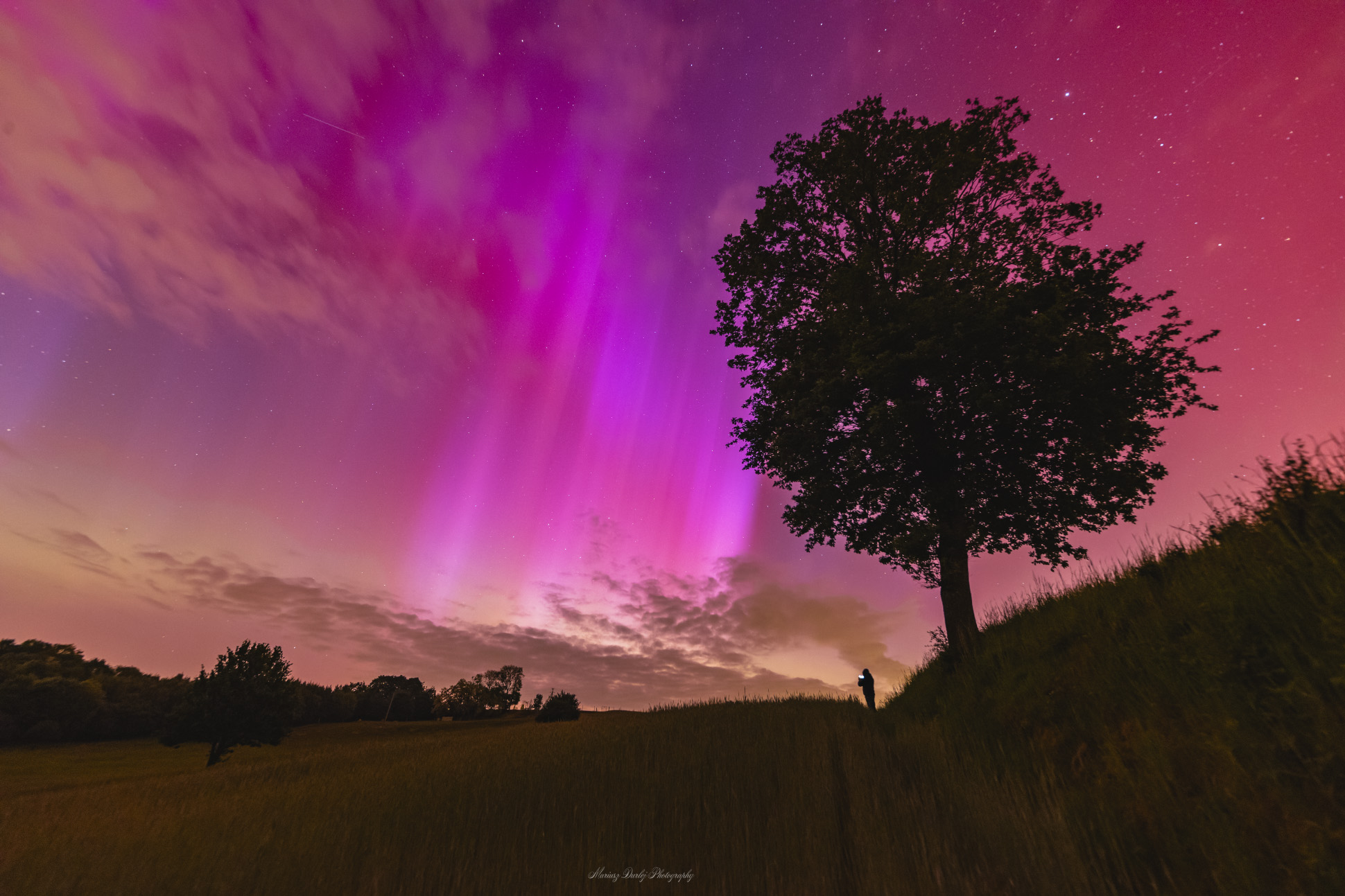
Red Aurora over Poland
12/05/2024
Northern lights don't usually reach this far south. Magnetic chaos in the Sun's huge Active Region 3664, however, produced a surface explosion that sent a burst of electrons, protons, and more massive, charged nuclei into the Solar System. A few days later, that coronal mass ejection (CME) impacted the Earth and triggered auroras that are being reported unusually far from our planet's north and south poles. The free sky show might not be over -- the sunspot rich AR3664 has ejected even more CMEs that might also impact the Earth tonight or tomorrow. That active region is now near the Sun's edge, though, and will soon be rotating away from the Earth. Pictured, a red and rayed aurora was captured in a single 6-second exposure from Racibórz, Poland early last night. The photographer's friend, seeing an aurora for the first time, is visible in the distance also taking images of the beautifully colorful nighttime sky. Gallery: Global Aurora from Solar Active Region 3664
Copyright: Mariusz Durlej
AR 3664: Giant Sunspot Group
11/05/2024
Right now, one of the largest sunspot groups in recent history is crossing the Sun. Active Region 3664 is not only big -- it's violent, throwing off clouds of particles into the Solar System. Some of these CMEs are already impacting the Earth, and others might follow. At the extreme, these solar storms could cause some Earth-orbiting satellites to malfunction, the Earth's atmosphere to slightly distort, and electrical power grids to surge. When impacting Earth's upper atmosphere, these particles can produce beautiful auroras, with some auroras already being reported unusually far south. Pictured here, AR3664 and its dark sunspots were captured yesterday in visible light from Rome, Italy. The AR3664 sunspot group is so large that it is visible just with glasses designed to view last month's total solar eclipse. This weekend, skygazing enthusiasts will be keenly watching the night skies all over the globe for bright and unusual auroras. Gallery: Active Region 3664 on the Sun and Associated Aurora
Copyright: Franco Fantasia & Guiseppe Conzo (Gruppo Astrofili Palidoro)
Simulation: Two Black Holes Merge
10/05/2024
Relax and watch two black holes merge. Inspired by the first direct detection of gravitational waves in 2015, this simulation plays in slow motion but would take about one third of a second if run in real time. Set on a cosmic stage, the black holes are posed in front of stars, gas, and dust. Their extreme gravity lenses the light from behind them into Einstein rings as they spiral closer and finally merge into one. The otherwise invisible gravitational waves generated as the massive objects rapidly coalesce cause the visible image to ripple and slosh both inside and outside the Einstein rings even after the black holes have merged. Dubbed GW150914, the gravitational waves detected by LIGO are consistent with the merger of 36 and 31 solar mass black holes at a distance of 1.3 billion light-years. The final, single black hole has 63 times the mass of the Sun, with the remaining 3 solar masses converted into energy radiated in gravitational waves. Today's Event Horizon: It's Black Hole Week at NASA!
Copyright: NASA
The Galaxy, the Jet, and a Famous Black Hole
09/05/2024
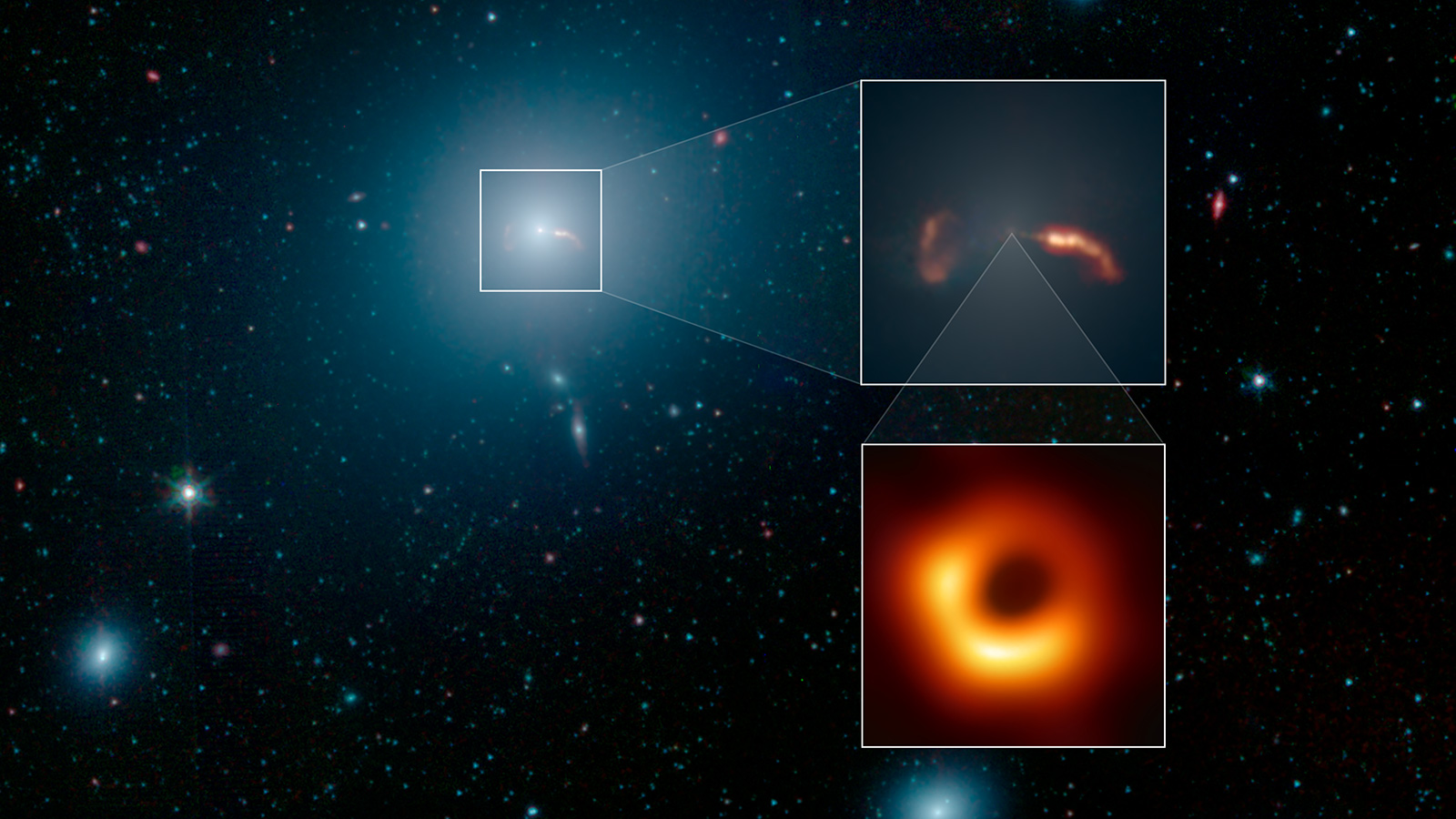
Bright elliptical galaxy Messier 87 (M87) is home to the supermassive black hole captured in 2017 by planet Earth's Event Horizon Telescope in the first ever image of a black hole. Giant of the Virgo galaxy cluster about 55 million light-years away, M87 is rendered in blue hues in this infrared image from the Spitzer Space telescope. Though M87 appears mostly featureless and cloud-like, the Spitzer image does record details of relativistic jets blasting from the galaxy's central region. Shown in the inset at top right, the jets themselves span thousands of light-years. The brighter jet seen on the right is approaching and close to our line of sight. Opposite, the shock created by the otherwise unseen receding jet lights up a fainter arc of material. Inset at bottom right, the historic black hole image is shown in context at the center of giant galaxy, between the relativistic jets. Completely unresolved in the Spitzer image, the supermassive black hole surrounded by infalling material is the source of enormous energy driving the relativistic jets from the center of active galaxy M87. The Event Horizon Telescope image of M87 has been enhanced to reveal a sharper view of the famous supermassive black hole. It's inescapable: Black Hole Week at NASA!
Copyright: NASA
Visualization: A Black Hole Accretion Disk
08/05/2024
What would it look like to circle a black hole? If the black hole was surrounded by a swirling disk of glowing and accreting gas, then the great gravity of the black hole would deflect light emitted by the disk to make it look very unusual. The featured animated video gives a visualization. The video starts with you, the observer, looking toward the black hole from just above the plane of the accretion disk. Surrounding the central black hole is a thin circular image of the orbiting disk that marks the position of the photon sphere -- inside of which lies the black hole's event horizon. Toward the left, parts of the large main image of the disk appear brighter as they move toward you. As the video continues, you loop over the black hole, soon looking down from the top, then passing through the disk plane on the far side, then returning to your original vantage point. The accretion disk does some interesting image inversions -- but never appears flat. Visualizations such as this are particularly relevant today as black holes are being imaged in unprecedented detail by the Event Horizon Telescope. Singularity Impressive: It's Black Hole Week at NASA!
Copyright: NASA
Black Hole Accreting with Jet
07/05/2024
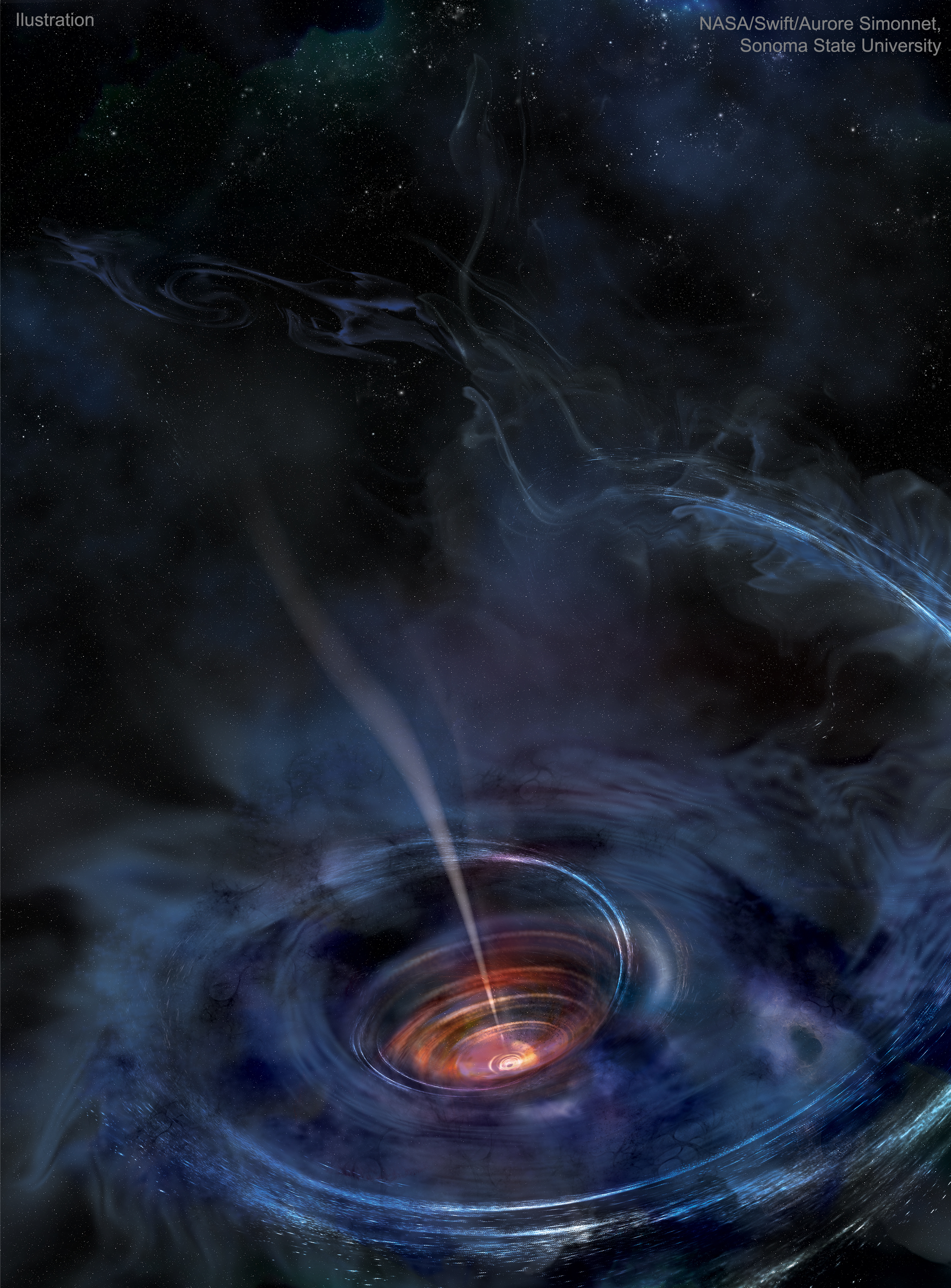
What happens when a black hole devours a star? Many details remain unknown, but observations are providing new clues. In 2014, a powerful explosion was recorded by the ground-based robotic telescopes of the All Sky Automated Survey for SuperNovae (Project ASAS-SN), with followed-up observations by instruments including NASA's Earth-orbiting Swift satellite. Computer modeling of these emissions fit a star being ripped apart by a distant supermassive black hole. The results of such a collision are portrayed in the featured artistic illustration. The black hole itself is a depicted as a tiny black dot in the center. As matter falls toward the hole, it collides with other matter and heats up. Surrounding the black hole is an accretion disk of hot matter that used to be the star, with a jet emanating from the black hole's spin axis. Fall towards eternity: It's Black Hole Week at NASA!
Copyright: NASA
Η Αστρονομική Εικόνα της Ημέρας από τη NASA (NASA Astronomy Picture of the Day) είναι μια δωρεάν υπηρεσία που παρέχει καθημερινά μια εντυπωσιακή εικόνα από το σύμπαν, την λήψη της οποίας έχει πραγματοποιήσει κάποιος από τους αστρονόμους της NASA ή από κάποιον από τους δορυφόρους ή τα τηλεσκόπια που η NASA λειτουργεί. Οι εικόνες που εμφανίζονται καλύπτουν μια ευρεία γκάμα από θέματα, συμπεριλαμβανομένων των αστερισμών, των γαλαξιών, των πλανητικών συστημάτων, των κομητών, των αστρικών σωμάτων και των παρατηρητηρίων. Κάθε εικόνα συνοδεύεται από μια σύντομη εξήγηση και πληροφορίες σχετικά με το τι παρατηρείται στην εικόνα.