Η Αστρονομική Εικόνα της Ημέρας από τη NASA
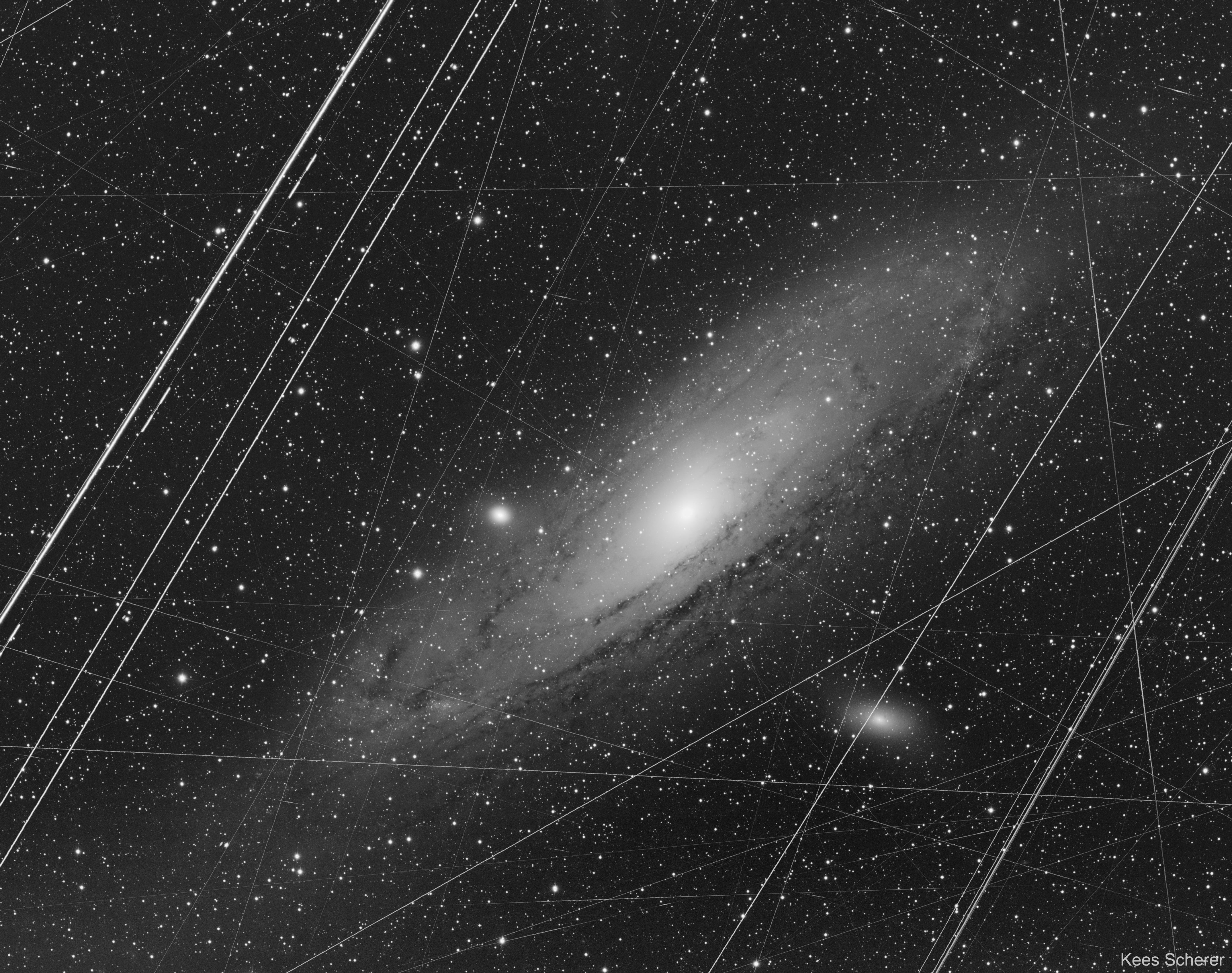
Andromeda before Photoshop
27/09/2026
What does the Andromeda galaxy really look like? The featured image shows how our Milky Way Galaxy's closest major galactic neighbor really appears in a long exposure through Earth's busy skies and with a digital camera that introduces normal imperfections. The picture is a stack of 223 images, each a 300 second exposure, taken from a garden observatory in Portugal during 2019. Obvious image deficiencies include bright parallel airplane trails, long and continuous satellite trails, short cosmic ray streaks, and bad pixels. These imperfections were actually not removed with Photoshop specifically, but rather greatly reduced with a series of computer software packages that included Astro Pixel Processor, DeepSkyStacker, and PixInsight. All of this work was done not to deceive you with a digital fantasy that has little to do with the real likeness of the Andromeda galaxy (M31), but to minimize Earthly artifacts that have nothing to do with the distant galaxy and so better recreate what M31 really does look like. APOD's email for image submissions has changed. Please see: APOD Submissions APOD's main NASA site is moving: From apod.nasa.gov to science.nasa.gov/apod
Copyright: NASA
Προηγούμενες Αστρονομικές Εικόνες της Ημέρας από τη NASA
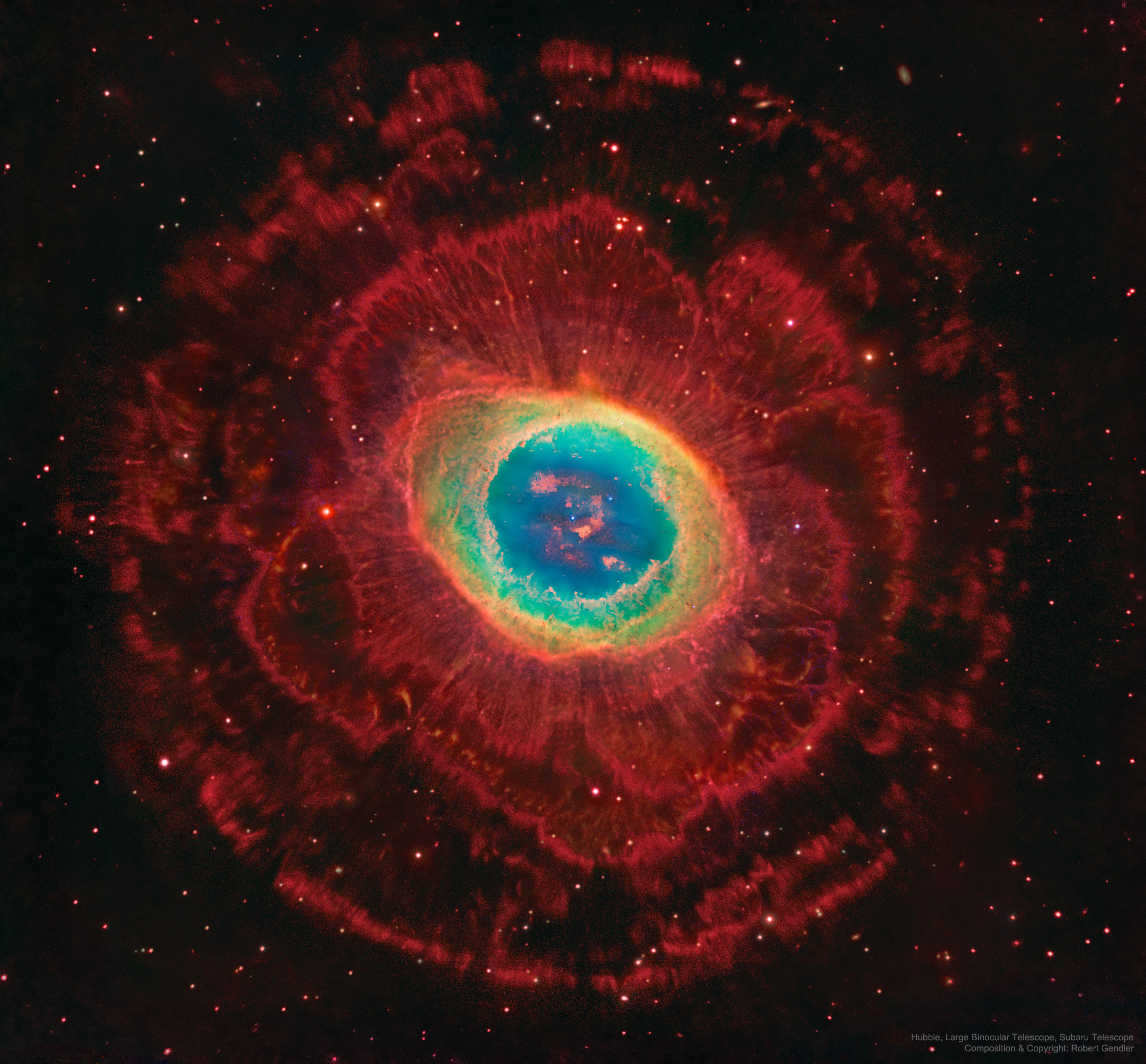
Rings Around the Ring Nebula
28/04/2024
The Ring Nebula (M57) is more complicated than it appears through a small telescope. The easily visible central ring is about one light-year across, but this remarkably deep exposure - a collaborative effort combining data from three different large telescopes - explores the looping filaments of glowing gas extending much farther from the nebula's central star. This composite image includes red light emitted by hydrogen as well as visible and infrared light. The Ring Nebula is an elongated planetary nebula, a type of nebula created when a Sun-like star evolves to throw off its outer atmosphere and become a white dwarf star. The Ring Nebula is about 2,500 light-years away toward the musical constellation Lyra. Your Sky Surprise: What picture did APOD feature on your birthday? (post 1995)
Copyright: Robert Gendler
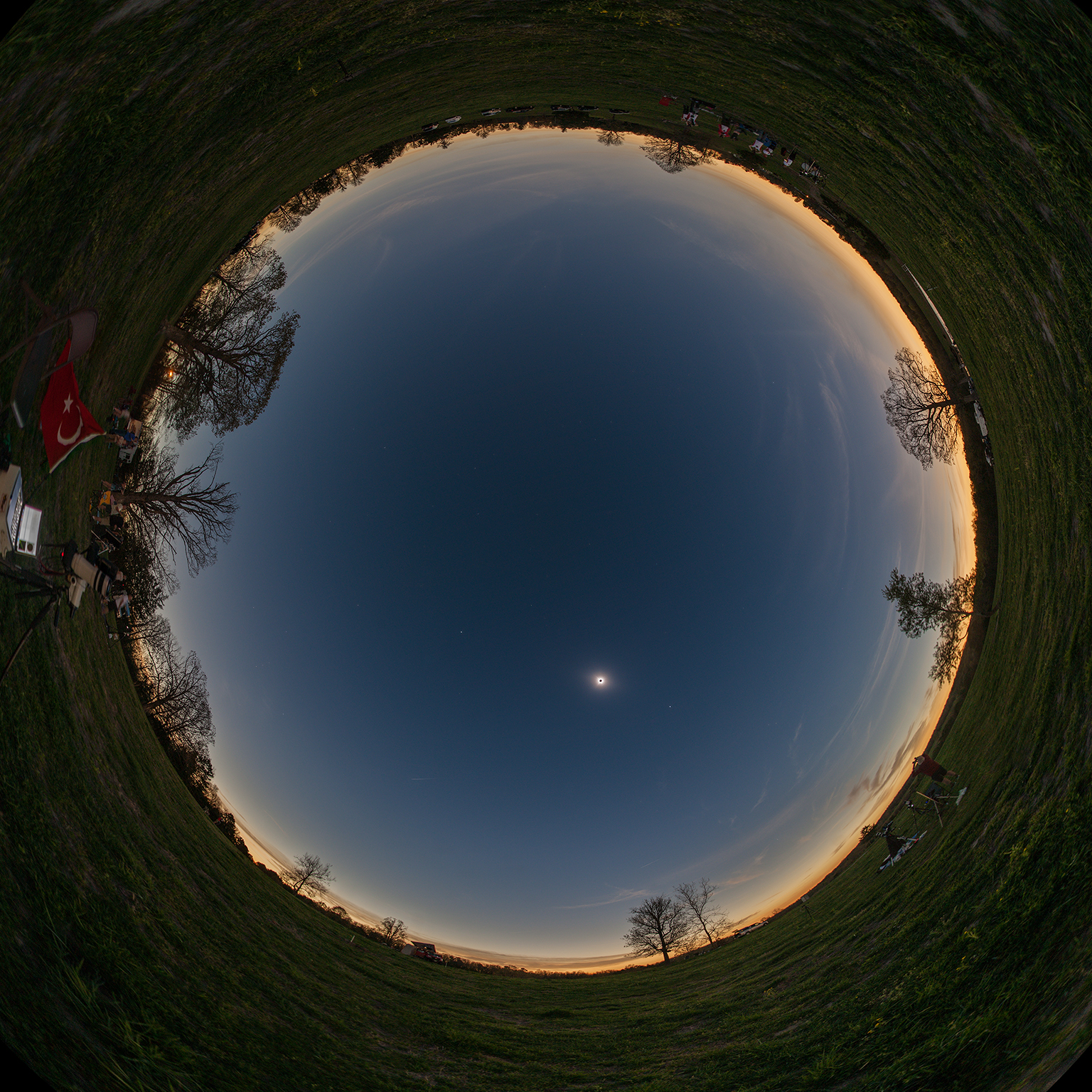
All Sky Moon Shadow
27/04/2024
If the Sun is up but the sky is dark and the horizon is bright all around, you might be standing in the Moon's shadow during a total eclipse of the Sun. In fact, the all-sky Moon shadow shown in this composited panoramic view was captured from a farm near Shirley, Arkansas, planet Earth. The exposures were made under clear skies during the April 8 total solar eclipse. For that location near the center line of the Moon's shadow track, totality lasted over 4 minutes. Along with the solar corona surrounding the silhouette of the Moon planets and stars were visible during the total eclipse phase. Easiest to see here are bright planets Venus and Jupiter, to the lower right and upper left of the eclipsed Sun.
Copyright: Tunc Tezel
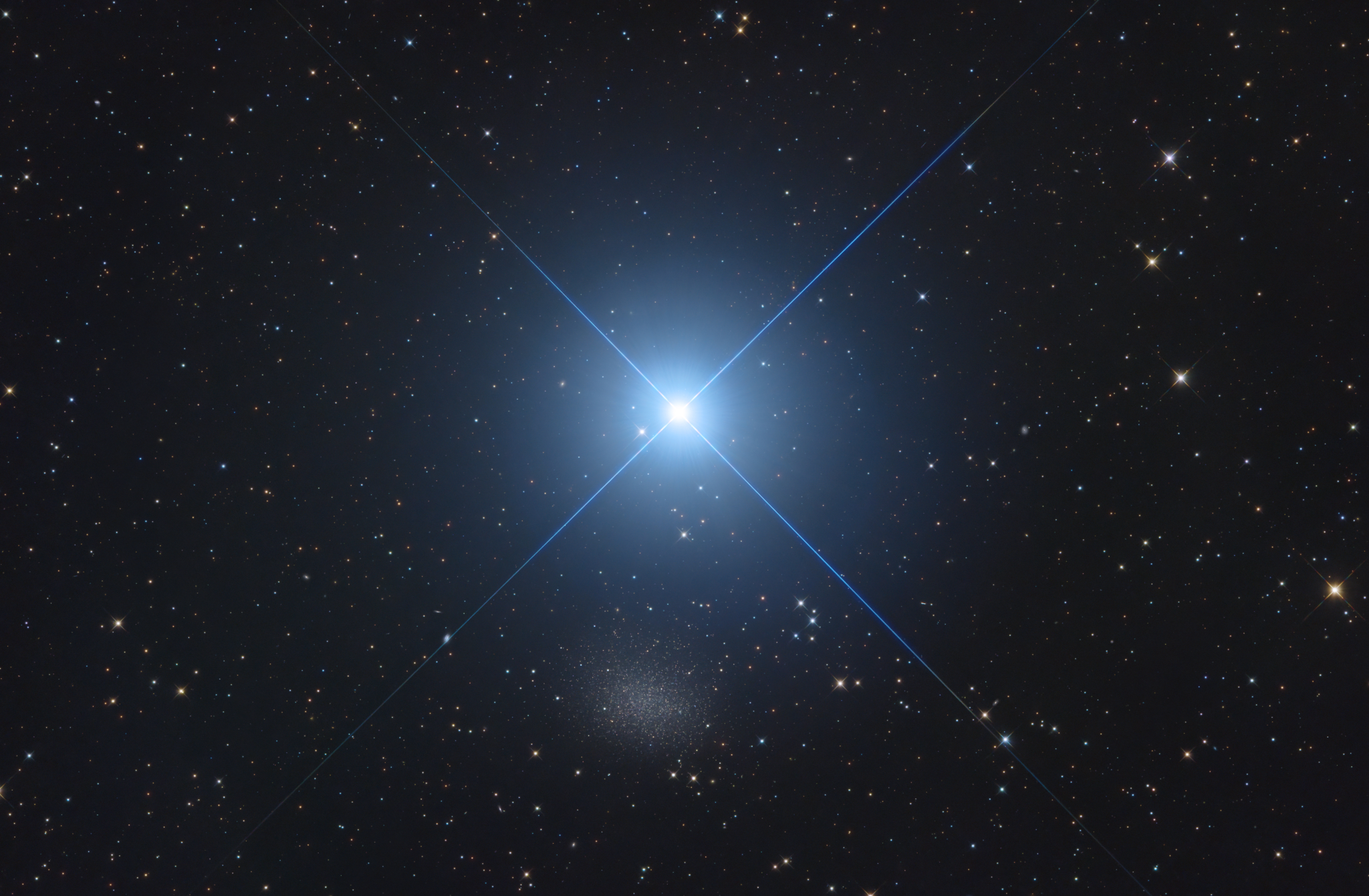
Regulus and the Dwarf Galaxy
26/04/2024
In northern hemisphere spring, bright star Regulus is easy to spot above the eastern horizon. The alpha star of the constellation Leo, Regulus is the spiky star centered in this telescopic field of view. A mere 79 light-years distant, Regulus is a hot, rapidly spinning star that is known to be part of a multiple star system. Not quite lost in the glare, the fuzzy patch just below Regulus is diffuse starlight from small galaxy Leo I. Leo I is a dwarf spheroidal galaxy, a member of the Local Group of galaxies dominated by our Milky Way Galaxy and the Andromeda Galaxy (M31). About 800 thousand light-years away, Leo I is thought to be the most distant of the known small satellite galaxies orbiting the Milky Way. But dwarf galaxy Leo I has shown evidence of a supermassive black hole at its center, comparable in mass to the black hole at the center of the Milky Way.
Copyright: Markus Horn
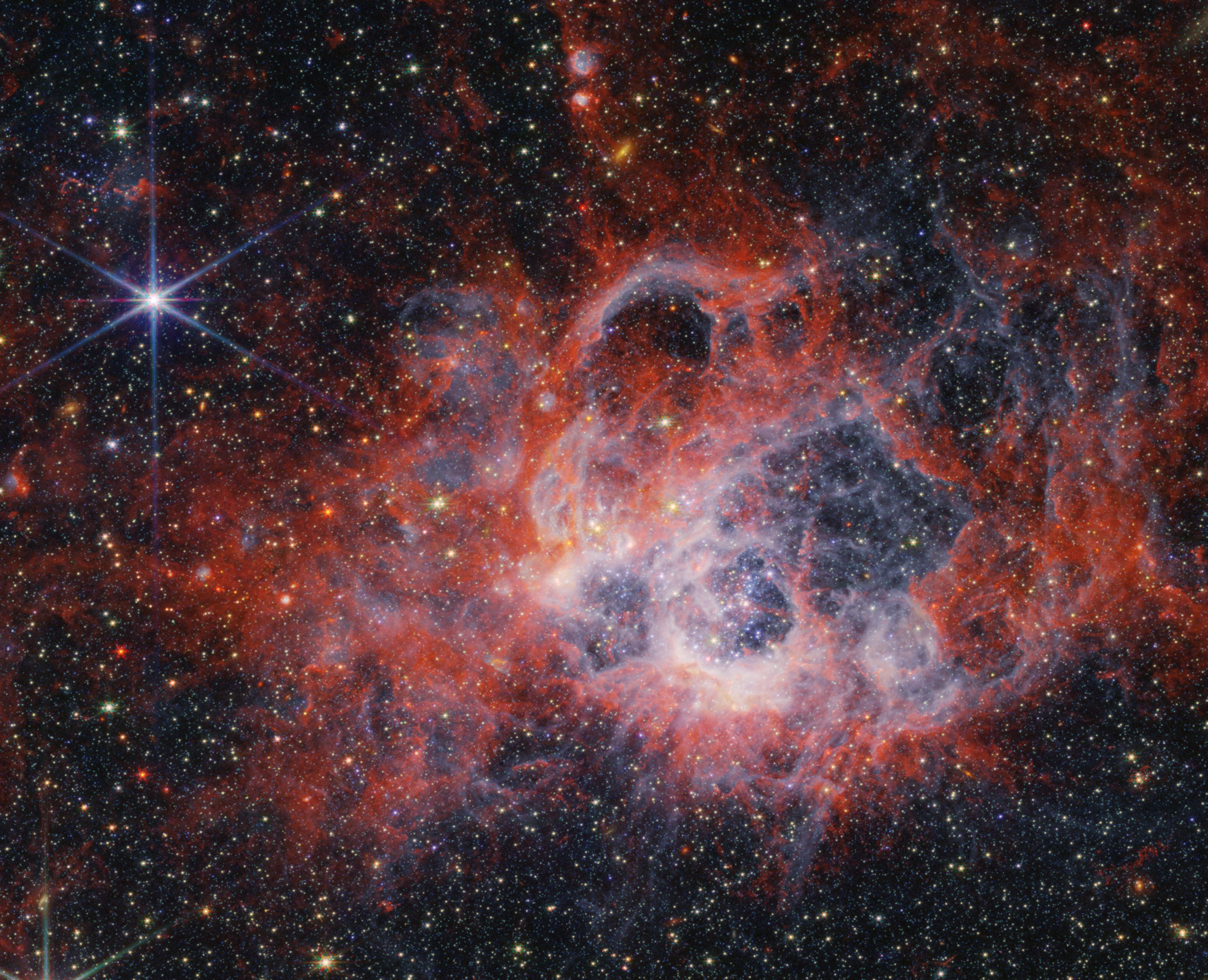
NGC 604: Giant Stellar Nursery
25/04/2024
Located some 3 million light-years away in the arms of nearby spiral galaxy M33, giant stellar nursery NGC 604 is about 1,300 light-years across. That's nearly 100 times the size of the Milky Way's Orion Nebula, the closest large star forming region to planet Earth. In fact, among the star forming regions within the Local Group of galaxies, NGC 604 is second in size only to 30 Doradus, also known as the Tarantula Nebula in the Large Magellanic Cloud. Cavernous bubbles and cavities in NGC 604 fill this stunning infrared image from the James Webb Space Telescope's NIRCam. They are carved out by energetic stellar winds from the region's more than 200 hot, massive, young stars, all still in early stages of their lives.
Copyright: NASA
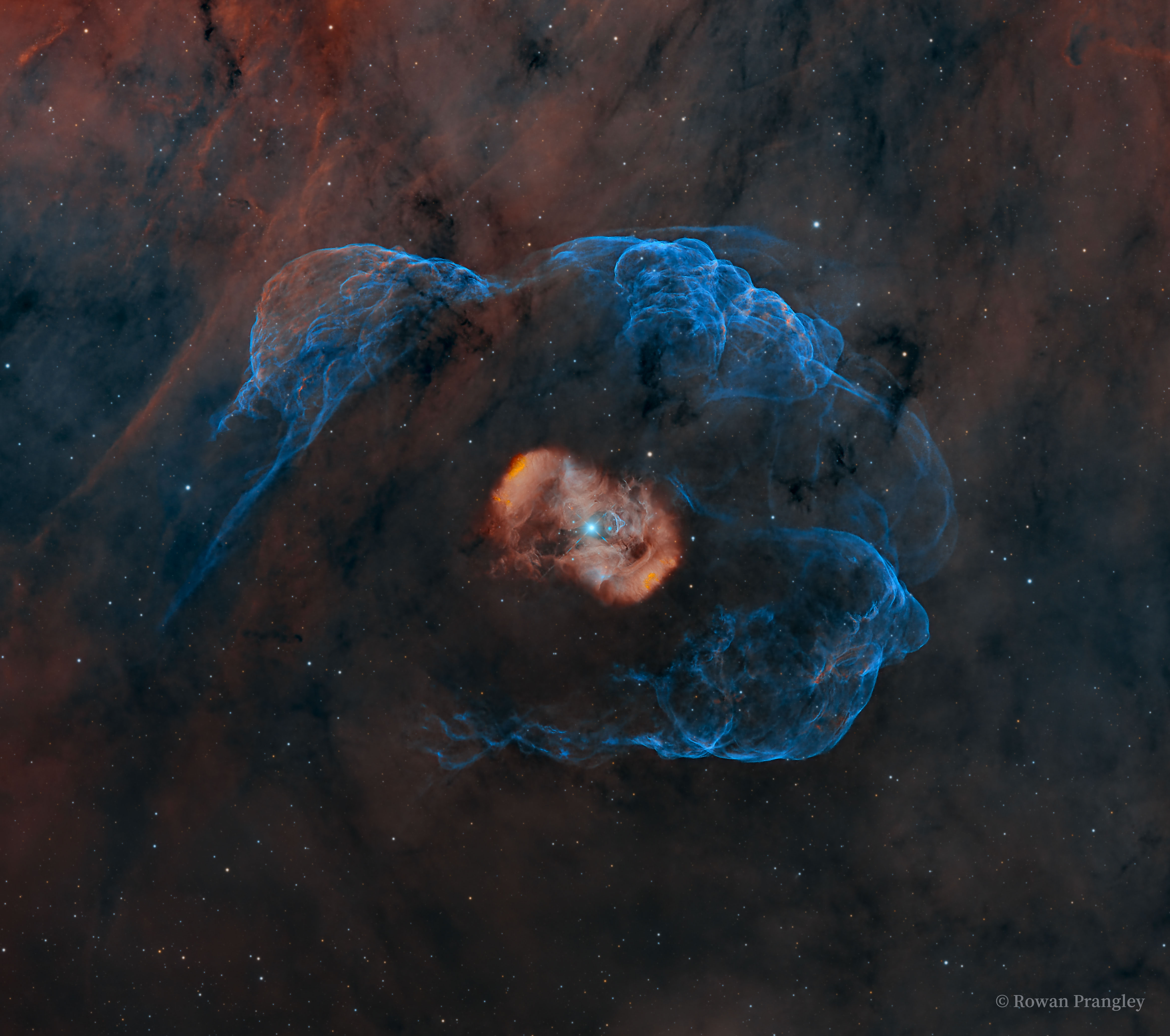
Dragon's Egg Bipolar Emission Nebula
24/04/2024
How did a star form this beautiful nebula? In the middle of emission nebula NGC 6164 is an unusually massive star. The central star has been compared to an oyster's pearl and an egg protected by the mythical sky dragons of Ara. The star, visible in the center of the featured image and catalogued as HD 148937, is so hot that the ultraviolet light it emits heats up gas that surrounds it. That gas was likely thrown off from the star previously, possibly the result of a gravitational interaction with a looping stellar companion. Expelled material might have been channeled by the magnetic field of the massive star, in all creating the symmetric shape of the bipolar nebula. NGC 6164 spans about four light years and is located about 3,600 light years away toward the southern constellation Norma. New Mirror: APOD now available via WhatsApp
Copyright: Rowan Prangley
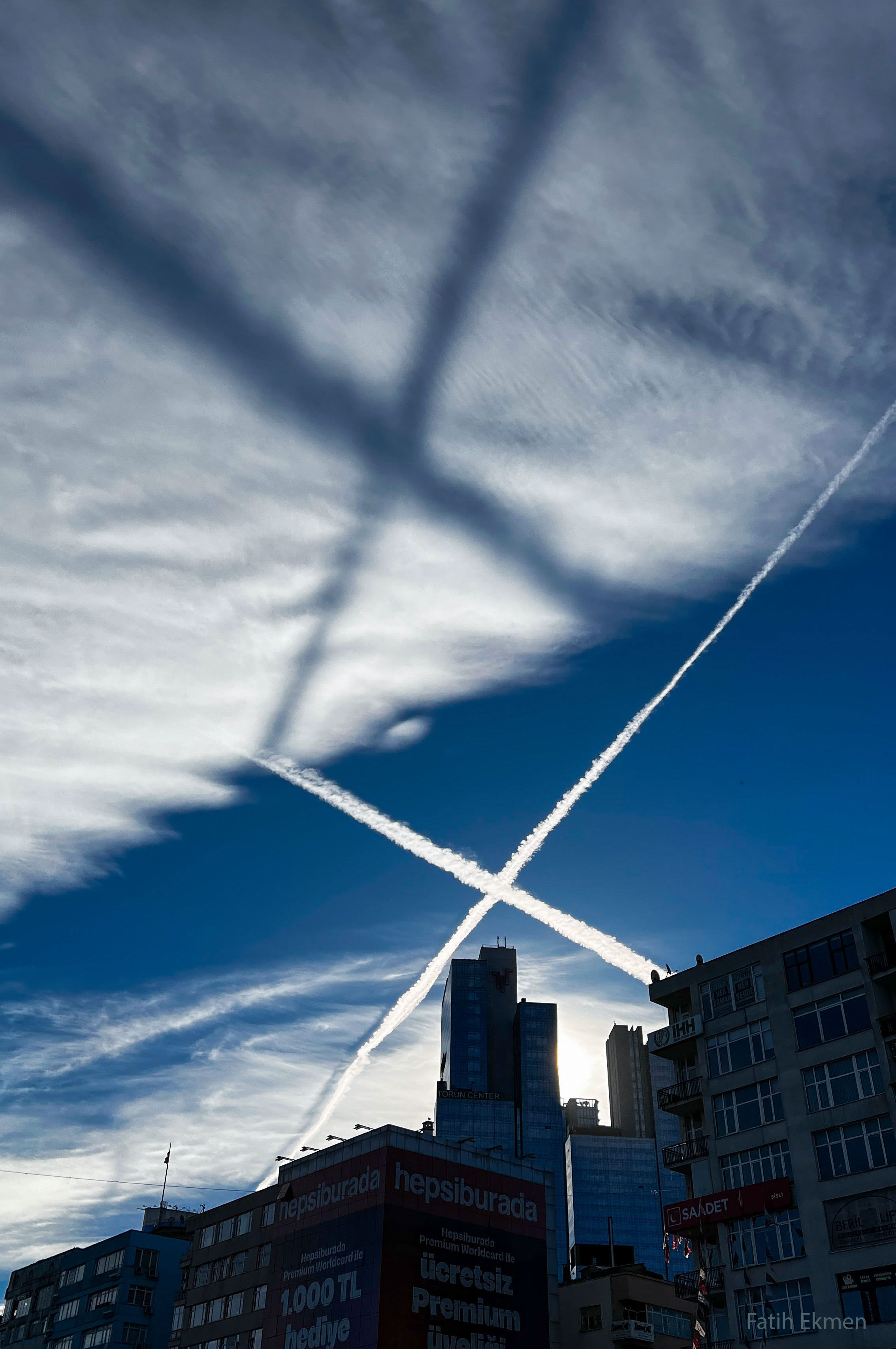
Contrail Shadow X
23/04/2024
What created this giant X in the clouds? It was the shadow of contrails. When airplanes fly, humid engine exhaust may form water droplets that might freeze in Earth's cold upper atmosphere. These persistent streams of water and ice scatter light from the Sun above and so appear bright. These contrails cast long shadows. That was just the case over Istanbul, Türkiye, earlier this month. Contrails occur all over planet Earth and, generally, warm the Earth when the trap infrared light but cool the Earth when they efficiently reflect sunlight. The image was taken by a surprised photographer in the morning on the way to work.
Copyright: Fatih Ekmen
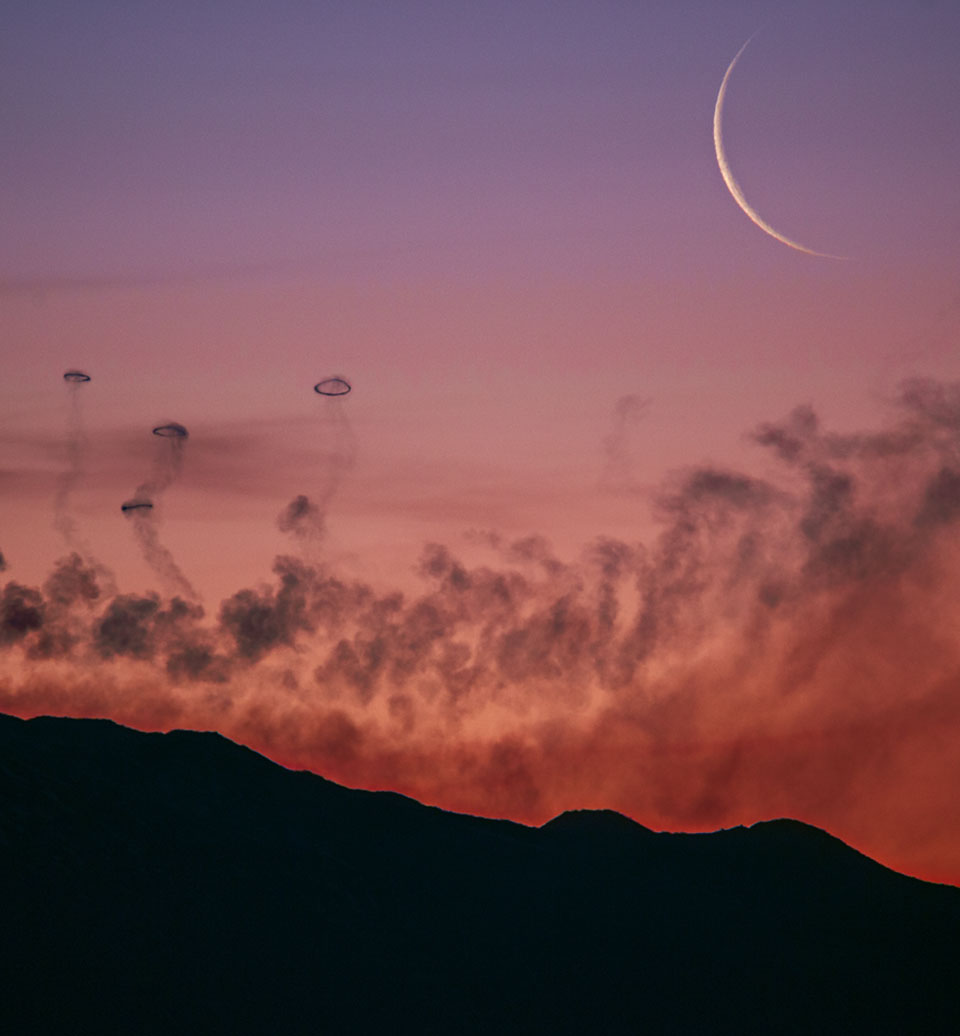
Moon and Smoke Rings from Mt. Etna
22/04/2024
Yes, but can your volcano do this? To the surprise of some, Mt. Etna emits, on occasion, smoke rings. Technically known as vortex rings, the walls of the volcano slightly slow the outside of emitted smoke puffs, causing the inside gas to move faster. A circle of low pressure develops so that the emitted puff of volcanic gas and ash loops around in a ring, a familiar geometric structure that can be surprisingly stable as it rises. Smoke rings are quite rare and need a coincidence of the right geometry of the vent, the right speed of ejected smoke, and the relative calmness of the outside atmosphere. In the featured image taken about two weeks ago from Gangi, Sicily, Italy, multiple volcanic smoke rings are visible. The scene is shaded by the red light of a dawn Sun, while a crescent Moon is visible in the background.
Copyright: Dario Giannobile
Perijove 16: Passing Jupiter
21/04/2024
Watch Juno zoom past Jupiter. NASA's robotic spacecraft Juno is continuing on its now month-long, highly-elongated orbits around our Solar System's largest planet. The featured video is from perijove 16, the sixteenth time that Juno passed near Jupiter since it arrived in mid-2016. Each perijove passes near a slightly different part of Jupiter's cloud tops. This color-enhanced video has been digitally composed from 21 JunoCam still images, resulting in a 125-fold time-lapse. The video begins with Jupiter rising as Juno approaches from the north. As Juno reaches its closest view -- from about 3,500 kilometers over Jupiter's cloud tops -- the spacecraft captures the great planet in tremendous detail. Juno passes light zones and dark belts of clouds that circle the planet, as well as numerous swirling circular storms, many of which are larger than hurricanes on Earth. As Juno moves away, the remarkable dolphin-shaped cloud is visible. After the perijove, Jupiter recedes into the distance, now displaying the unusual clouds that appear over Jupiter's south. To get desired science data, Juno swoops so close to Jupiter that its instruments are exposed to very high levels of radiation.
Copyright: NASA
Η Αστρονομική Εικόνα της Ημέρας από τη NASA (NASA Astronomy Picture of the Day) είναι μια δωρεάν υπηρεσία που παρέχει καθημερινά μια εντυπωσιακή εικόνα από το σύμπαν, την λήψη της οποίας έχει πραγματοποιήσει κάποιος από τους αστρονόμους της NASA ή από κάποιον από τους δορυφόρους ή τα τηλεσκόπια που η NASA λειτουργεί. Οι εικόνες που εμφανίζονται καλύπτουν μια ευρεία γκάμα από θέματα, συμπεριλαμβανομένων των αστερισμών, των γαλαξιών, των πλανητικών συστημάτων, των κομητών, των αστρικών σωμάτων και των παρατηρητηρίων. Κάθε εικόνα συνοδεύεται από μια σύντομη εξήγηση και πληροφορίες σχετικά με το τι παρατηρείται στην εικόνα.