Η Αστρονομική Εικόνα της Ημέρας από τη NASA
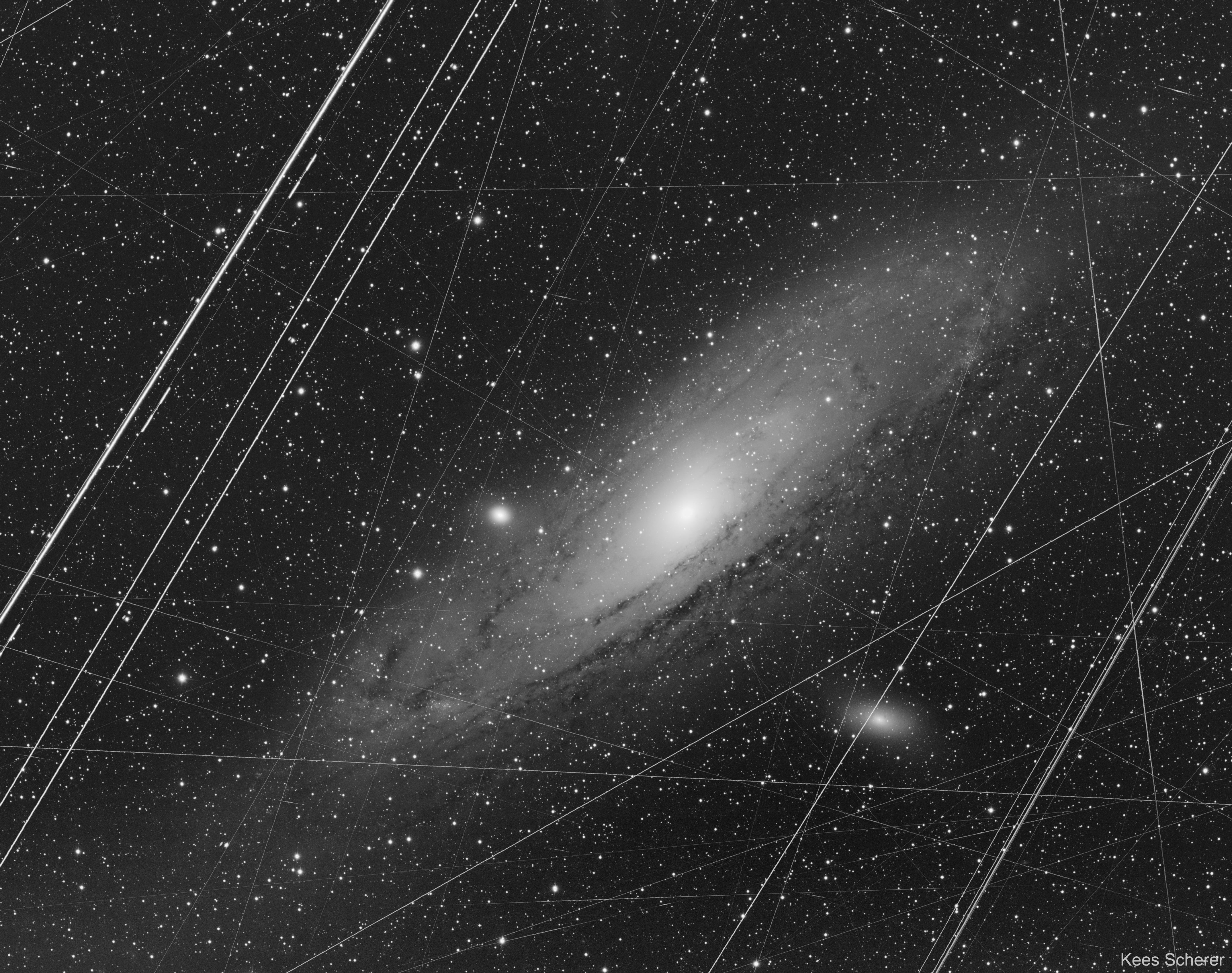
Andromeda before Photoshop
27/09/2026
What does the Andromeda galaxy really look like? The featured image shows how our Milky Way Galaxy's closest major galactic neighbor really appears in a long exposure through Earth's busy skies and with a digital camera that introduces normal imperfections. The picture is a stack of 223 images, each a 300 second exposure, taken from a garden observatory in Portugal during 2019. Obvious image deficiencies include bright parallel airplane trails, long and continuous satellite trails, short cosmic ray streaks, and bad pixels. These imperfections were actually not removed with Photoshop specifically, but rather greatly reduced with a series of computer software packages that included Astro Pixel Processor, DeepSkyStacker, and PixInsight. All of this work was done not to deceive you with a digital fantasy that has little to do with the real likeness of the Andromeda galaxy (M31), but to minimize Earthly artifacts that have nothing to do with the distant galaxy and so better recreate what M31 really does look like. APOD's email for image submissions has changed. Please see: APOD Submissions APOD's main NASA site is moving: From apod.nasa.gov to science.nasa.gov/apod
Copyright: NASA
Προηγούμενες Αστρονομικές Εικόνες της Ημέρας από τη NASA

A Lunar Corona over Paris
30/05/2024
Why does a cloudy moon sometimes appear colorful? The effect, called a lunar corona, is created by the quantum mechanical diffraction of light around individual, similarly-sized water droplets in an intervening but mostly-transparent cloud. Since light of different colors has different wavelengths, each color diffracts differently. Lunar coronae are one of the few quantum mechanical color effects that can be easily seen with the unaided eye. Solar coronae are also sometimes evident. The featured image was taken last month from Paris, France. The blue beacon emanating from the Eiffel Tower did not affect the colorful lunar corona. Portal Universe: Random APOD Generator
Copyright: Valter Binotto
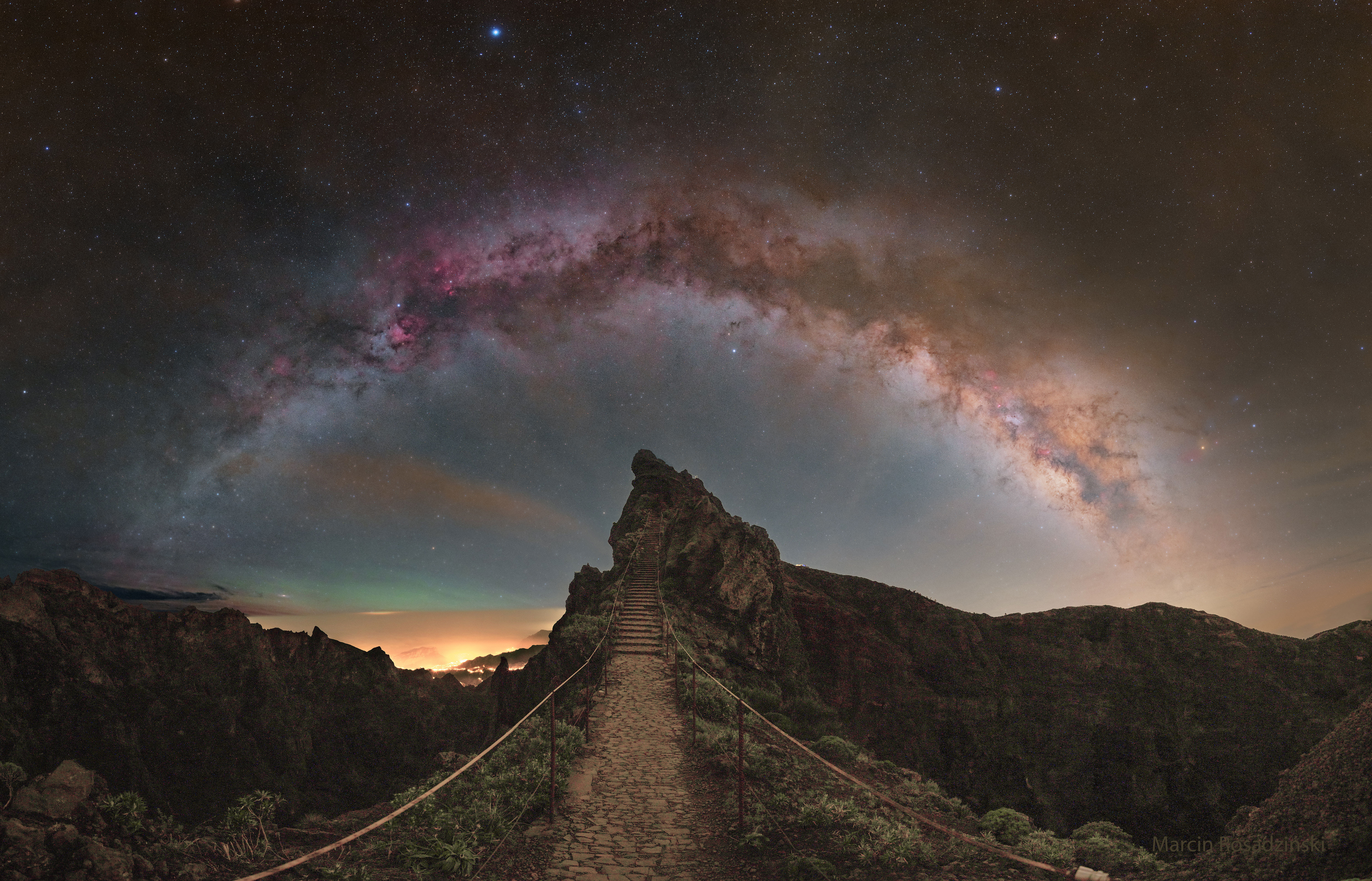
Stairway to the Milky Way
29/05/2024
What happens if you ascend this stairway to the Milky Way? Before answering that, let's understand the beautiful sky you will see. Most eye-catching is the grand arch of the Milky Way Galaxy, the band that is the central disk of our galaxy which is straight but distorted by the wide-angle nature of this composite image. Many stars well in front of the Milk Way will be visible, with the bright white star just below the stellar arch being Altair, and the bright blue star above it being Vega. The air glows green on the left, just above the yellow cloud deck. The featured image was taken last month on Portugal's Madeira Island in the North Atlantic Ocean. Oh, and what happens after you reach the top of these stairs and admire the amazing sky is, quite probably, that you then descend down the stairs on the other side. Your Sky Surprise: What picture did APOD feature on your birthday? (post 1995)
Copyright: Marcin Rosadziński
Solar X Flare as Famous Active Region Returns
28/05/2024
It's back. The famous active region on the Sun that created auroras visible around the Earth earlier this month has survived its rotation around the far side of the Sun -- and returned. Yesterday, as it was beginning to reappear on the Earth-facing side, the region formerly labeled AR 3664 threw another major solar flare, again in the highest-energy X-class range. The featured video shows the emerging active region on the lower left, as it was captured by NASA's Earth-orbiting Solar Dynamics Observatory yesterday in ultraviolet light. The video is a time-lapse of the entire Sun rotating over 24 hours. Watch the lower-left region carefully at about the 2-second mark to see the powerful flare burst out. The energetic particles from that flare and associated CME are not expected to directly impact the Earth and trigger impressive auroras, but scientists will keep a close watch on this unusually active region over the next two weeks, as it faces the Earth, to see what develops.
Copyright: NASA
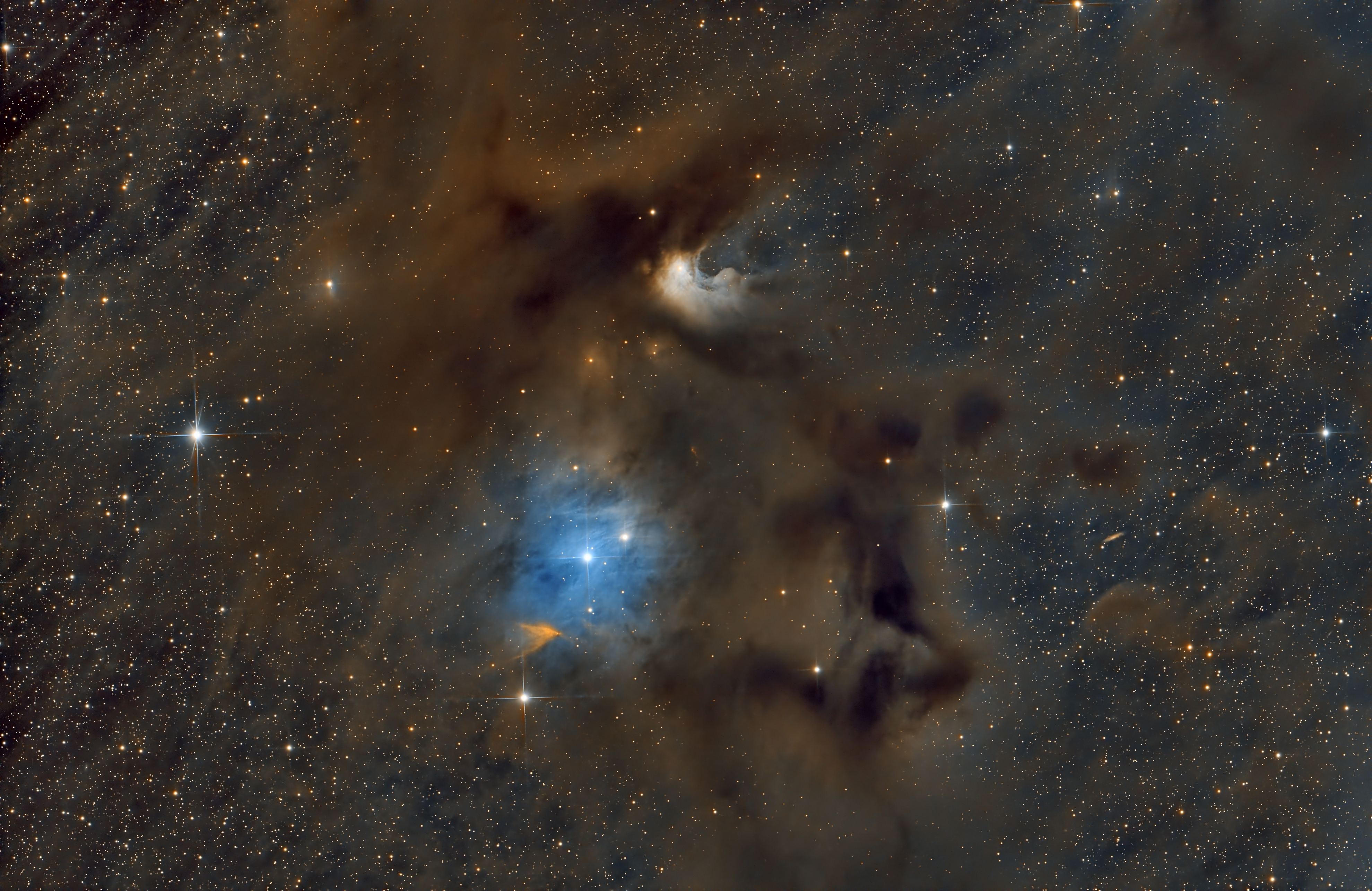
Chamaeleon I Molecular Cloud
27/05/2024
Dark markings and bright nebulae in this telescopic southern sky view are telltale signs of young stars and active star formation. They lie a mere 650 light-years away, at the boundary of the local bubble and the Chamaeleon molecular cloud complex. Regions with young stars identified as dusty reflection nebulae from the 1946 Cederblad catalog include the C-shaped Ced 110 just above and right of center, and bluish Ced 111 below it. Also a standout in the frame, the orange tinted V-shape of the Chamaeleon Infrared Nebula (Cha IRN) was carved by material streaming from a newly formed low-mass star. The well-composed image spans 1.5 degrees. That's about 17 light-years at the estimated distance of the nearby Chamaeleon I molecular cloud.
Copyright: Amiel Contuliano
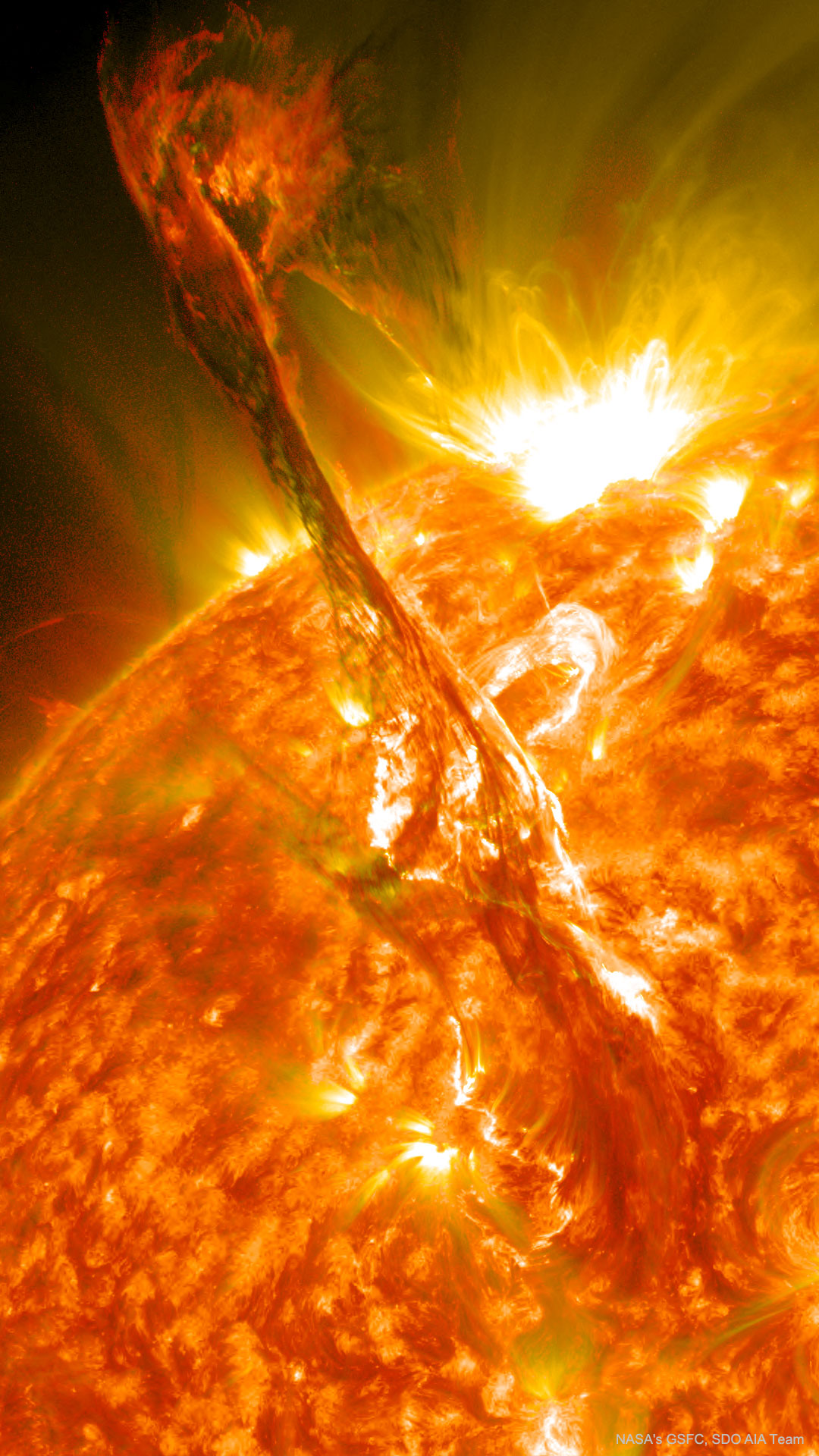
A Solar Filament Erupts
26/05/2024
What's happened to our Sun? Nothing very unusual -- it just threw a filament. Toward the middle of 2012, a long standing solar filament suddenly erupted into space, producing an energetic coronal mass ejection (CME). The filament had been held up for days by the Sun's ever changing magnetic field and the timing of the eruption was unexpected. Watched closely by the Sun-orbiting Solar Dynamics Observatory, the resulting explosion shot electrons and ions into the Solar System, some of which arrived at Earth three days later and impacted Earth's magnetosphere, causing visible auroras. Loops of plasma surrounding the active region can be seen above the erupting filament in the featured ultraviolet image. Our Sun is nearing the most active time in its 11-year cycle, creating many coronal holes that allow for the ejection of charged particles into space. As before, these charged particles can create auroras. Your Sky Surprise: What picture did APOD feature on your birthday? (post 1995)
Copyright: NASA
Manicouagan Impact Crater from Space
25/05/2024
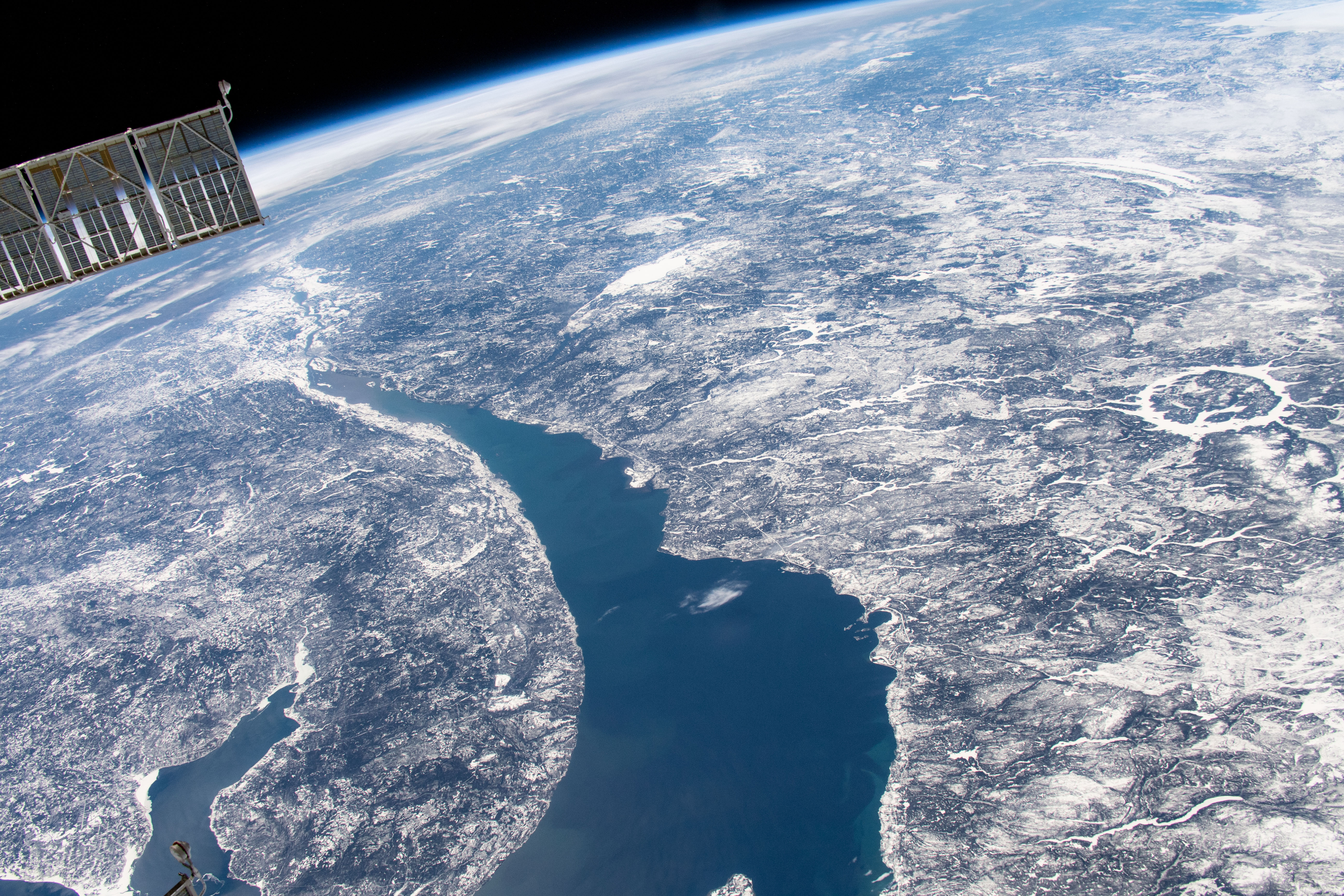
Orbiting 400 kilometers above Quebec, Canada, planet Earth, the International Space Station Expedition 59 crew captured this snapshot of the broad St. Lawrence River and curiously circular Lake Manicouagan on April 11. Right of center, the ring-shaped lake is a modern reservoir within the eroded remnant of an ancient 100 kilometer diameter impact crater. The ancient crater is very conspicuous from orbit, a visible reminder that Earth is vulnerable to rocks from space. Over 200 million years old, the Manicouagan crater was likely caused by the impact of a rocky body about 5 kilometers in diameter. Currently, there is no known asteroid with a significant probability of impacting Earth in the next century. Each month, NASA’s Planetary Defense Coordination Office releases an update featuring the most recent figures on near-Earth object close approaches, and other facts about comets and asteroids that could pose a potential impact hazard with Earth.
Copyright: NASA
M78 from the Euclid Space Telescope
24/05/2024

Star formation can be messy. To help find out just how messy, ESA's new Sun-orbiting Euclid telescope recently captured the most detailed image ever of the bright star forming region M78. Near the image center, M78 lies at a distance of only about 1,300 light-years away and has a main glowing core that spans about 5 light-years. The featured image was taken in both visible and infrared light. The purple tint in M78's center is caused by dark dust preferentially reflecting the blue light of hot, young stars. Complex dust lanes and filaments can be traced through this gorgeous and revealing skyscape. On the upper left is associated star forming region NGC 2071, while a third region of star formation is visible on the lower right. These nebulas are all part of the vast Orion Molecular Cloud Complex which can be found with even a small telescope just north of Orion's belt. More Euclid Sky Candy: Recent images released from Euclid
Copyright: NASA
Unraveling NGC 3169
23/05/2024
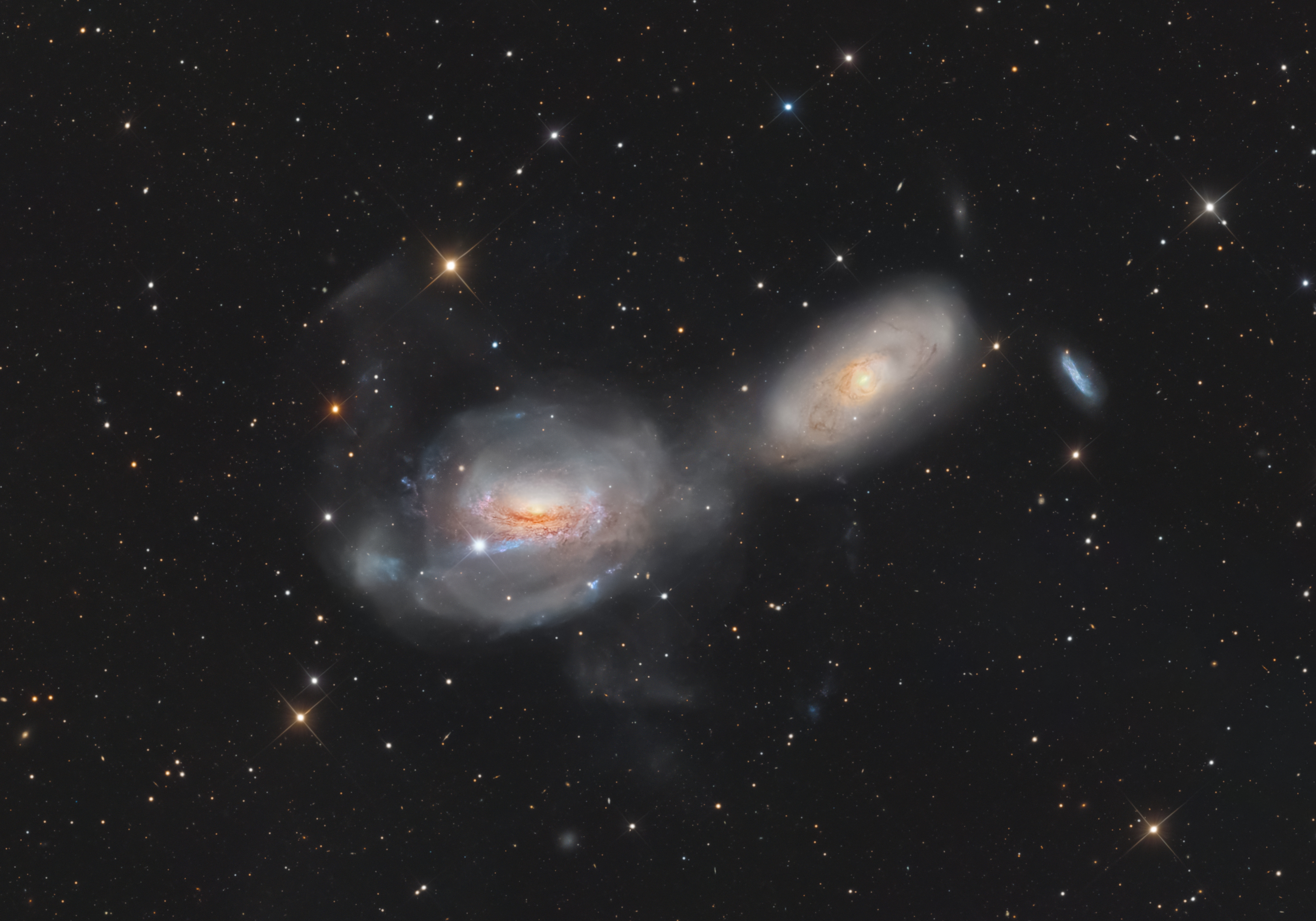
Spiral galaxy NGC 3169 looks to be unraveling like a ball of cosmic yarn. It lies some 70 million light-years away, south of bright star Regulus toward the faint constellation Sextans. Wound up spiral arms are pulled out into sweeping tidal tails as NGC 3169 (left) and neighboring NGC 3166 interact gravitationally. Eventually the galaxies will merge into one, a common fate even for bright galaxies in the local universe. Drawn out stellar arcs and plumes are clear indications of the ongoing gravitational interactions across the deep and colorful galaxy group photo. The telescopic frame spans about 20 arc minutes or about 400,000 light-years at the group's estimated distance, and includes smaller, bluish NGC 3165 to the right. NGC 3169 is also known to shine across the spectrum from radio to X-rays, harboring an active galactic nucleus that is the site of a supermassive black hole.
Copyright: Christophe Vergnes
Η Αστρονομική Εικόνα της Ημέρας από τη NASA (NASA Astronomy Picture of the Day) είναι μια δωρεάν υπηρεσία που παρέχει καθημερινά μια εντυπωσιακή εικόνα από το σύμπαν, την λήψη της οποίας έχει πραγματοποιήσει κάποιος από τους αστρονόμους της NASA ή από κάποιον από τους δορυφόρους ή τα τηλεσκόπια που η NASA λειτουργεί. Οι εικόνες που εμφανίζονται καλύπτουν μια ευρεία γκάμα από θέματα, συμπεριλαμβανομένων των αστερισμών, των γαλαξιών, των πλανητικών συστημάτων, των κομητών, των αστρικών σωμάτων και των παρατηρητηρίων. Κάθε εικόνα συνοδεύεται από μια σύντομη εξήγηση και πληροφορίες σχετικά με το τι παρατηρείται στην εικόνα.