Η Αστρονομική Εικόνα της Ημέρας από τη NASA
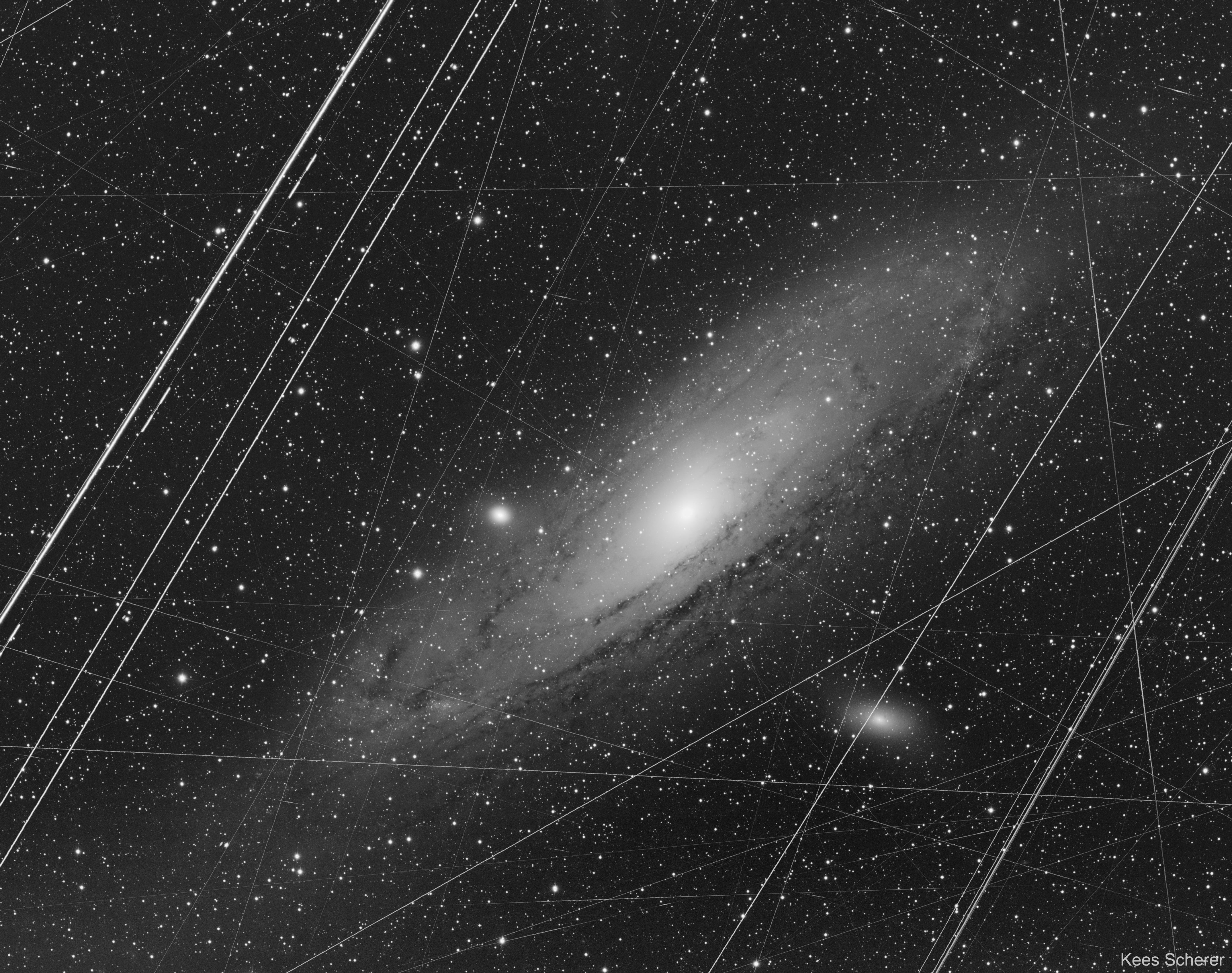
Andromeda before Photoshop
27/09/2026
What does the Andromeda galaxy really look like? The featured image shows how our Milky Way Galaxy's closest major galactic neighbor really appears in a long exposure through Earth's busy skies and with a digital camera that introduces normal imperfections. The picture is a stack of 223 images, each a 300 second exposure, taken from a garden observatory in Portugal during 2019. Obvious image deficiencies include bright parallel airplane trails, long and continuous satellite trails, short cosmic ray streaks, and bad pixels. These imperfections were actually not removed with Photoshop specifically, but rather greatly reduced with a series of computer software packages that included Astro Pixel Processor, DeepSkyStacker, and PixInsight. All of this work was done not to deceive you with a digital fantasy that has little to do with the real likeness of the Andromeda galaxy (M31), but to minimize Earthly artifacts that have nothing to do with the distant galaxy and so better recreate what M31 really does look like. APOD's email for image submissions has changed. Please see: APOD Submissions APOD's main NASA site is moving: From apod.nasa.gov to science.nasa.gov/apod
Copyright: NASA
Προηγούμενες Αστρονομικές Εικόνες της Ημέρας από τη NASA

SH2-308: The Dolphin Head Nebula
07/06/2024
Blown by fast winds from a hot, massive star, this cosmic bubble is huge. Cataloged as Sharpless 2-308 it lies some 5,000 light-years away toward the well-trained constellation Canis Major and covers slightly more of the sky than a Full Moon. That corresponds to a diameter of 60 light-years at its estimated distance. The massive star that created the bubble, a Wolf-Rayet star, is the bright one near the center of the nebula. Wolf-Rayet stars have over 20 times the mass of the Sun and are thought to be in a brief, pre-supernova phase of massive star evolution. Fast winds from this Wolf-Rayet star create the bubble-shaped nebula as they sweep up slower moving material from an earlier phase of evolution. The windblown nebula has an age of about 70,000 years. Relatively faint emission captured by narrowband filters in the deep image is dominated by the glow of ionized oxygen atoms mapped to a blue hue. Presenting a mostly harmless outline, SH2-308 is also known as The Dolphin-head Nebula.
Copyright: Prabhu Kutti

NGC 4565: Galaxy on Edge
06/06/2024
Magnificent spiral galaxy NGC 4565 is viewed edge-on from planet Earth. Also known as the Needle Galaxy for its narrow profile, bright NGC 4565 is a stop on many telescopic tours of the northern sky, in the faint but well-groomed constellation Coma Berenices. This sharp, colorful image reveals the galaxy's boxy, bulging central core cut by obscuring dust lanes that lace NGC 4565's thin galactic plane. NGC 4565 itself lies about 40 million light-years distant and spans some 100,000 light-years. Easily spotted with small telescopes, sky enthusiasts consider NGC 4565 to be a prominent celestial masterpiece Messier missed.
Copyright: Lóránd Fényes
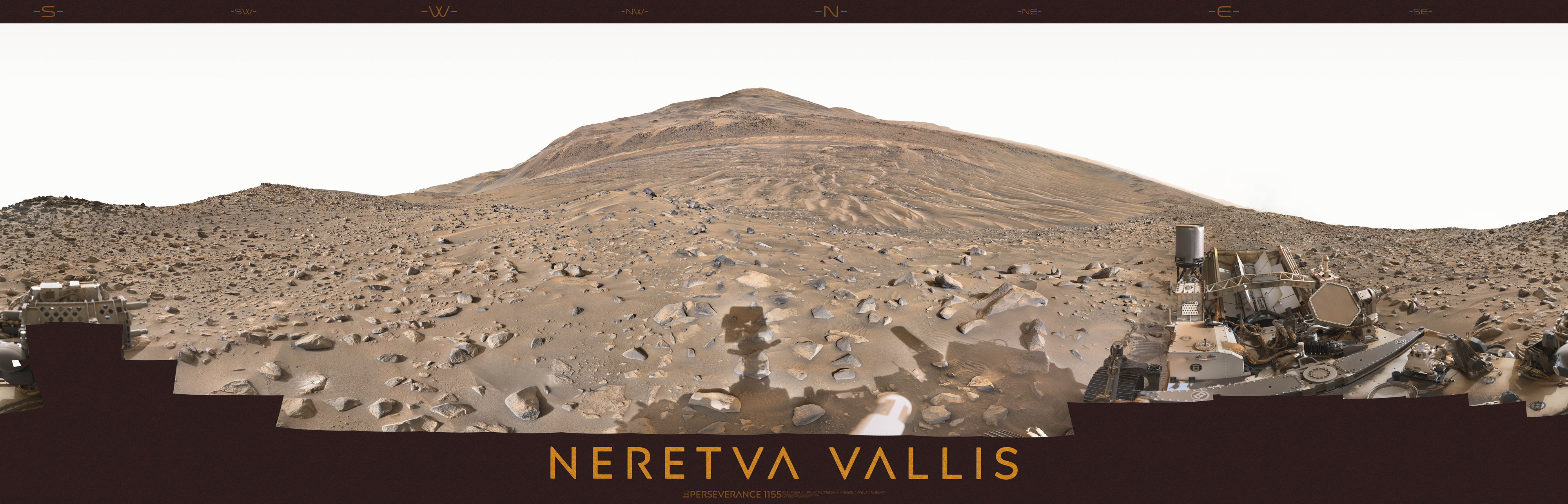
Shadow of a Martian Robot
05/06/2024
What if you saw your shadow on Mars and it wasn't human? Then you might be the Perseverance rover exploring Mars. Perseverance has been examining the Red Planet since 2021, finding evidence of its complex history of volcanism and ancient flowing water, and sending breathtaking images across the inner Solar System. Pictured here in February of 2024, Perseverance looks opposite the Sun and across Neretva Vallis in Jezero Crater, with a local hill visible at the top of the frame. The distinctively non-human shadow of the car-sized rover is visible below center, superposed on scattered rocks. Perseverance, now working without its flying companion Ingenuity, continues to search Mars for signs of ancient life.
Copyright: NASA

Comet Pons-Brooks Develops Opposing Tails
04/06/2024
Why does Comet Pons-Brooks now have tails pointing in opposite directions? The most spectacular tail is the blue-glowing ion tail that is visible flowing down the image. The ion tail is pushed directly out from the Sun by the solar wind. On the upper right is the glowing central coma of Comet 12P/Pons–Brooks. Fanning out from the coma, mostly to the left, is the comet's dust tail. Pushed out and slowed down by the pressure of sunlight, the dust tail tends to trail the comet along its orbit and, from some viewing angles, can appear opposite to the ion tail. The distant, bright star Alpha Leporis is seen at the bottom of the featured image captured last week from Namibia. Two days ago, the comet passed its closest to the Earth and is now best visible from southern skies as it dims and glides back to the outer Solar System.
Copyright: Rolando Ligustri & Lukas Demetz
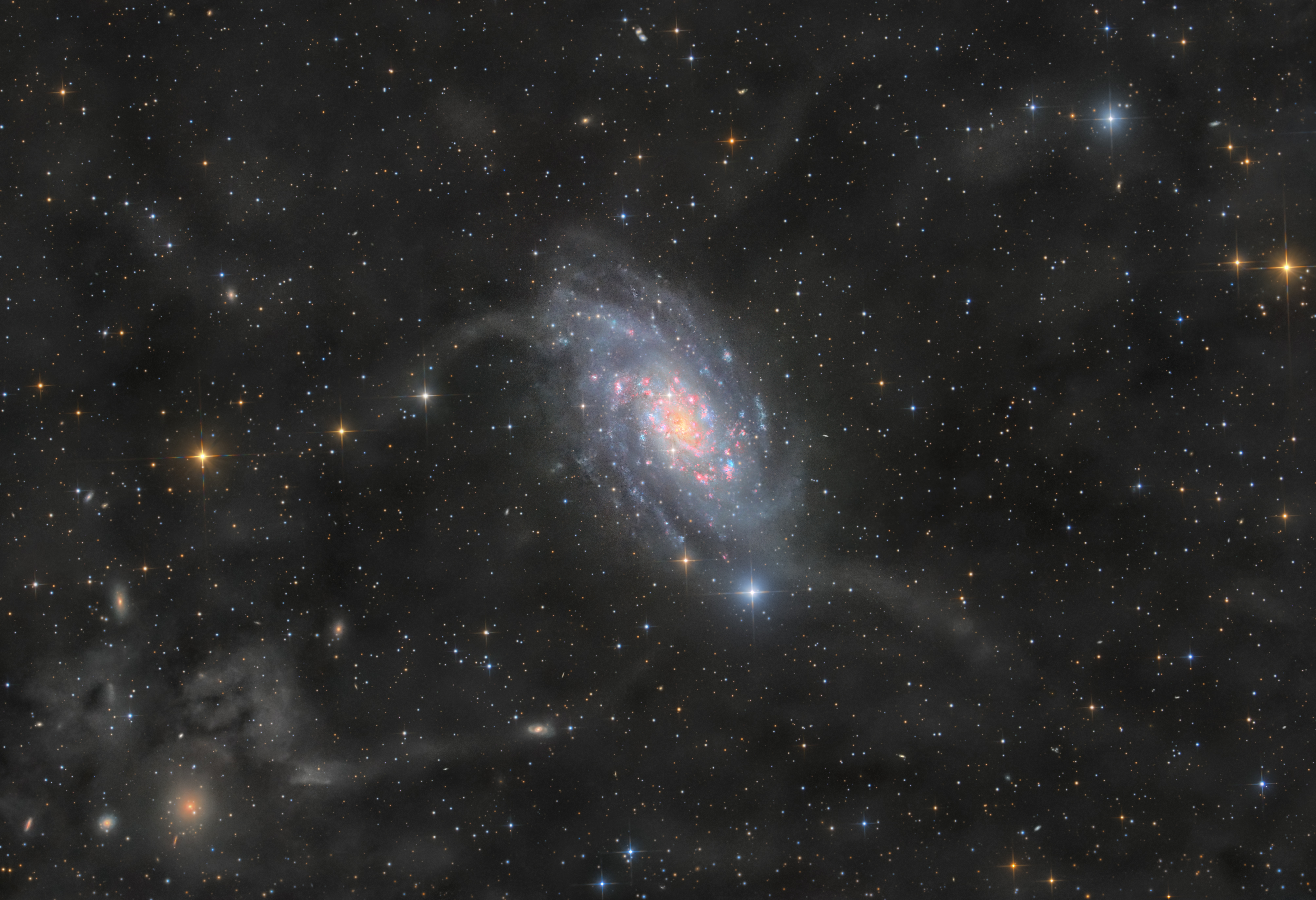
NGC 2403 in Camelopardalis
03/06/2024
Magnificent island universe NGC 2403 stands within the boundaries of the long-necked constellation Camelopardalis. Some 10 million light-years distant and about 50,000 light-years across, the spiral galaxy also seems to have more than its fair share of giant star forming HII regions, marked by the telltale reddish glow of atomic hydrogen gas. The giant HII regions are energized by clusters of hot, massive stars that explode as bright supernovae at the end of their short and furious lives. A member of the M81 group of galaxies, NGC 2403 closely resembles a galaxy in our own local galaxy group with an abundance of star forming regions, M33, the Triangulum Galaxy. Spiky in appearance, bright stars in this portrait of NGC 2403 are in the foreground, within our own Milky Way. Also in the foreground of the deep, wide-field, telescopic image are the Milky Way's dim and dusty interstellar clouds also known as galactic cirrus or integrated flux nebulae. But faint features that seem to extend from NGC 2403 itself are likely tidal stellar streams drawn out by gravitational interactions with neighboring galaxies.
Copyright: (Team F.A.C.T.)
Rotating Moon from LRO
02/06/2024
No one, presently, sees the Moon rotate like this. That's because the Earth's moon is tidally locked to the Earth, showing us only one side. Given modern digital technology, however, combined with many detailed images returned by the Lunar Reconnaissance Orbiter (LRO), a high resolution virtual Moon rotation movie has been composed. The featured time-lapse video starts with the standard Earth view of the Moon. Quickly, though, Mare Orientale, a large crater with a dark center that is difficult to see from the Earth, rotates into view just below the equator. From an entire lunar month condensed into 24 seconds, the video clearly shows that the Earth side of the Moon contains an abundance of dark lunar maria, while the lunar far side is dominated by bright lunar highlands. Currently, over 32 new missions to the Moon are under active development from multiple countries and companies, including NASA's Artemis program which aims to land people on the Moon again within the next few years.
Copyright: NASA
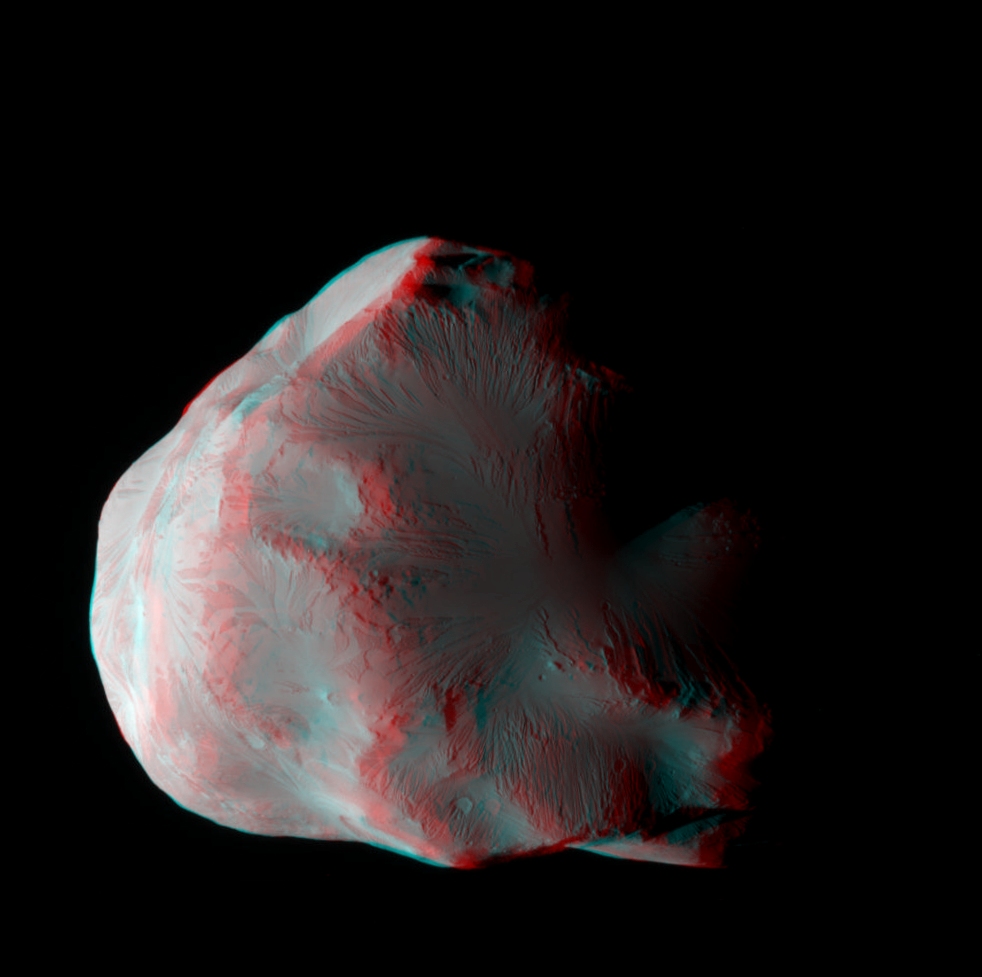
Stereo Helene
01/06/2024
Get out your red/blue glasses and float next to Helene, small, icy moon of Saturn. Appropriately named, Helene is a Trojan moon, so called because it orbits at a Lagrange point. A Lagrange point is a gravitationally stable position near two massive bodies, in this case Saturn and larger moon Dione. In fact, irregularly shaped ( about 36 by 32 by 30 kilometers) Helene orbits at Dione's leading Lagrange point while brotherly ice moon Polydeuces follows at Dione's trailing Lagrange point. The sharp stereo anaglyph was constructed from two Cassini images captured during a close flyby in 2011. It shows part of the Saturn-facing hemisphere of Helene mottled with craters and gully-like features.
Copyright: NASA

The Nebulous Realm of WR 134
31/05/2024
Made with narrowband filters, this cosmic snapshot covers a field of view over twice as wide as the full Moon within the boundaries of the constellation Cygnus. It highlights the bright edge of a ring-like nebula traced by the glow of ionized hydrogen and oxygen gas. Embedded in the region's expanse of interstellar clouds, the complex, glowing arcs are sections of shells of material swept up by the wind from Wolf-Rayet star WR 134, brightest star near the center of the frame. Distance estimates put WR 134 about 6,000 light-years away, making the frame over 100 light-years across. Shedding their outer envelopes in powerful stellar winds, massive Wolf-Rayet stars have burned through their nuclear fuel at a prodigious rate and end this final phase of massive star evolution in a spectacular supernova explosion. The stellar winds and final supernova enrich the interstellar material with heavy elements to be incorporated in future generations of stars.
Copyright: Xin Long
Η Αστρονομική Εικόνα της Ημέρας από τη NASA (NASA Astronomy Picture of the Day) είναι μια δωρεάν υπηρεσία που παρέχει καθημερινά μια εντυπωσιακή εικόνα από το σύμπαν, την λήψη της οποίας έχει πραγματοποιήσει κάποιος από τους αστρονόμους της NASA ή από κάποιον από τους δορυφόρους ή τα τηλεσκόπια που η NASA λειτουργεί. Οι εικόνες που εμφανίζονται καλύπτουν μια ευρεία γκάμα από θέματα, συμπεριλαμβανομένων των αστερισμών, των γαλαξιών, των πλανητικών συστημάτων, των κομητών, των αστρικών σωμάτων και των παρατηρητηρίων. Κάθε εικόνα συνοδεύεται από μια σύντομη εξήγηση και πληροφορίες σχετικά με το τι παρατηρείται στην εικόνα.