Η Αστρονομική Εικόνα της Ημέρας από τη NASA
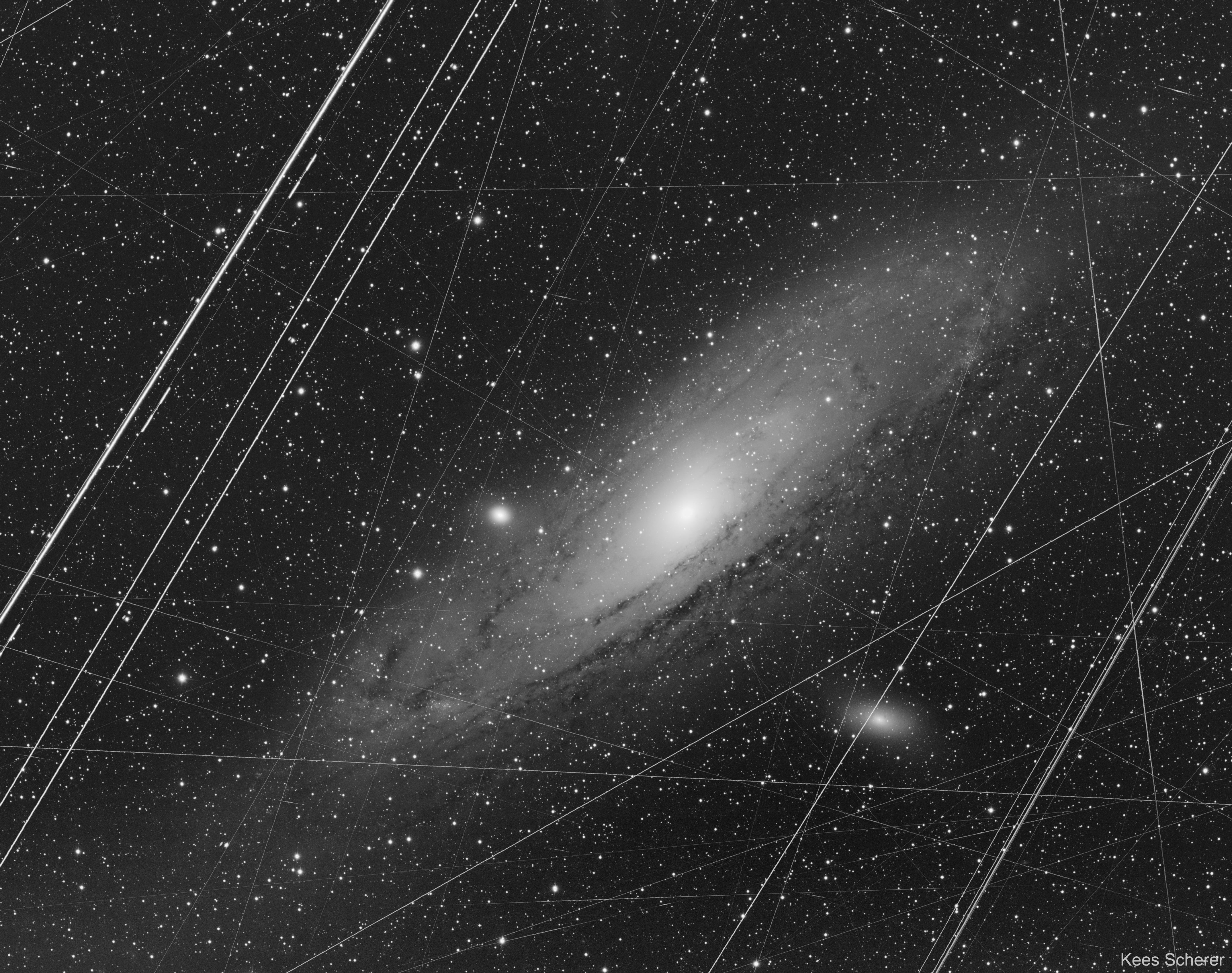
Andromeda before Photoshop
27/09/2026
What does the Andromeda galaxy really look like? The featured image shows how our Milky Way Galaxy's closest major galactic neighbor really appears in a long exposure through Earth's busy skies and with a digital camera that introduces normal imperfections. The picture is a stack of 223 images, each a 300 second exposure, taken from a garden observatory in Portugal during 2019. Obvious image deficiencies include bright parallel airplane trails, long and continuous satellite trails, short cosmic ray streaks, and bad pixels. These imperfections were actually not removed with Photoshop specifically, but rather greatly reduced with a series of computer software packages that included Astro Pixel Processor, DeepSkyStacker, and PixInsight. All of this work was done not to deceive you with a digital fantasy that has little to do with the real likeness of the Andromeda galaxy (M31), but to minimize Earthly artifacts that have nothing to do with the distant galaxy and so better recreate what M31 really does look like. APOD's email for image submissions has changed. Please see: APOD Submissions APOD's main NASA site is moving: From apod.nasa.gov to science.nasa.gov/apod
Copyright: NASA
Προηγούμενες Αστρονομικές Εικόνες της Ημέρας από τη NASA
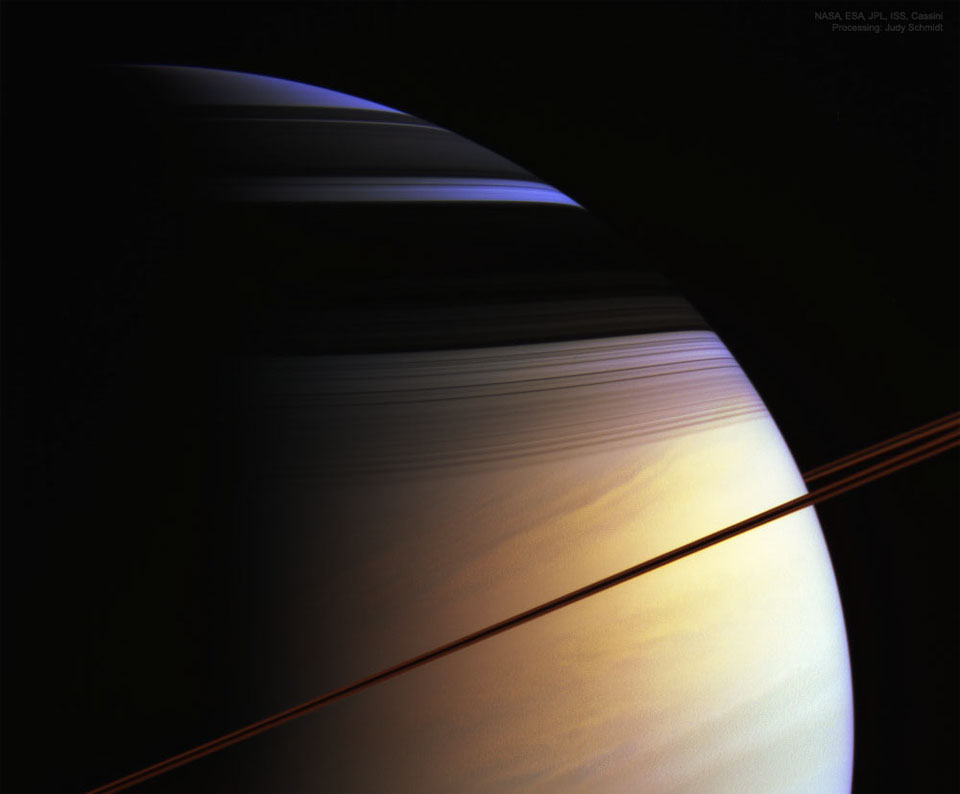
The Colors of Saturn from Cassini
23/06/2024
What creates Saturn's colors? The featured picture of Saturn only slightly exaggerates what a human would see if hovering close to the giant ringed world. The image was taken in 2005 by the robot Cassini spacecraft that orbited Saturn from 2004 to 2017. Here Saturn's majestic rings appear directly only as a curved line, appearing brown, in part from its infrared glow. The rings best show their complex structure in the dark shadows they create across the upper part of the planet. The northern hemisphere of Saturn can appear partly blue for the same reason that Earth's skies can appear blue -- molecules in the cloudless portions of both planet's atmospheres are better at scattering blue light than red. When looking deep into Saturn's clouds, however, the natural gold hue of Saturn's clouds becomes dominant. It is not known why southern Saturn does not show the same blue hue -- one hypothesis holds that clouds are higher there. It is also not known why some of Saturn's clouds are colored gold.
Copyright: NASA

Lynds Dark Nebula 1251
22/06/2024
Stars are forming in Lynds Dark Nebula (LDN) 1251. About 1,000 light-years away and drifting above the plane of our Milky Way galaxy, LDN 1251 is also less appetizingly known as "The Rotten Fish Nebula." The dusty molecular cloud is part of a complex of dark nebulae mapped toward the Cepheus flare region. Across the spectrum, astronomical explorations of the obscuring interstellar clouds reveal energetic shocks and outflows associated with newborn stars, including the telltale reddish glow from scattered Herbig-Haro objects hiding in the image. Distant background galaxies also lurk in the scene, almost buried behind the dusty expanse. This alluring view spans over four full moons on the sky, or 35 light-years at the estimated distance of LDN 1251.
Copyright: Long Xin

Hubble's NGC 1546
21/06/2024
Returning to science operations on June 14, the Hubble Space Telescope used its new pointing mode to capture this sharp image of spiral galaxy NGC 1546. A member of the Dorado galaxy group, the island universe lies a mere 50 million light-years away. The galactic disk of NGC 1546 is tilted to our line-of-sight, with the yellowish light of the old stars and bluish regions of newly formed stars shining through the galaxy's dust lanes. More distant background galaxies are scattered throughout this Hubble view. Launched in 1990, Hubble has been exploring the cosmos for more than three decades, recently celebrating its 34th anniversary.
Copyright: NASA

Sandy and the Moon Halo
20/06/2024
Last April's Full Moon shines through high clouds near the horizon, casting shadows in this garden-at-night skyscape. Along with canine sentinel Sandy watching the garden gate, the wide-angle snapshot also captured the bright Moon's 22 degree ice halo. But June's bright Full Moon will cast shadows too. This month, the Moon's exact full phase occurs at 01:08 UTC June 22. That's a mere 28 hours or so after today's June solstice (at 20:51 UTC June 20), the moment when the Sun reaches its maximum northern declination. Known to some as a Strawberry Moon, June's Full Moon is at its southernmost declination, and of course will create its own 22 degree halos in hazy night skies.
Copyright: Marcella Giulia Pace

NGC 6188: Dragons of Ara
19/06/2024
Do dragons fight on the altar of the sky? Although it might appear that way, these dragons are illusions made of thin gas and dust. The emission nebula NGC 6188, home to the glowing clouds, is found about 4,000 light years away near the edge of a large molecular cloud, unseen at visible wavelengths, in the southern constellation Ara (the Altar). Massive, young stars of the embedded Ara OB1 association were formed in that region only a few million years ago, sculpting the dark shapes and powering the nebular glow with stellar winds and intense ultraviolet radiation. The recent star formation itself was likely triggered by winds and supernova explosions from previous generations of massive stars, that swept up and compressed the molecular gas. This impressively detailed image spans over 2 degrees (four full Moons), corresponding to over 150 light years at the estimated distance of NGC 6188.
Copyright: Carlos Taylor

Gigantic Jets over Himalayan Mountains
18/06/2024
Yes, but can your thunderstorm do this? Pictured here are gigantic jets shooting up from a thunderstorm last week toward the Himalayan Mountains in China and Bhutan. The composite image captured four long jets that occurred only minutes apart. Gigantic jets, documented only in this century, are a type of lightning discharge that occurs between some thunderstorms and the Earth's ionosphere high above them. They are an unusual type of lightning that is much different from regular cloud-to-cloud and cloud-to-ground lightning. The bottoms of gigantic jets appear similar to a cloud-to-above strike called blue jets, while the tops appear similar to upper-atmosphere red sprites. Although the mechanism and trigger that cause gigantic jets remains a topic of research, it is clear that the jets reduce charge imbalance between different parts of Earth's atmosphere. A good way to look for gigantic jets is to watch a powerful but distant thunderstorm from a clear location.
Copyright: Li Xuanhua
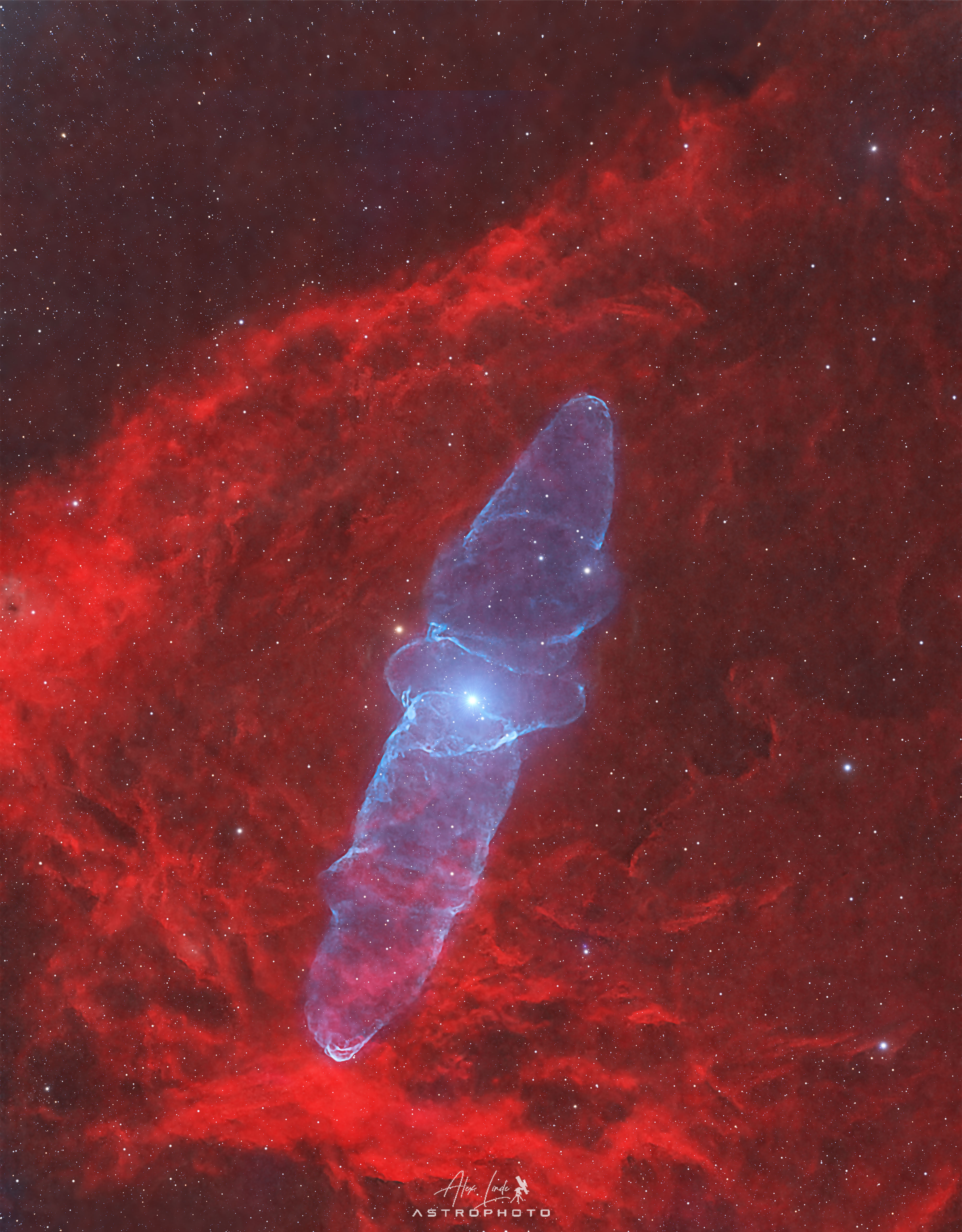
Ou4: The Giant Squid Nebula
17/06/2024
Squids on Earth aren't this big. This mysterious squid-like cosmic cloud spans nearly three full moons on planet Earth's sky. Discovered in 2011 by French astro-imager Nicolas Outters, the Squid Nebula's bipolar shape is distinguished here by the telltale blue emission from doubly ionized oxygen atoms. Though apparently surrounded by the reddish hydrogen emission region Sh2-129, the true distance and nature of the Squid Nebula have been difficult to determine. Still, one investigation suggests Ou4 really does lie within Sh2-129 some 2,300 light-years away. Consistent with that scenario, the cosmic squid would represent a spectacular outflow of material driven by a triple system of hot, massive stars, cataloged as HR8119, seen near the center of the nebula. If so, this truly giant squid nebula would physically be over 50 light-years across.
Copyright: Alex Linde
Animation: Black Hole Destroys Star
16/06/2024
What happens if a star gets too close to a black hole? The black hole can rip it apart -- but how? It's not the high gravitational attraction itself that's the problem -- it's the difference in gravitational pull across the star that creates the destruction. In the featured animated video illustrating this disintegration, you first see a star approaching the black hole. Increasing in orbital speed, the star's outer atmosphere is ripped away during closest approach. Much of the star's atmosphere disperses into deep space, but some continues to orbit the black hole and forms an accretion disk. The animation then takes you into the accretion disk while looking toward the black hole. Including the strange visual effects of gravitational lensing, you can even see the far side of the disk. Finally, you look along one of the jets being expelled along the spin axis. Theoretical models indicate that these jets not only expel energetic gas, but also create energetic neutrinos -- one of which may have been seen recently on Earth. Almost Hyperspace: Random APOD Generator
Copyright: NASA
Η Αστρονομική Εικόνα της Ημέρας από τη NASA (NASA Astronomy Picture of the Day) είναι μια δωρεάν υπηρεσία που παρέχει καθημερινά μια εντυπωσιακή εικόνα από το σύμπαν, την λήψη της οποίας έχει πραγματοποιήσει κάποιος από τους αστρονόμους της NASA ή από κάποιον από τους δορυφόρους ή τα τηλεσκόπια που η NASA λειτουργεί. Οι εικόνες που εμφανίζονται καλύπτουν μια ευρεία γκάμα από θέματα, συμπεριλαμβανομένων των αστερισμών, των γαλαξιών, των πλανητικών συστημάτων, των κομητών, των αστρικών σωμάτων και των παρατηρητηρίων. Κάθε εικόνα συνοδεύεται από μια σύντομη εξήγηση και πληροφορίες σχετικά με το τι παρατηρείται στην εικόνα.