Η Αστρονομική Εικόνα της Ημέρας από τη NASA
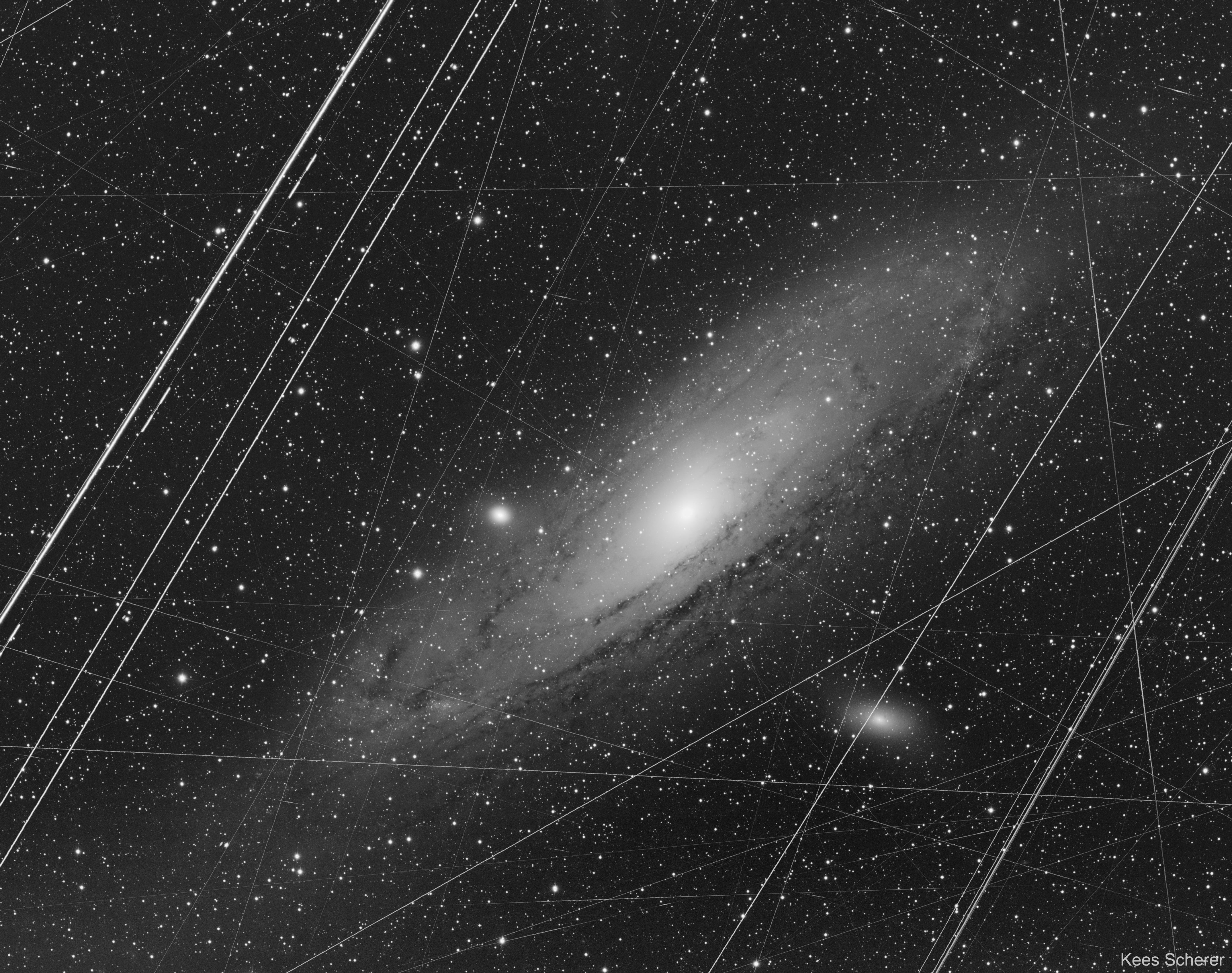
Andromeda before Photoshop
27/09/2026
What does the Andromeda galaxy really look like? The featured image shows how our Milky Way Galaxy's closest major galactic neighbor really appears in a long exposure through Earth's busy skies and with a digital camera that introduces normal imperfections. The picture is a stack of 223 images, each a 300 second exposure, taken from a garden observatory in Portugal during 2019. Obvious image deficiencies include bright parallel airplane trails, long and continuous satellite trails, short cosmic ray streaks, and bad pixels. These imperfections were actually not removed with Photoshop specifically, but rather greatly reduced with a series of computer software packages that included Astro Pixel Processor, DeepSkyStacker, and PixInsight. All of this work was done not to deceive you with a digital fantasy that has little to do with the real likeness of the Andromeda galaxy (M31), but to minimize Earthly artifacts that have nothing to do with the distant galaxy and so better recreate what M31 really does look like. APOD's email for image submissions has changed. Please see: APOD Submissions APOD's main NASA site is moving: From apod.nasa.gov to science.nasa.gov/apod
Copyright: NASA
Προηγούμενες Αστρονομικές Εικόνες της Ημέρας από τη NASA

Milky Way Over Tunisia
05/08/2024
That's no moon. On the ground, that's the Lars Homestead in Tunisia. And that's not just any galaxy. That's the central band of our own Milky Way galaxy. Last, that's not just any meteor. It is a bright fireball likely from last year's Perseids meteor shower. The featured image composite combines consecutive exposures taken by the same camera from the same location. This year's Perseids peak during the coming weekend is expected to show the most meteors after the first quarter moon sets, near midnight. To best experience a meteor shower, you should have clear and dark skies, a comfortable seat, and patience.
Copyright: Makrem Larnaout

Glory and Fog Bow
03/08/2024
On a road trip up Mount Uludağ in Bursa province, Turkey these motorcyclists found themselves above low clouds and fog in late June. With the bright Sun directly behind them, the view down the side of the great mountain revealed a beautiful, atmospheric glory and fog bow. Known to some as the heiligenschein or the Specter of the Brocken, a glory can also sometimes be seen from airplanes or even high buildings. It often appears to be a dark giant surrounded by a bright halo. Of course the dark giant is just the shadow of the observer (90MB video) cast opposite the Sun. The clouds and fog are composed of very small water droplets, smaller than rain drops, that refract and reflect sunlight to create the glory's colorful halo and this more extensive fog bow.
Copyright: Cem Özkeser

Mars Passing By
02/08/2024
As Mars wanders through Earth's night, it passes about 5 degrees south of the Pleiades star cluster in this composite astrophoto. The skyview was constructed from a series of images captured over a run of 16 consecutive clear nights beginning on July 12. Mars' march across the field of view begins at the far right, the planet's ruddy hue. showing a nice contrast with the blue Pleiades stars. Moving much faster across the sky against the distant stars, the fourth planet from the Sun easily passes seventh planet Uranus, also moving across this field of view. Red planet Mars and the ice giant world were in close conjunction, about 1/2 degree apart, on July 16. Continuing its rapid eastward trek, Mars has now left the sister stars and outer planet behind though, passing north of red giant star Aldebaran. Mars will come within about 1/3 degree of Jupiter in planet Earth's sky on August 14.
Copyright: Tunc Tezel
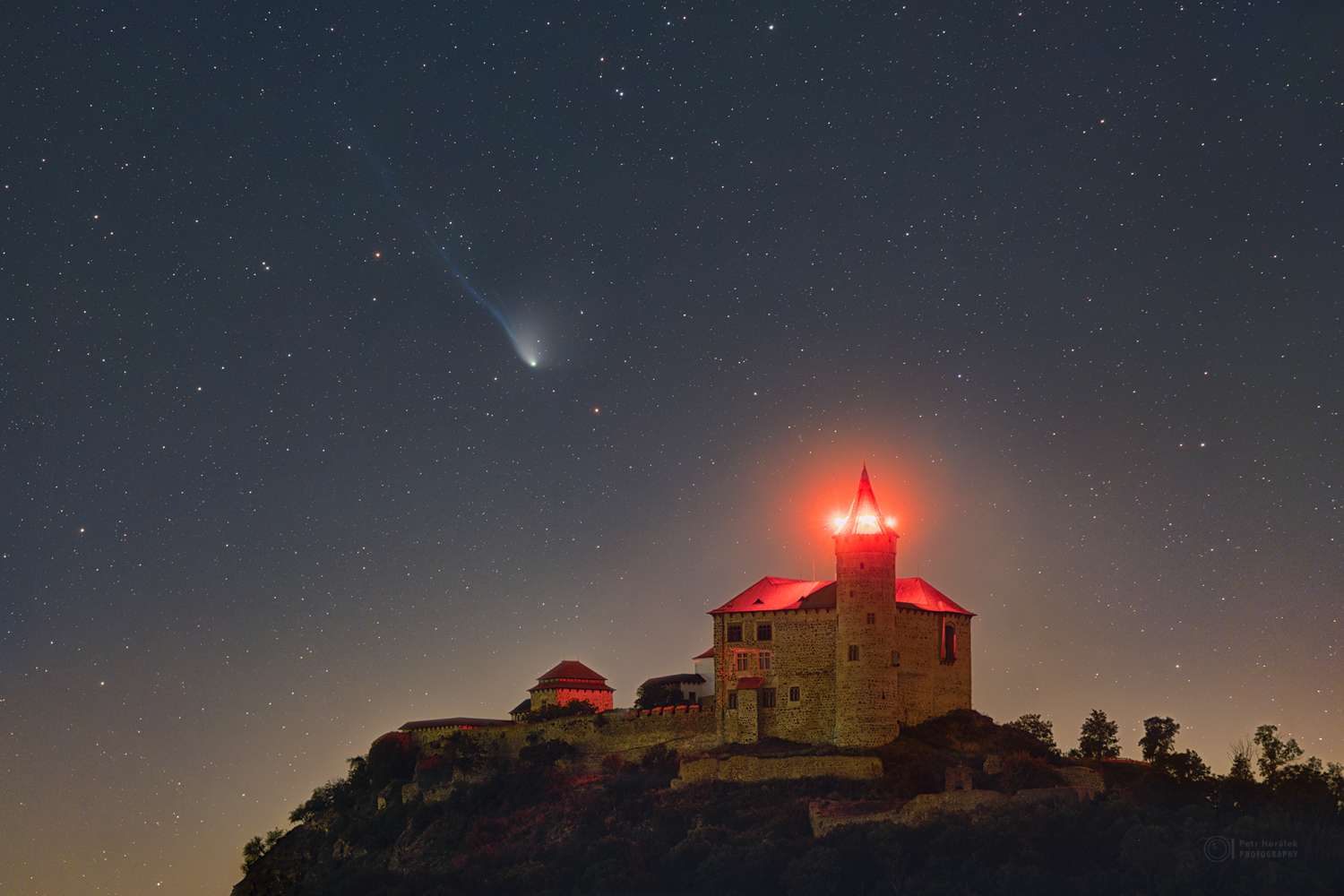
Comet Olbers over Kunetice Castle
01/08/2024
A visitor to the inner solar system every 70 years or so Comet 13P/Olbers reached its most recent perihelion, or closest approach to the Sun, on June 30 2024. Now on a return voyage to the distant Oort cloud the Halley-type comet is recorded here sweeping through northern summer night skies over historic Kunetice Castle, Czech Republic. Along with a broad dust tail, and brighter coma, this comet's long ion tail buffeted by storms and winds from the Sun, is revealed in the composite of tracked exposures for comet and sky, and fixed exposures for foreground landscape recorded on July 28. The comet is about 16 light-minutes beyond the castle and seen against faint background stars below the northern constellation Ursa Major. The hilltop castle dates to the 15th century, while Heinrich Olbers discovered the comet in 1815. Captured here low in northwestern skies just after sunset Comet Olbers, for now, offers skywatchers on planet Earth rewarding telescopic and binocular views. Comet 13P/Olbers next perihelion passage will be in 2094.
Copyright: Petr Horálek

Leopard Spots on Martian Rocks
31/07/2024
What is creating these unusual spots? Light-colored spots on Martian rocks, each surrounded by a dark border, were discovered earlier this month by NASA's Perseverance Rover currently exploring Mars. Dubbed leopard spots because of their seemingly similarity to markings on famous Earth-bound predators, these curious patterns are being studied with the possibility they were created by ancient Martian life. The pictured spots measure only millimeters across and were discovered on a larger rock named Cheyava Falls. The exciting but unproven speculation is that long ago, microbes generated energy with chemical reactions that turned rock from red to white while leaving a dark ring, like some similarly appearing spots on Earth rocks. Although other non-biological explanations may ultimately prevail, speculation focusing on this potential biological origin is causing much intrigue. New Mirror: APOD is now available from Brazil in Portuguese
Copyright: NASA

Arp 142: Interacting Galaxies from Webb
30/07/2024
To some, it looks like a penguin. But to people who study the universe, it is an interesting example of two big galaxies interacting. Just a few hundred million years ago, the upper NGC 2936 was likely a normal spiral galaxy: spinning, creating stars, and minding its own business. Then it got too close to the massive elliptical galaxy NGC 2937, below, and took a dive. Together known as Arp 142, they are featured in this new Webb infrared image, while a visible light Hubble image appears in comparison. NGC 2936 is not only being deflected, but distorted, by this close gravitational interaction. When massive galaxies pass near each other, gas is typically condensed from which new stars form. A young group of stars appears as the nose of the penguin toward the right of the upper galaxy, while in the center of the spiral, bright stars together appear as an eye. Before a billion years, the two galaxies will likely merge into one larger galaxy. Explore Your Universe: Random APOD Generator
Copyright: NASA

Milky Way over Uluru
29/07/2024
What's happening above Uluru? A United Nations World Heritage Site, Uluru is an extraordinary 350-meter high mountain in central Australia that rises sharply from nearly flat surroundings. Composed of sandstone, Uluru has slowly formed over the past 300 million years as softer rock eroded away. The Uluru region has been a home to humans for over 22,000 years. Recorded last month, the starry sky above Uluru includes the central band of our Milky Way galaxy, complete with complex dark filaments of dust, bright red emission nebulas, and billions of stars.
Copyright: Max Inwood
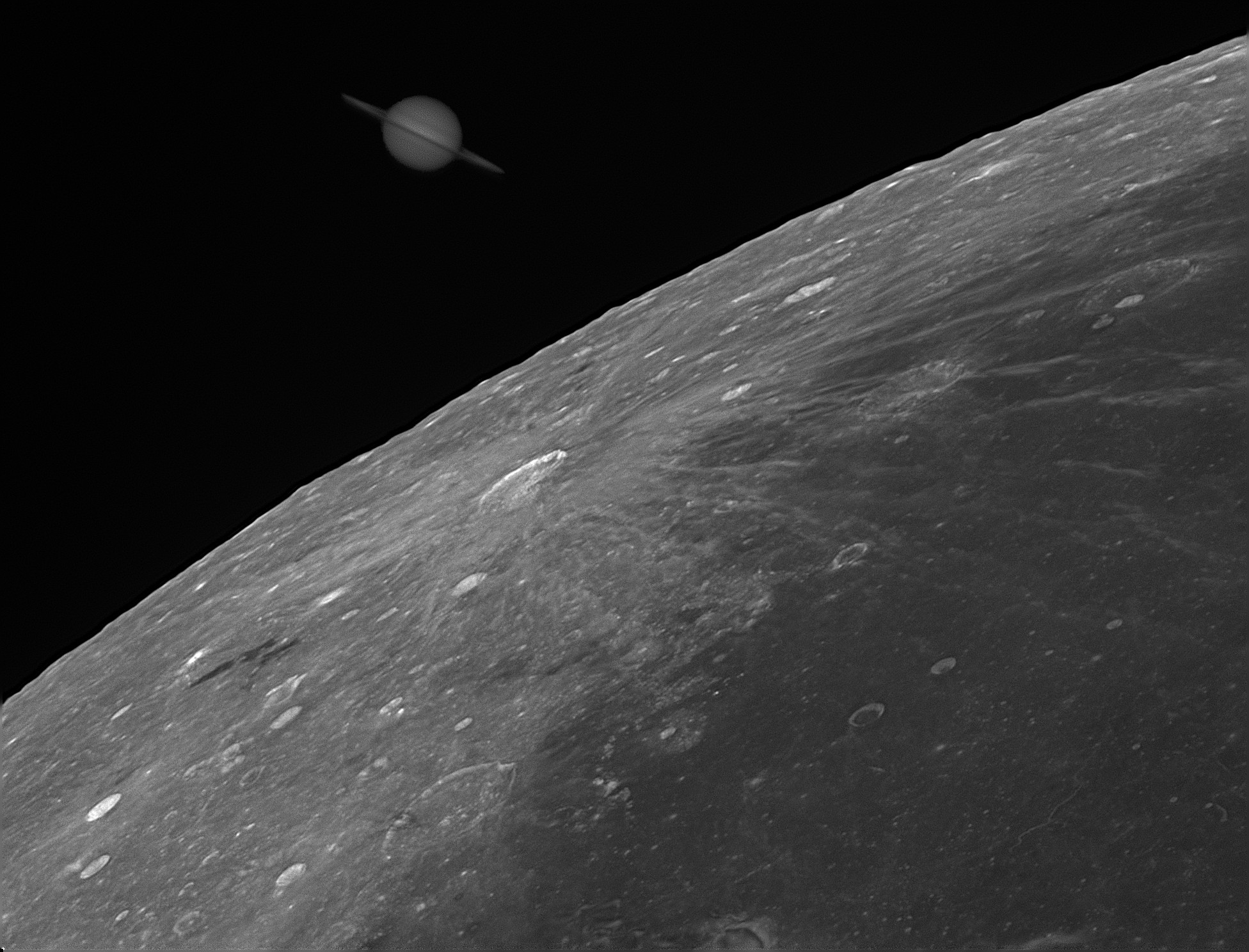
Saturn at the Moon's Edge
27/07/2024
Saturn now rises before midnight in planet Earth's sky. On July 24, the naked-eye planet was in close conjunction, close on the sky, to a waning gibbous Moon. But from some locations on planet Earth the ringed gas giant was occulted, disappearing behind the Moon for about an hour from skies over parts of Asia and Africa. Because the Moon and bright planets wander through the sky near the ecliptic plane, such occultation events are not uncommon, but they can be dramatic. In this telescopic view from Nanjing, Jiangsu, China, Saturn is caught moments before its disappearance behind the lunar disk. The snapshot gives the illusion that Saturn hangs just above Glushko crater, a 43 kilometer diameter, young, ray crater near the Moon's western edge. Of course, the Moon is 400 thousand kilometers away, compared to Saturn's distance of 1.4 billion kilometers.
Copyright: Chengcheng Xu
Η Αστρονομική Εικόνα της Ημέρας από τη NASA (NASA Astronomy Picture of the Day) είναι μια δωρεάν υπηρεσία που παρέχει καθημερινά μια εντυπωσιακή εικόνα από το σύμπαν, την λήψη της οποίας έχει πραγματοποιήσει κάποιος από τους αστρονόμους της NASA ή από κάποιον από τους δορυφόρους ή τα τηλεσκόπια που η NASA λειτουργεί. Οι εικόνες που εμφανίζονται καλύπτουν μια ευρεία γκάμα από θέματα, συμπεριλαμβανομένων των αστερισμών, των γαλαξιών, των πλανητικών συστημάτων, των κομητών, των αστρικών σωμάτων και των παρατηρητηρίων. Κάθε εικόνα συνοδεύεται από μια σύντομη εξήγηση και πληροφορίες σχετικά με το τι παρατηρείται στην εικόνα.