Η Αστρονομική Εικόνα της Ημέρας από τη NASA
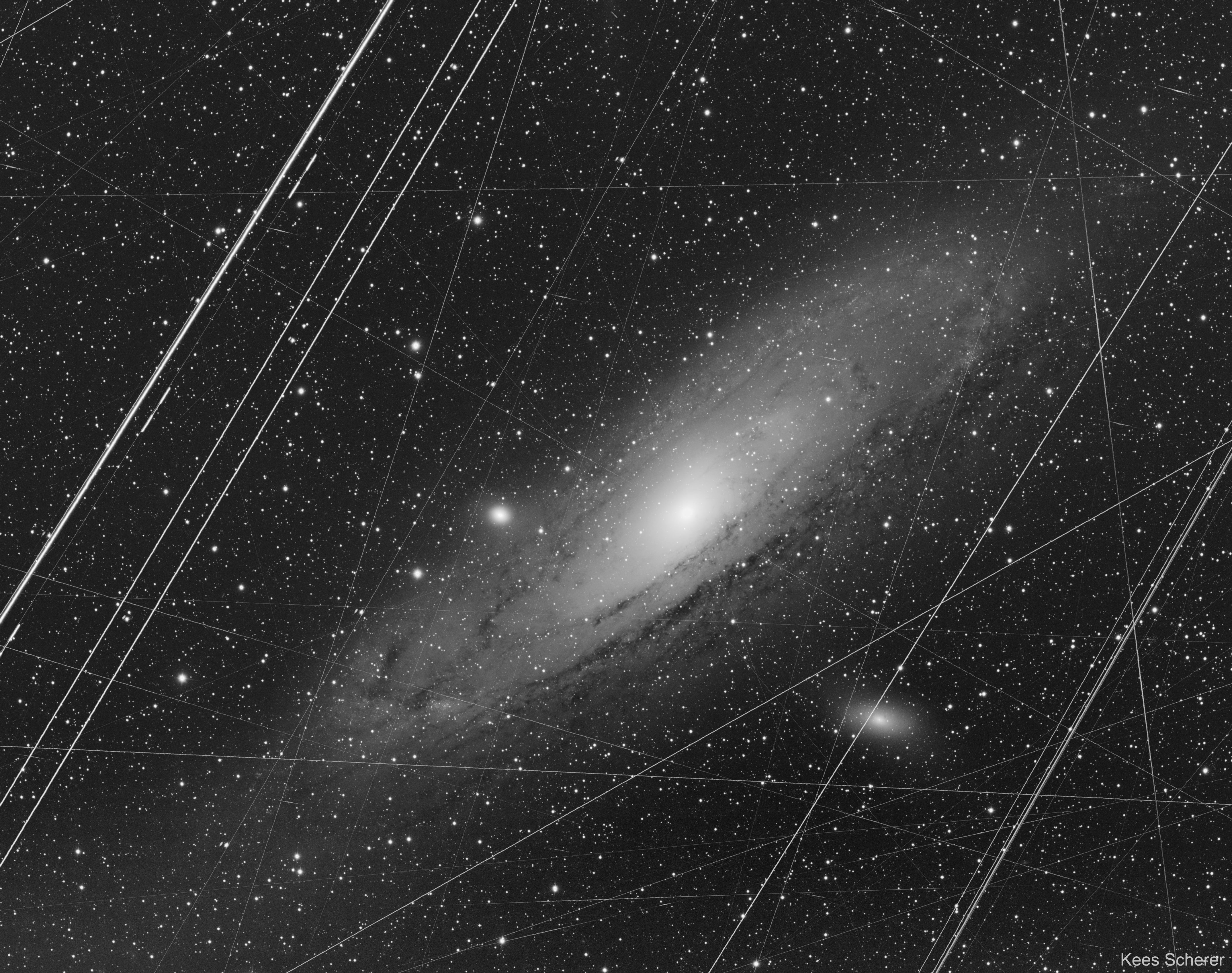
Andromeda before Photoshop
27/09/2026
What does the Andromeda galaxy really look like? The featured image shows how our Milky Way Galaxy's closest major galactic neighbor really appears in a long exposure through Earth's busy skies and with a digital camera that introduces normal imperfections. The picture is a stack of 223 images, each a 300 second exposure, taken from a garden observatory in Portugal during 2019. Obvious image deficiencies include bright parallel airplane trails, long and continuous satellite trails, short cosmic ray streaks, and bad pixels. These imperfections were actually not removed with Photoshop specifically, but rather greatly reduced with a series of computer software packages that included Astro Pixel Processor, DeepSkyStacker, and PixInsight. All of this work was done not to deceive you with a digital fantasy that has little to do with the real likeness of the Andromeda galaxy (M31), but to minimize Earthly artifacts that have nothing to do with the distant galaxy and so better recreate what M31 really does look like. APOD's email for image submissions has changed. Please see: APOD Submissions APOD's main NASA site is moving: From apod.nasa.gov to science.nasa.gov/apod
Copyright: NASA
Προηγούμενες Αστρονομικές Εικόνες της Ημέρας από τη NASA
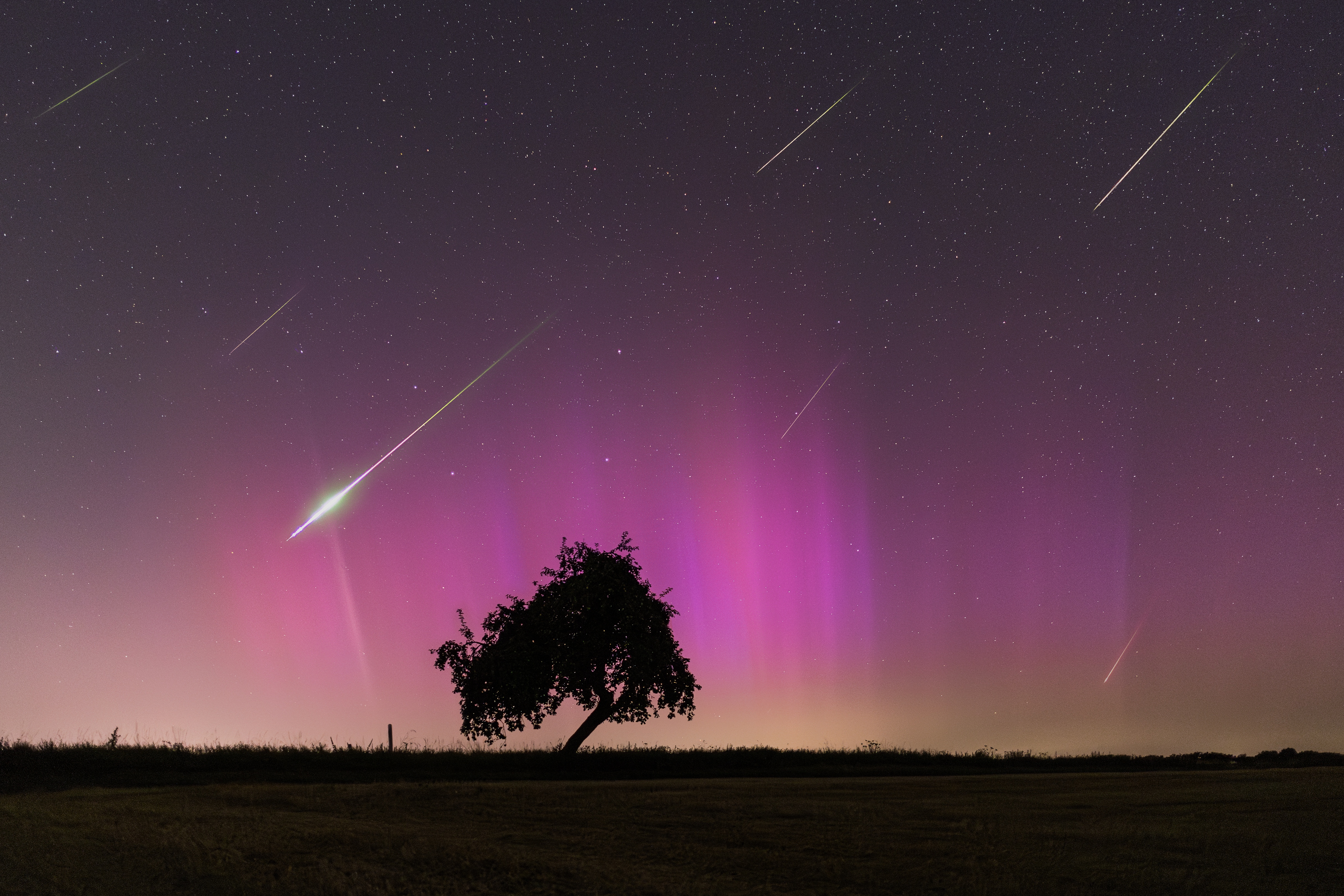
Meteors and Aurora over Germany
14/08/2024
This was an unusual night. For one thing, the night sky of August 11 and 12, earlier this week, occurred near the peak of the annual Perseid Meteor Shower. Therefore, meteors streaked across the dark night as small bits cast off from Comet Swift-Tuttle came crashing into the Earth's atmosphere. Even more unusually, for central Germany at least, the night sky glowed purple. The red-blue hue was due to aurora caused by an explosion of particles from the Sun a few days before. This auroral storm was so intense that it was seen as far south as Texas and Italy, in Earth's northern hemisphere. The featured image composite was built from 7 exposures taken over 26 minutes from Ense, Germany. The Perseids occur predictably every August, but auroras visible this far south are more unusual and less predictable. Gallery: Perseid Meteor Shower 2024 and Aurorae
Copyright: Chantal Anders
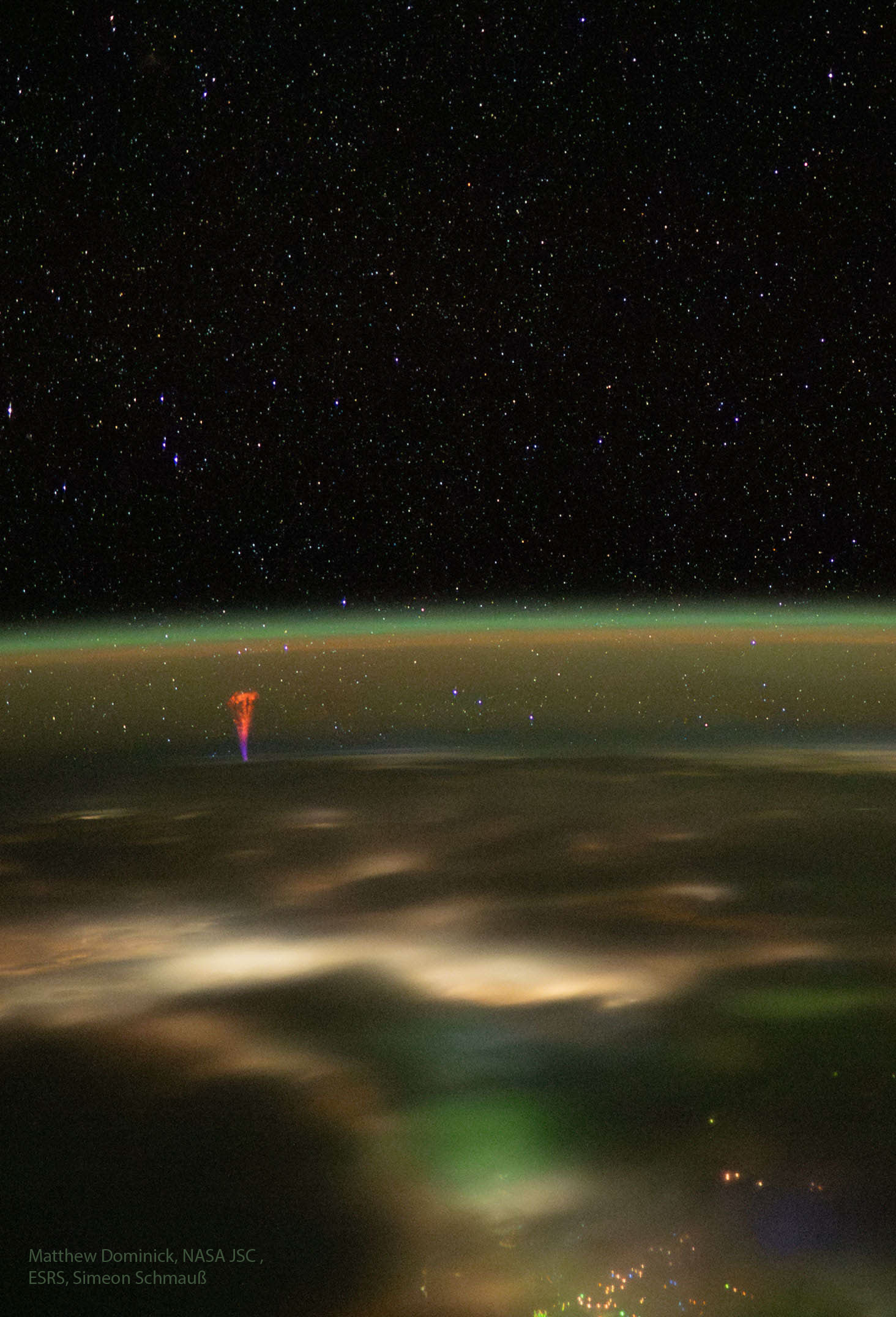
Giant Jet from the International Space Station
13/08/2024
What's that on the horizon? When circling the Earth on the International Space Station early last month, astronaut Matthew Dominick saw an unusual type of lightning just beyond the Earth's edge: a gigantic jet. The powerful jet appears on the left of the featured image in red and blue. Giant jet lightning has only been known about for the past 23 years. The atmospheric jets are associated with thunderstorms and extend upwards towards Earth's ionosphere. The lower part of the frame shows the Earth at night, with Earth's thin atmosphere tinted green from airglow. City lights are visible, sometimes resolved, but usually creating diffuse white glows in intervening clouds. The top of the frame reveals distant stars in the dark night sky. The nature of gigantic jets and their possible association with other types of Transient Luminous Events (TLEs) such as blue jets and red sprites remains an active topic of research. Growing Gallery: Perseid Meteor Shower 2024 and Aurorae
Copyright: NASA
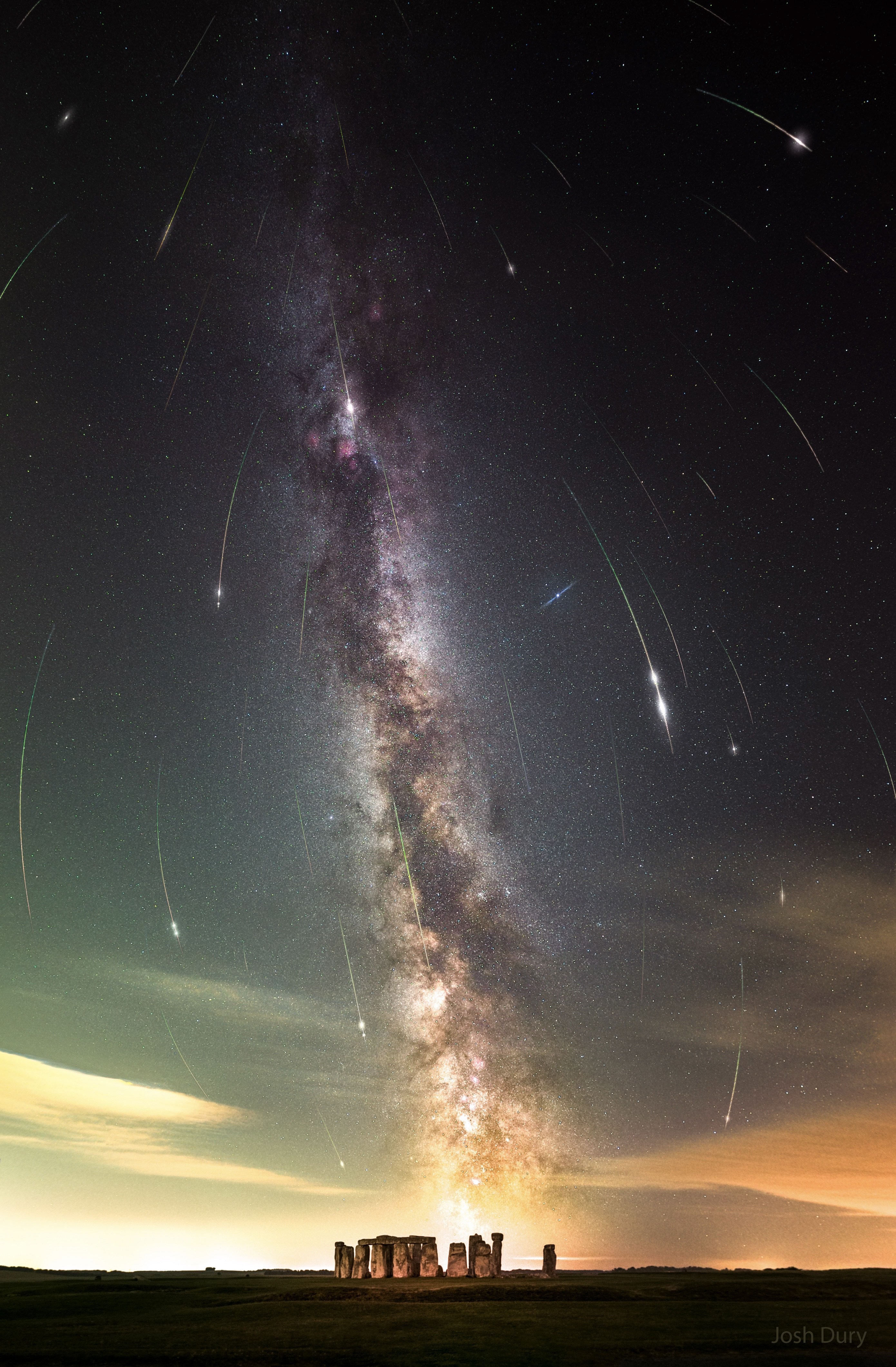
Perseid Meteors over Stonehenge
12/08/2024
What's happening in the sky above Stonehenge? A meteor shower: specifically, the Perseid meteor shower. A few nights ago, after the sky darkened, many images of meteors from this year's Perseids were captured separately and merged into a single frame. Although the meteors all traveled on straight paths, these paths appear slightly curved by the wide-angle lens of the capturing camera. The meteor streaks can all be traced back to a single point on the sky called the radiant, here just off the top of the frame in the constellation of Perseus. The same camera took a deep image of the background sky that brought up the central band of our Milky Way galaxy running nearly vertical through the image center. The featured image was taken from Wiltshire, England, being careful to include, at the bottom, the famous astronomical monument of Stonehenge. Although the Perseids peaked last night, some Perseid meteors should still be visible for a few more nights.
Copyright: Josh Dury
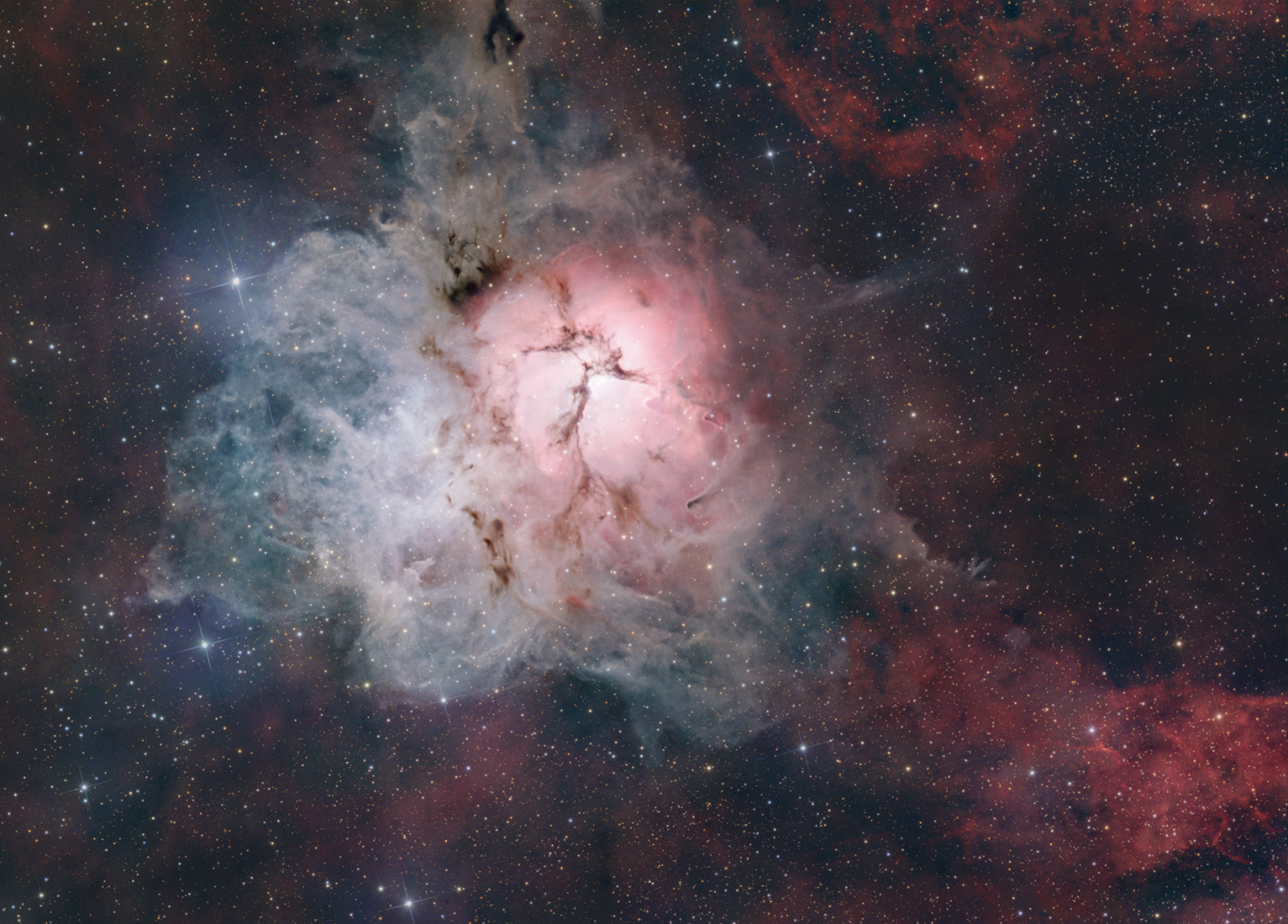
The Light, Dark, and Dusty Trifid
10/08/2024
Messier 20, popularly known as the Trifid Nebula, lies about 5,000 light-years away toward the nebula rich constellation Sagittarius. A star forming region in the plane of our galaxy, the Trifid does illustrate three different types of astronomical nebulae; red emission nebulae dominated by light from hydrogen atoms, blue reflection nebulae produced by dust reflecting starlight, and dark nebulae where dense dust clouds appear in silhouette. The reddish emission region, roughly separated into three parts by obscuring dust lanes, is what lends the Trifid its popular name. The cosmic cloud complex is over 40 light-years across and would cover the area of a full moon on planet Earth's sky. But the Trifid Nebula is too faint to be seen by the unaided eye. Over 75 hours of image data captured under dark night skies was used to create this stunning telescopic view. Watch: The Perseid Meteor Shower
Copyright: Robert Edelmaier and Gabriele Gegenbauer

A Perseid Below
09/08/2024
Denizens of planet Earth typically watch meteor showers by looking up. But this remarkable view, captured on August 13, 2011 by astronaut Ron Garan, caught a Perseid meteor by looking down. From Garan's perspective on board the International Space Station orbiting at an altitude of about 380 kilometers, the Perseid meteors streak below, swept up dust from comet Swift-Tuttle. The vaporizing comet dust grains are traveling at about 60 kilometers per second through the denser atmosphere around 100 kilometers above Earth's surface. In this case, the foreshortened meteor flash is near frame center, below the curving limb of the Earth and a layer of greenish airglow, just below bright star Arcturus. Want to look up at a meteor shower? You're in luck, as the 2024 Perseid meteor shower is active now and predicted to peak near August 12. With interfering bright moonlight absent, this year you'll likely see many Perseid meteors under clear, dark skies after midnight.
Copyright: NASA

Periodic Comet Swift-Tuttle
08/08/2024
A Halley-type comet with an orbital period of about 133 years, Comet 109P/Swift-Tuttle is recognized as the parent of the annual Perseid Meteor Shower. The comet's last visit to the inner Solar System was in 1992. Then, it did not become easily visible to the naked eye, but it did become bright enough to see from most locations with binoculars and small telescopes. This stunning color image of Swift-Tuttle's greenish coma, long ion tail and dust tail was recorded using film on November 24, 1992. That was about 16 days after the large periodic comet's closest approach to Earth. Comet Swift-Tuttle is expected to next make an impressive appearance in night skies in 2126. Meanwhile, dusty cometary debris left along the orbit of Swift-Tuttle will continue to be swept up creating planet Earth's best-known July and August meteor shower.
Copyright: Gerald Rhemann
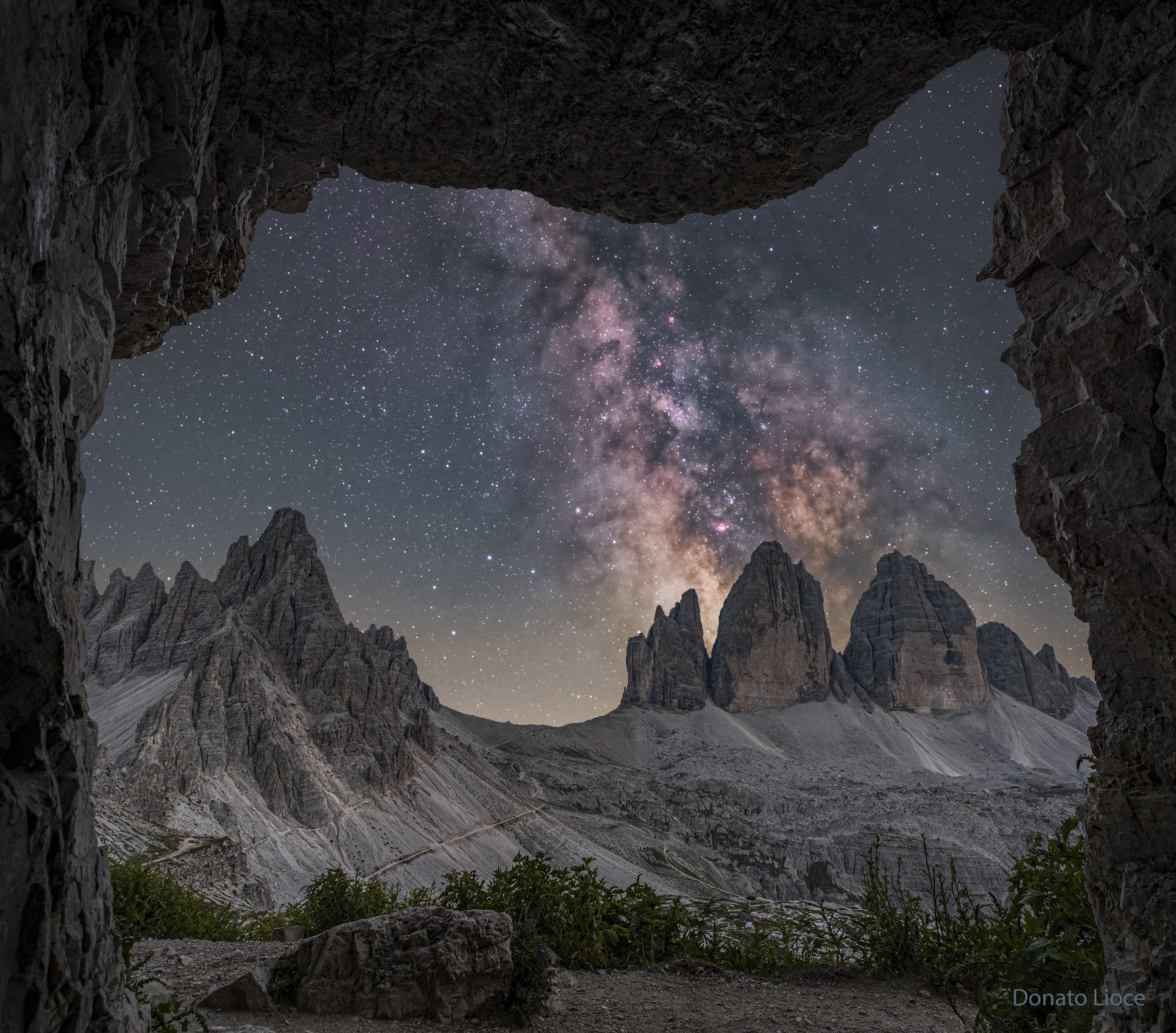
Milky Way Behind Three Merlons
07/08/2024
To some, they look like battlements, here protecting us against the center of the Milky Way. The Three Merlons, also called the Three Peaks of Lavaredo, stand tall today because they are made of dense dolomite rock which has better resisted erosion than surrounding softer rock. They formed about 250 million years ago and so are comparable in age with one of the great extinctions of life on Earth. A leading hypothesis is that this great extinction was triggered by an asteroid about 10-km across, larger in size than Mount Everest, impacting the Earth. Humans have gazed up at the stars in the Milky Way and beyond for centuries, making these battlefield-like formations, based in the Sexten Dolomites, a popular place for current and ancient astronomers.
Copyright: Donato Lioce; Text: Natalia Lewandowska (SUNY Oswego)
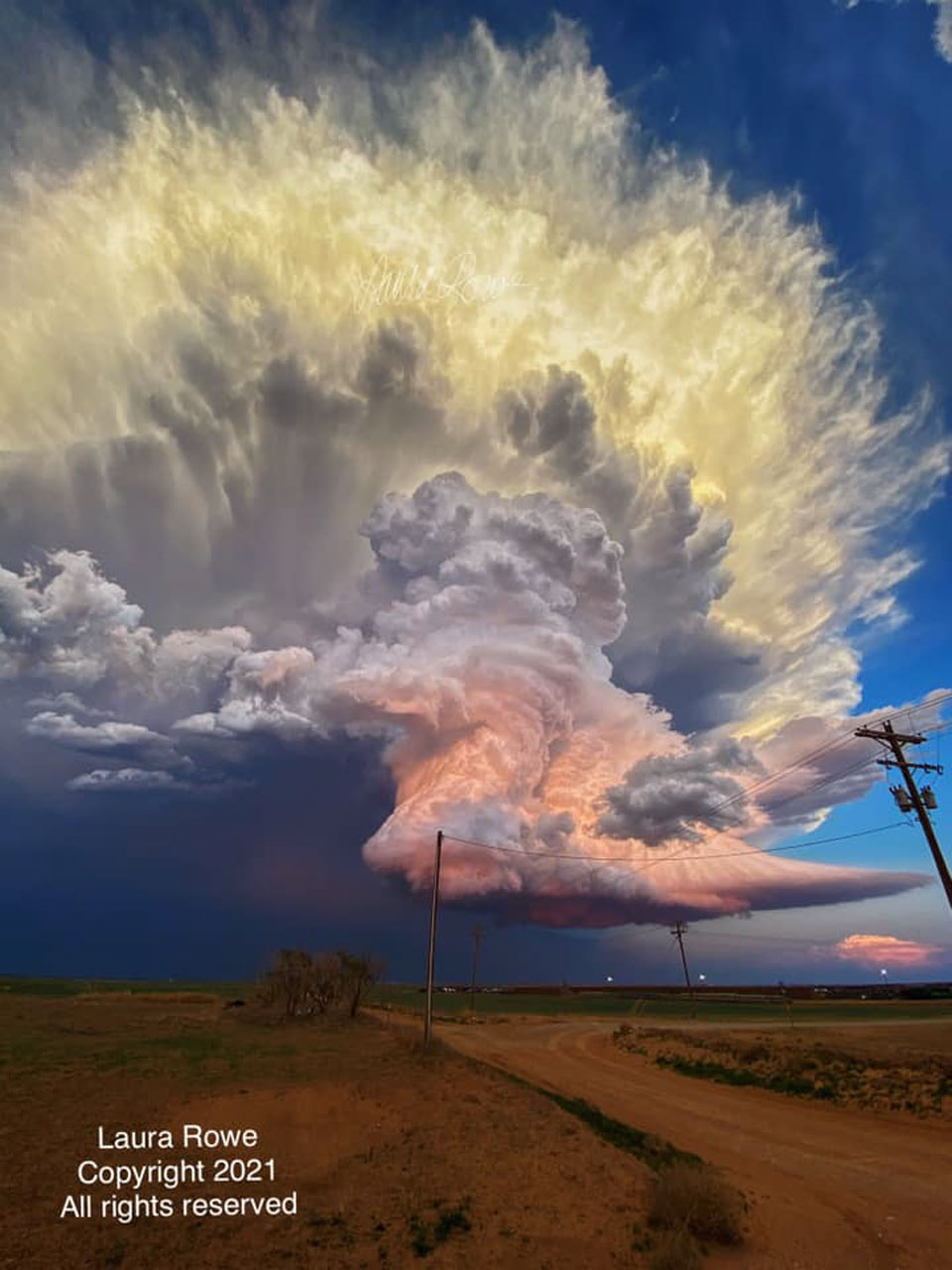
Storm Cloud Over Texas
06/08/2024
What makes this storm cloud so colorful? First, the cloud itself is composed of millions of tiny droplets of water and ice. Its bottom is almost completely flat -- but this isn't unusual. Bottom flatness in clouds is generally caused by air temperature dropping as you go up, and that above a specific height, water-saturated air condenses out water droplets. The shape of the cloud middle is caused by a water-droplet-laden column of air being blown upward. Most unusual, though, are the orange and yellow colors. Both colors are caused by the cloud's water drops reflecting sunlight. The orange color in the cloud's middle and bottom sections are reflections of a nearly red sunset. In contrast, the yellow color of the cloud's top results from reflection of light from a not-yet-setting Sun, where some -- but less -- blue light is being scattered away. Appearing to float above the plains in Texas, the featured impressive image of a dynamic cumulonimbus cloud was captured in 2021 while investigating a tornado.
Copyright: Laura Rowe (Used with permission)
Η Αστρονομική Εικόνα της Ημέρας από τη NASA (NASA Astronomy Picture of the Day) είναι μια δωρεάν υπηρεσία που παρέχει καθημερινά μια εντυπωσιακή εικόνα από το σύμπαν, την λήψη της οποίας έχει πραγματοποιήσει κάποιος από τους αστρονόμους της NASA ή από κάποιον από τους δορυφόρους ή τα τηλεσκόπια που η NASA λειτουργεί. Οι εικόνες που εμφανίζονται καλύπτουν μια ευρεία γκάμα από θέματα, συμπεριλαμβανομένων των αστερισμών, των γαλαξιών, των πλανητικών συστημάτων, των κομητών, των αστρικών σωμάτων και των παρατηρητηρίων. Κάθε εικόνα συνοδεύεται από μια σύντομη εξήγηση και πληροφορίες σχετικά με το τι παρατηρείται στην εικόνα.