Η Αστρονομική Εικόνα της Ημέρας από τη NASA
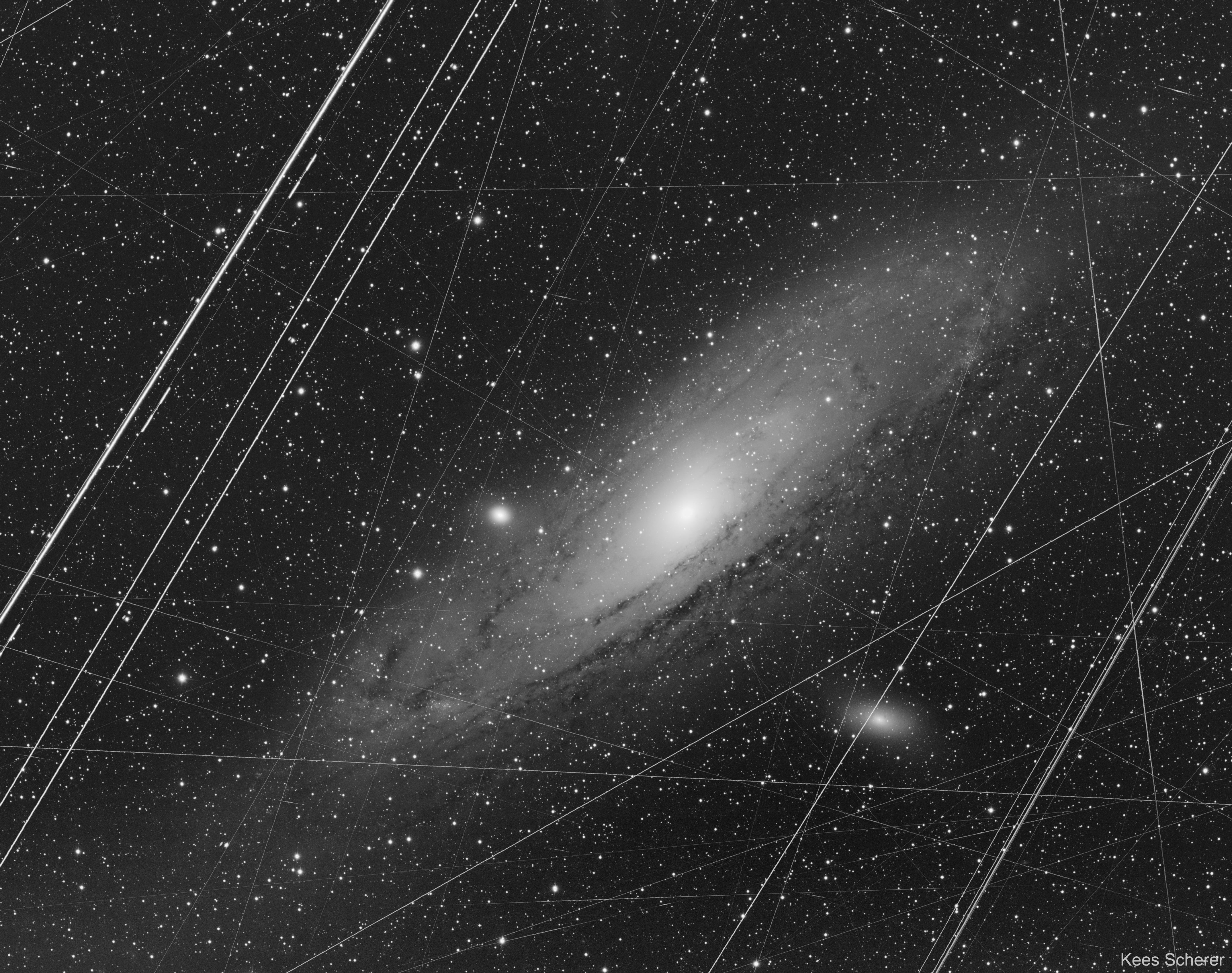
Andromeda before Photoshop
27/09/2026
What does the Andromeda galaxy really look like? The featured image shows how our Milky Way Galaxy's closest major galactic neighbor really appears in a long exposure through Earth's busy skies and with a digital camera that introduces normal imperfections. The picture is a stack of 223 images, each a 300 second exposure, taken from a garden observatory in Portugal during 2019. Obvious image deficiencies include bright parallel airplane trails, long and continuous satellite trails, short cosmic ray streaks, and bad pixels. These imperfections were actually not removed with Photoshop specifically, but rather greatly reduced with a series of computer software packages that included Astro Pixel Processor, DeepSkyStacker, and PixInsight. All of this work was done not to deceive you with a digital fantasy that has little to do with the real likeness of the Andromeda galaxy (M31), but to minimize Earthly artifacts that have nothing to do with the distant galaxy and so better recreate what M31 really does look like. APOD's email for image submissions has changed. Please see: APOD Submissions APOD's main NASA site is moving: From apod.nasa.gov to science.nasa.gov/apod
Copyright: NASA
Προηγούμενες Αστρονομικές Εικόνες της Ημέρας από τη NASA

A Picturesque Equinox Sunset
19/03/2024
What's that at the end of the road? The Sun. Many towns have roads that run east-west, and on two days each year, the Sun rises and sets right down the middle. Today, in some parts of the world (tomorrow in others), is one of those days: an equinox. Not only is this a day of equal night ("aequus"-"nox") and day time, but also a day when the sun rises precisely to the east and sets due west. Displayed here is a picturesque rural road in Alberta, Canada that runs approximately east-west. The featured image was taken during the September Equinox of 2021, but the geometry remains the same every year. In many cultures, this March equinox is taken to be the first day of a season, typically spring in Earth's northern hemisphere, and autumn in the south. Does your favorite street run east-west? Tonight, at sunset, you can find out with a quick glance.
Copyright: Alan Dyer, Amazingsky.com, TWAN
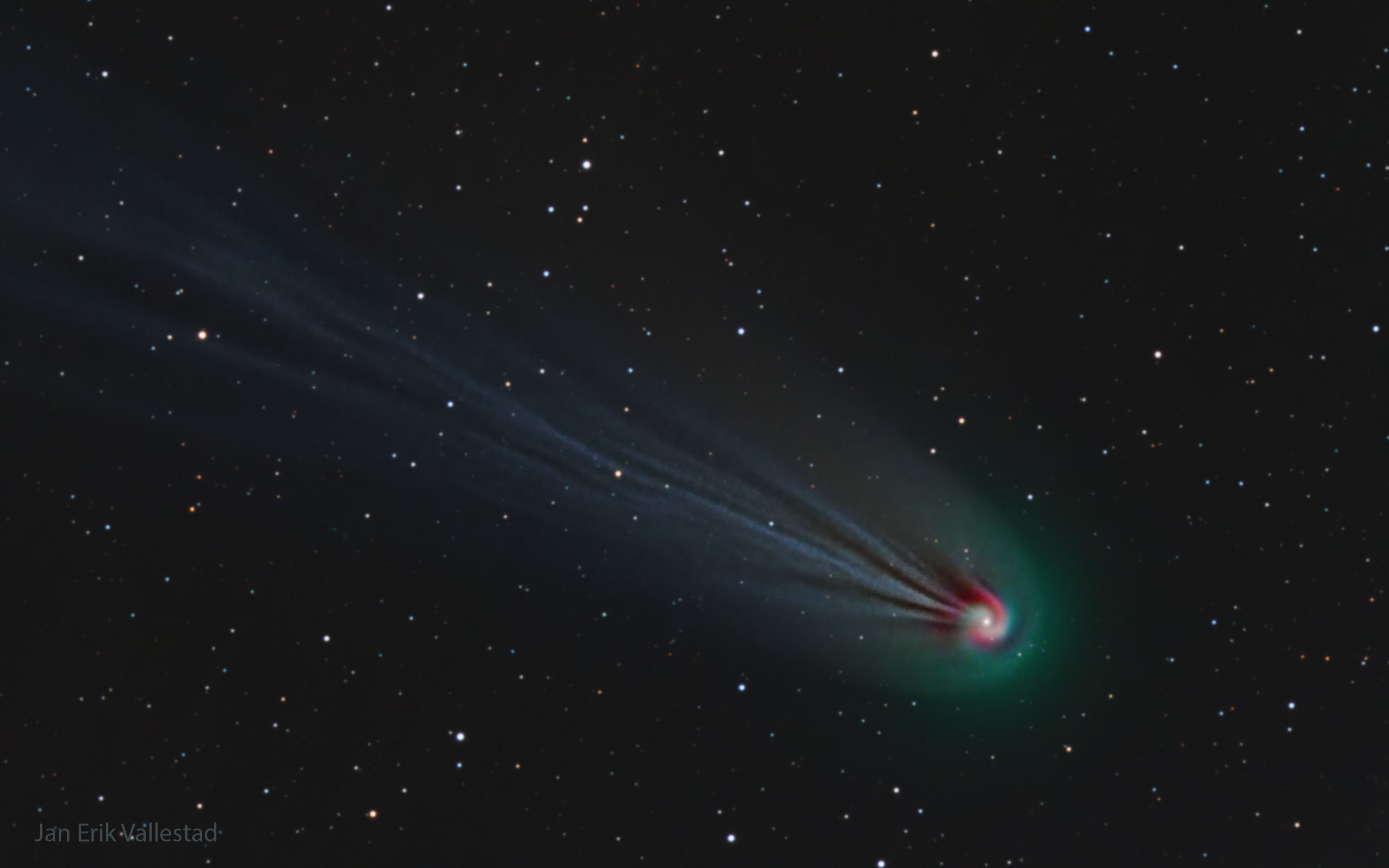
Comet Pons-Brooks' Swirling Coma
18/03/2024
A bright comet will be visible during next month's total solar eclipse. This very unusual coincidence occurs because Comet 12P/Pons-Brooks's return to the inner Solar System places it by chance only 25 degrees away from the Sun during Earth's April 8 total solar eclipse. Currently the comet is just on the edge of visibility to the unaided eye, best visible with binoculars in the early evening sky toward the constellation of the Fish (Pisces). Comet Pons-Brooks, though, is putting on quite a show for deep camera images even now. The featured image is a composite of three very specific colors, showing the comet's ever-changing ion tail in light blue, its outer coma in green, and highlights some red-glowing gas around the coma in a spiral. The spiral is thought to be caused by gas being expelled by the slowly rotating nucleus of the giant iceberg comet. Although it is always difficult to predict the future brightness of comets, Comet Pons-Brook has been particularly prone to outbursts, making it even more difficult to predict how bright it will actually be as the Moon moves in front of the Sun on April 8. Total Eclipse Info: 2024 Total Solar Eclipse from NASA
Copyright: Jan Erik Vallestad
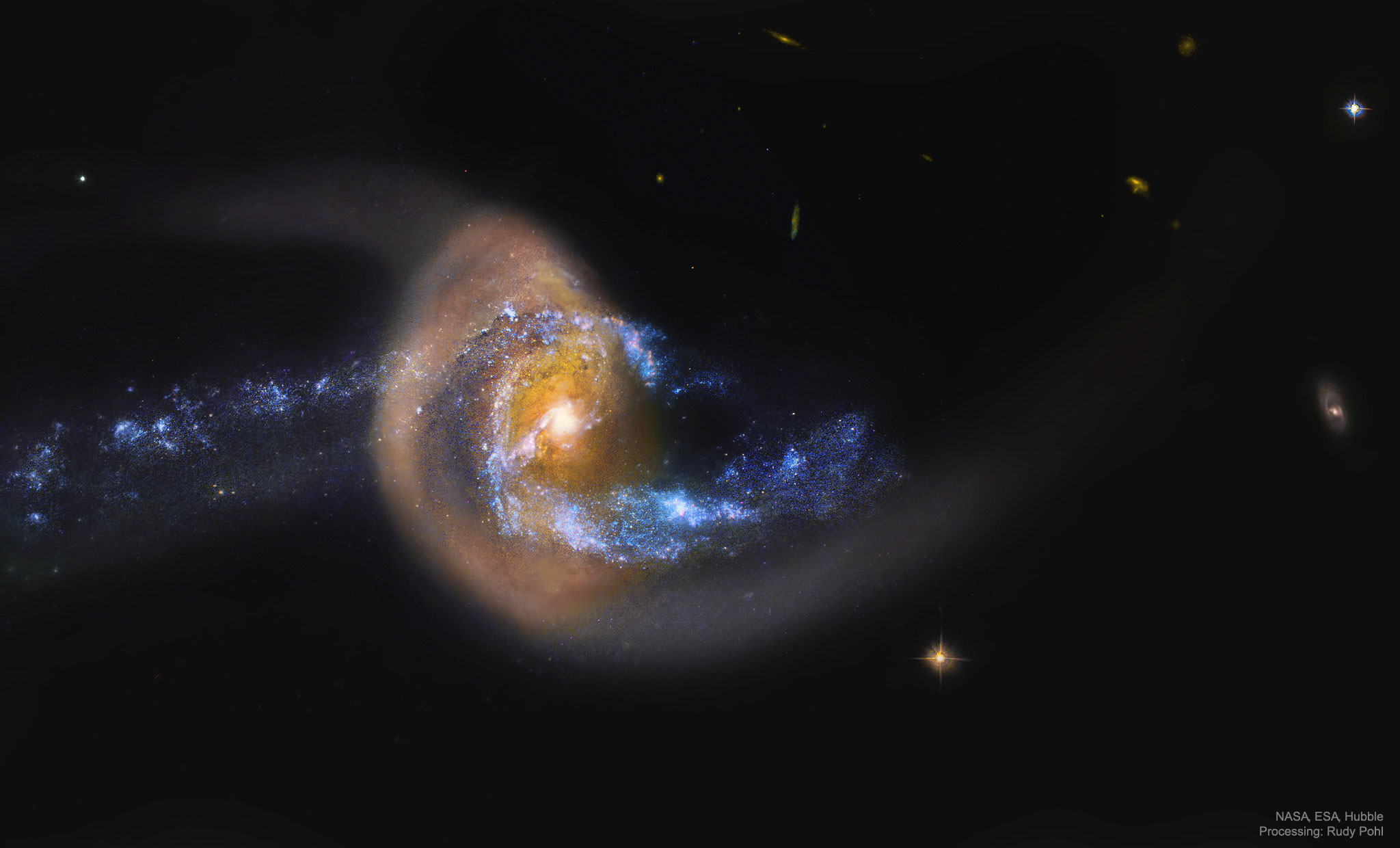
NGC 7714: Starburst after Galaxy Collision
17/03/2024
Is this galaxy jumping through a giant ring of stars? Probably not. Although the precise dynamics behind the featured image is yet unclear, what is clear is that the pictured galaxy, NGC 7714, has been stretched and distorted by a recent collision with a neighboring galaxy. This smaller neighbor, NGC 7715, situated off to the left of the frame, is thought to have charged right through NGC 7714. Observations indicate that the golden ring pictured is composed of millions of older Sun-like stars that are likely co-moving with the interior bluer stars. In contrast, the bright center of NGC 7714 appears to be undergoing a burst of new star formation. The featured image was captured by the Hubble Space Telescope. NGC 7714 is located about 130 million light years away toward the constellation of the Two Fish (Pisces). The interactions between these galaxies likely started about 150 million years ago and should continue for several hundred million years more, after which a single central galaxy may result.
Copyright: NASA
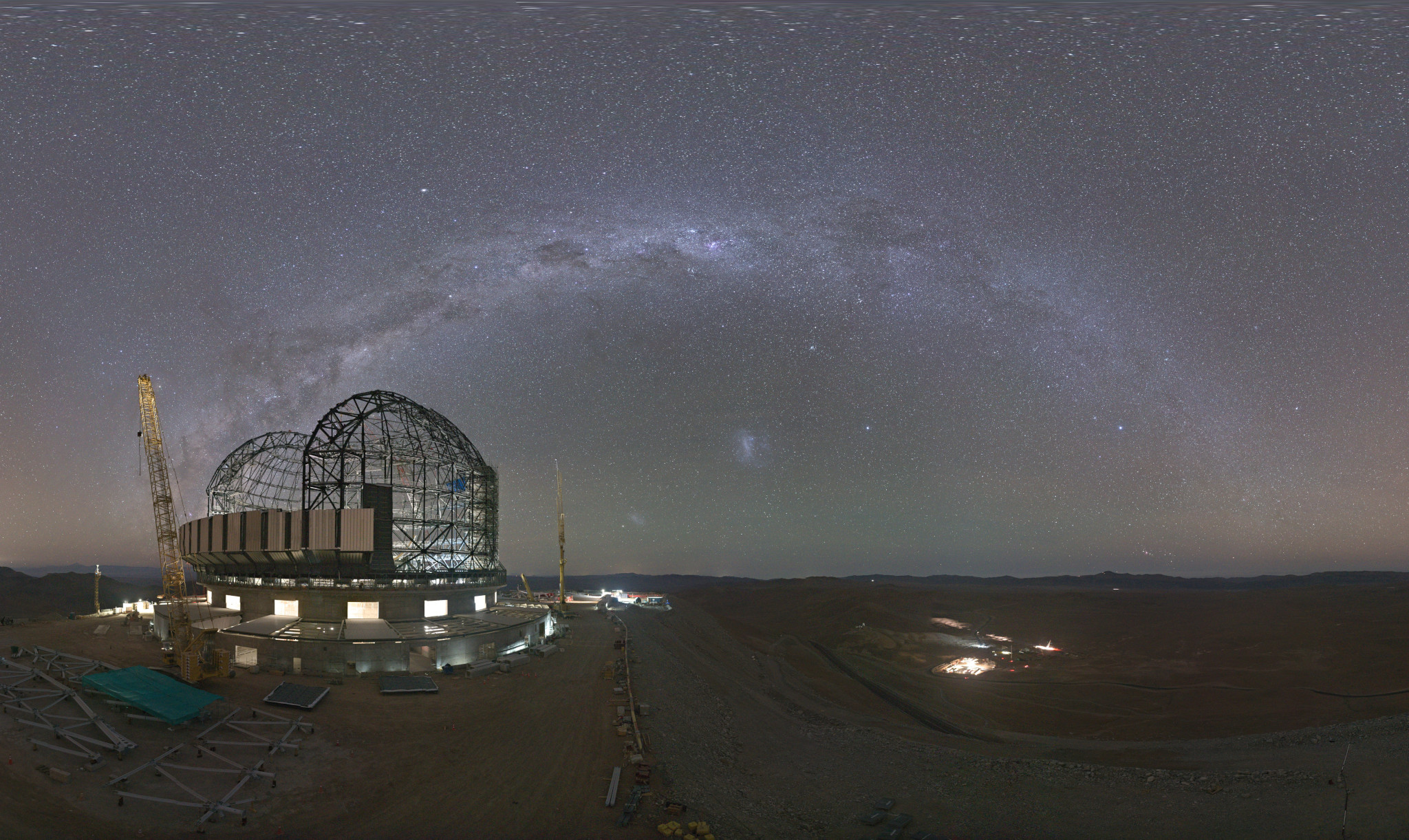
ELT and the Milky Way
16/03/2024
The southern winter Milky Way sprawls across this night skyscape. Looking due south, the webcam view was recorded near local midnight on March 11 in dry, dark skies over the central Chilean Atacama desert. Seen below the graceful arc of diffuse starlight are satellite galaxies of the mighty Milky Way, also known as the Large and Small Magellanic clouds. In the foreground is the site of the European Southern Observatory's 40-metre-class Extremely Large Telescope (ELT). Under construction at the 3000 metre summit of Cerro Armazones, the ELT is on track to become planet Earth's biggest Eye on the Sky.
Copyright: NASA
Portrait of NGC 1055
15/03/2024
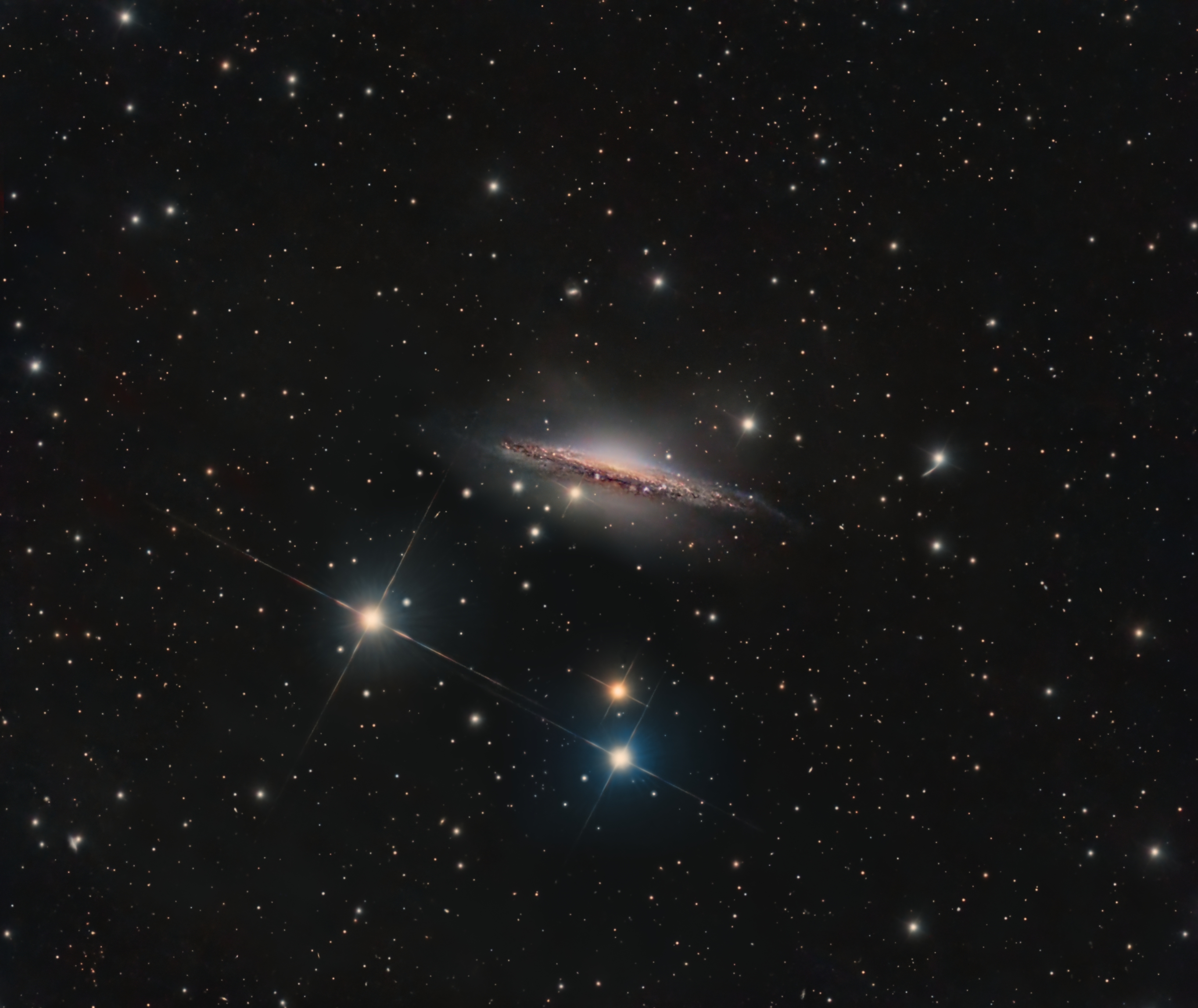
Big, beautiful spiral galaxy NGC 1055 is a dominant member of a small galaxy group a mere 60 million light-years away toward the aquatically intimidating constellation Cetus. Seen edge-on, the island universe spans over 100,000 light-years, a little larger than our own Milky Way galaxy. The colorful, spiky stars decorating this cosmic portrait of NGC 1055 are in the foreground, well within the Milky Way. But the telltale pinkish star forming regions are scattered through winding dust lanes along the distant galaxy's thin disk. With a smattering of even more distant background galaxies, the deep image also reveals a boxy halo that extends far above and below the central bulge and disk of NGC 1055. The halo itself is laced with faint, narrow structures, and could represent the mixed and spread out debris from a satellite galaxy disrupted by the larger spiral some 10 billion years ago.
Copyright: Dave Doctor
Moon Pi and Mountain Shadow
14/03/2024
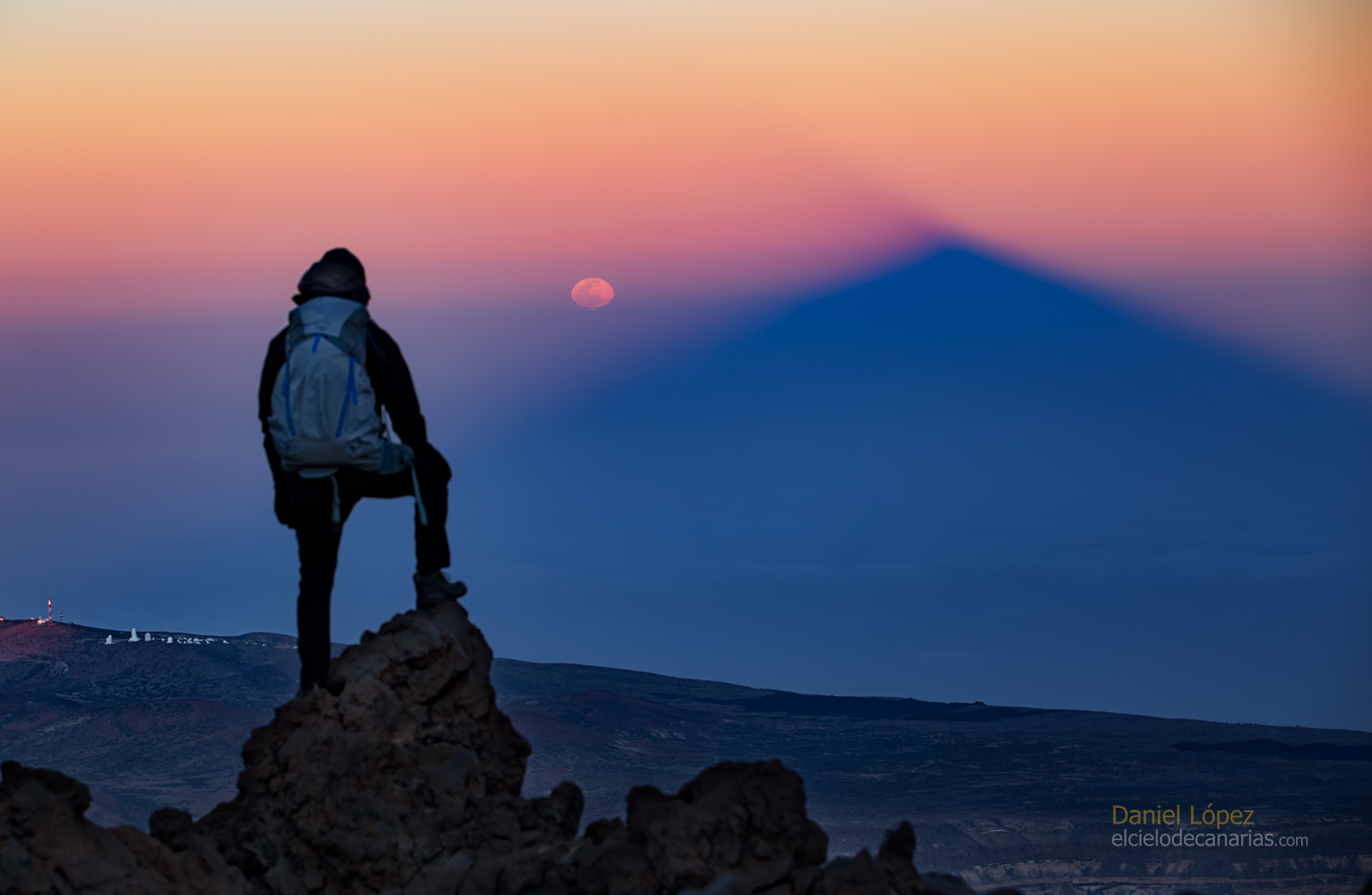
What phase of the Moon is 3.14 radians from the Sun? The Full Moon, of course. Even though the Moon might look full for several days, the Moon is truly at its full phase when it is Pi radians (aka 180 degrees) from the Sun in ecliptic longitude. That's opposite the Sun in planet Earth's sky. Rising as the Sun set on March 9, 2020, only an hour or so after the moment of its full phase, this orange tinted and slightly flattened Moon still looked full. It was photographed opposite the setting Sun from Teide National Park on the Canary Island of Tenerife. Also opposite the setting Sun, seen from near the Teide volcano peak about 3,500 meters above sea level, is the mountain's rising triangular shadow extending into Earth's dense atmosphere. Below the distant ridge line on the left are the white telescope domes of Teide Observatory. Again Pi radians from the Sun, on March 25 the Full Moon will dim slightly as it glides through Earth's outer shadow in a penumbral lunar eclipse.
Copyright: El Cielo de Canarias
The Seagull Nebula
13/03/2024
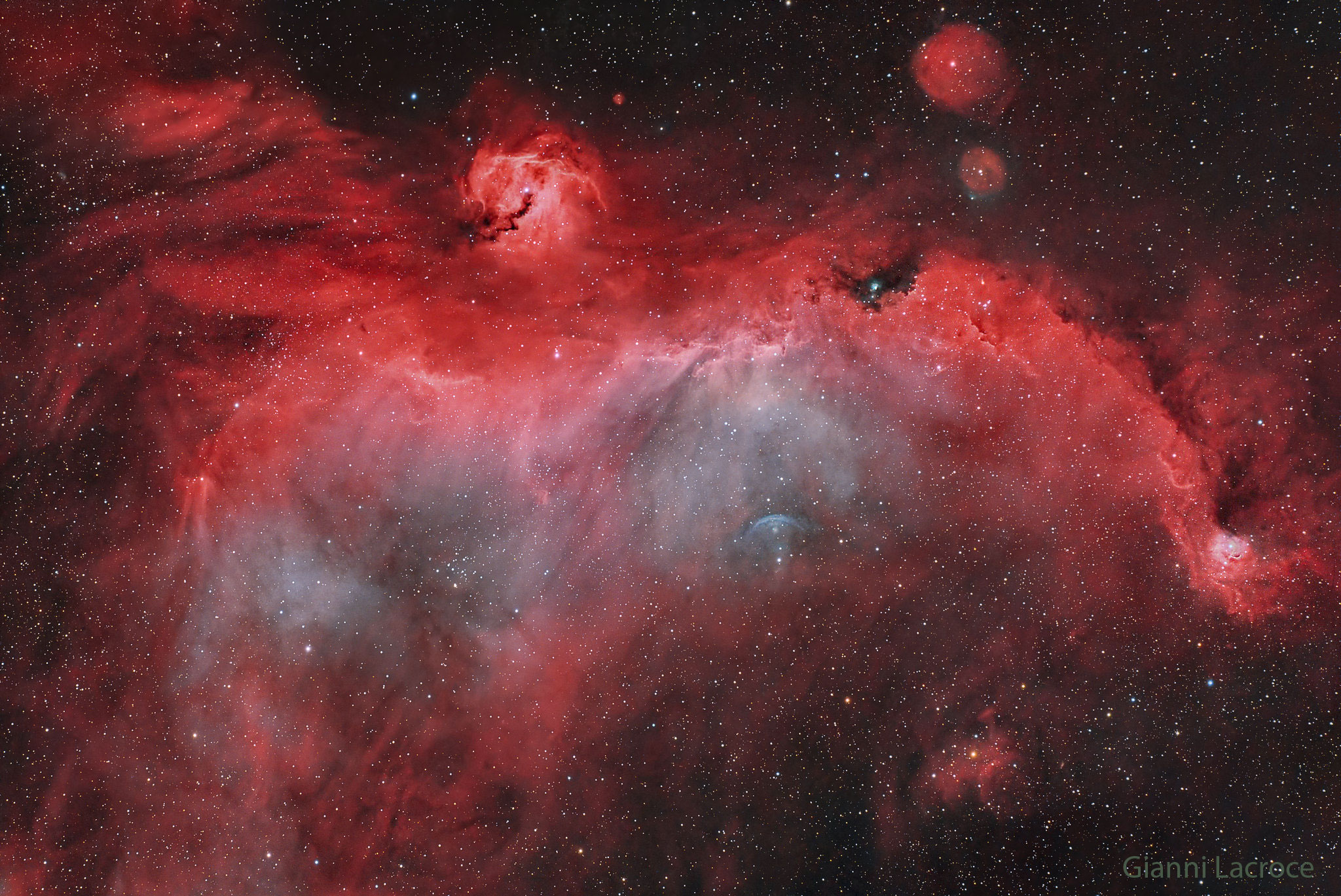
A broad expanse of glowing gas and dust presents a bird-like visage to astronomers from planet Earth, suggesting its popular moniker: the Seagull Nebula. This portrait of the cosmic bird covers a 2.5-degree wide swath across the plane of the Milky Way, near the direction of Sirius, alpha star of the constellation of the Big Dog (Canis Major). Of course, the region includes objects with other catalog designations: notably NGC 2327, a compact, dusty emission and reflection nebula with an embedded massive star that forms the bird's head. Likely part of a larger shell structure swept up by successive supernova explosions, the broad Seagull Nebula is cataloged as Sh2-296 and IC 2177. The prominent bluish arc below and right of center is a bow shock from runaway star FN Canis Majoris. Dominated by the reddish glow of atomic hydrogen, this complex of gas and dust clouds with other stars of the Canis Majoris OB1 association spans over 200 light-years at the Seagull Nebula's estimated 3,800 light-year distance. Almost Hyperspace: Random APOD Generator
Copyright: Gianni Lacroce
A Galaxy-Shaped Rocket Exhaust Spiral
12/03/2024
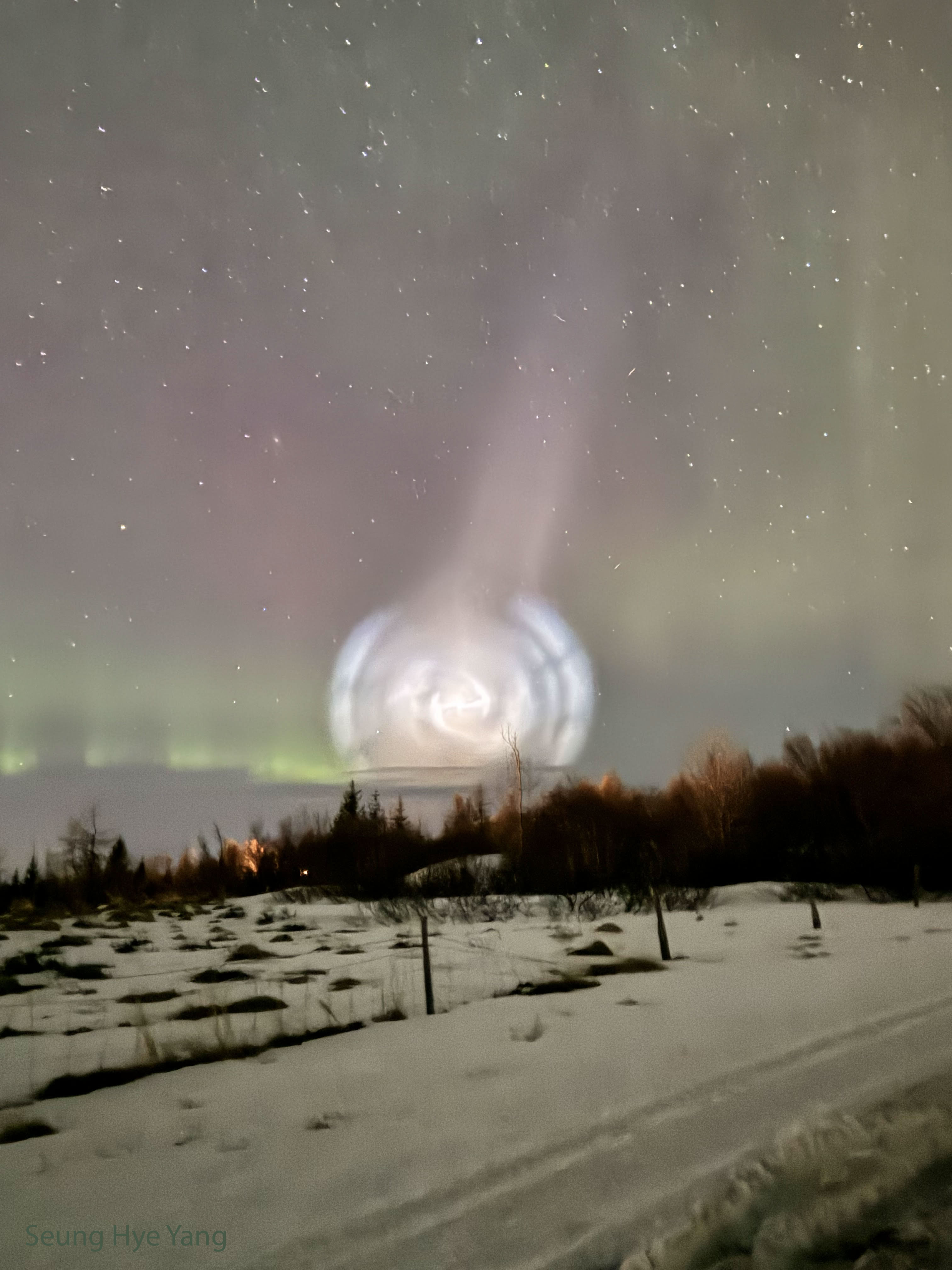
What's that over the horizon? What may look like a strangely nearby galaxy is actually a normal rocket's exhaust plume -- but unusually backlit. Although the SpaceX Falcon 9 rocket was launched from Vandenberg Space Force Base in California, USA, its burned propellant was visible over a much wider area, with the featured photograph being taken from Akureyri, Iceland. The huge spaceship was lifted off a week ago, and the resulting spectacle was captured soon afterward with a single 10-second smartphone exposure, before it quickly dissipated. Like noctilucent clouds, the plume's brightness is caused by the Twilight Effect, where an object is high enough to be illuminated by the twilight Sun, even when the observer on the ground experiences the darkness of night. The spiral shape is caused by the Falcon rocket reorienting to release satellites in different directions. Stars and faint green and red aurora appear in the background of this extraordinary image.
Copyright: Seung Hye Yang
Η Αστρονομική Εικόνα της Ημέρας από τη NASA (NASA Astronomy Picture of the Day) είναι μια δωρεάν υπηρεσία που παρέχει καθημερινά μια εντυπωσιακή εικόνα από το σύμπαν, την λήψη της οποίας έχει πραγματοποιήσει κάποιος από τους αστρονόμους της NASA ή από κάποιον από τους δορυφόρους ή τα τηλεσκόπια που η NASA λειτουργεί. Οι εικόνες που εμφανίζονται καλύπτουν μια ευρεία γκάμα από θέματα, συμπεριλαμβανομένων των αστερισμών, των γαλαξιών, των πλανητικών συστημάτων, των κομητών, των αστρικών σωμάτων και των παρατηρητηρίων. Κάθε εικόνα συνοδεύεται από μια σύντομη εξήγηση και πληροφορίες σχετικά με το τι παρατηρείται στην εικόνα.