Η Αστρονομική Εικόνα της Ημέρας από τη NASA
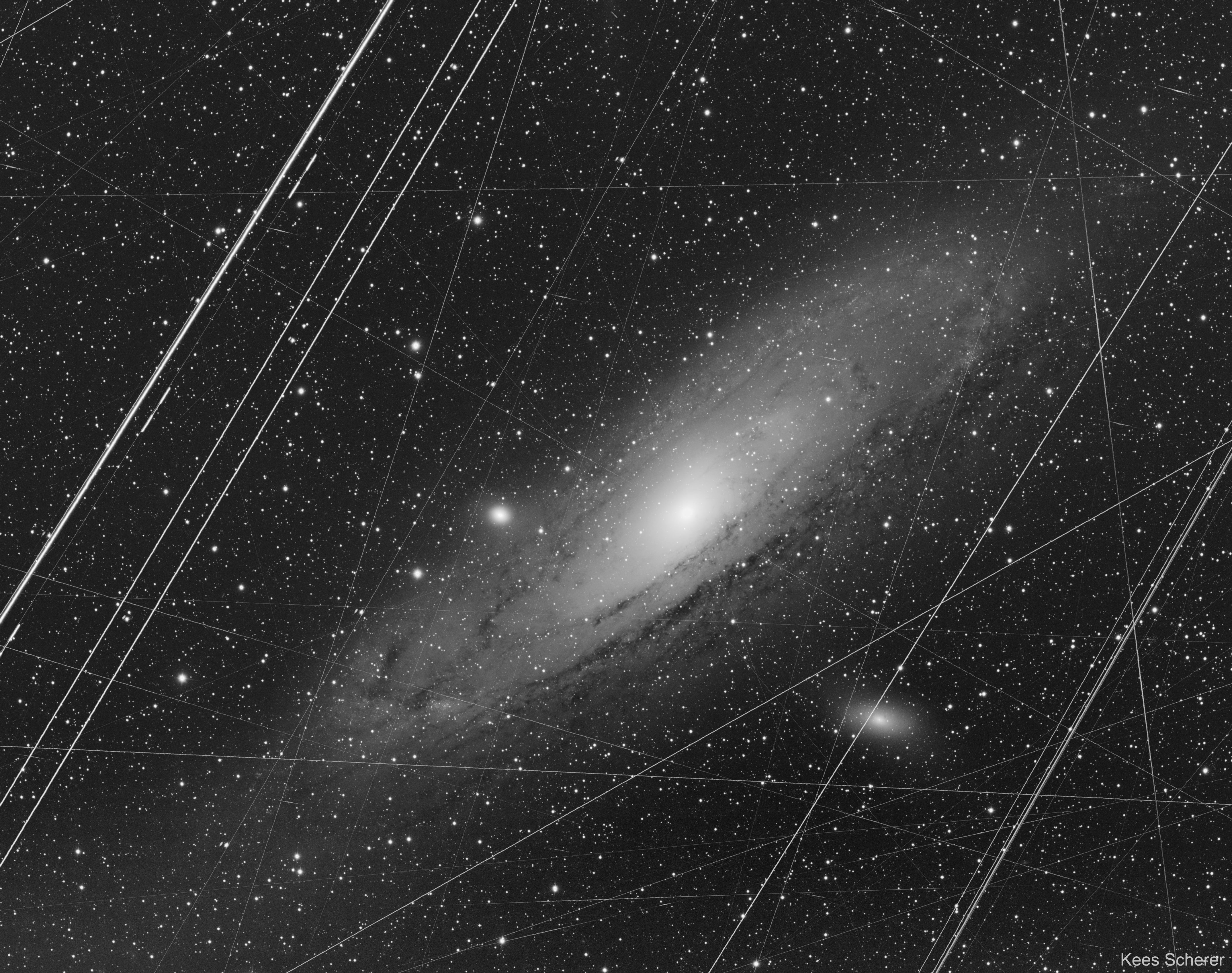
Andromeda before Photoshop
27/09/2026
What does the Andromeda galaxy really look like? The featured image shows how our Milky Way Galaxy's closest major galactic neighbor really appears in a long exposure through Earth's busy skies and with a digital camera that introduces normal imperfections. The picture is a stack of 223 images, each a 300 second exposure, taken from a garden observatory in Portugal during 2019. Obvious image deficiencies include bright parallel airplane trails, long and continuous satellite trails, short cosmic ray streaks, and bad pixels. These imperfections were actually not removed with Photoshop specifically, but rather greatly reduced with a series of computer software packages that included Astro Pixel Processor, DeepSkyStacker, and PixInsight. All of this work was done not to deceive you with a digital fantasy that has little to do with the real likeness of the Andromeda galaxy (M31), but to minimize Earthly artifacts that have nothing to do with the distant galaxy and so better recreate what M31 really does look like. APOD's email for image submissions has changed. Please see: APOD Submissions APOD's main NASA site is moving: From apod.nasa.gov to science.nasa.gov/apod
Copyright: NASA
Προηγούμενες Αστρονομικές Εικόνες της Ημέρας από τη NASA
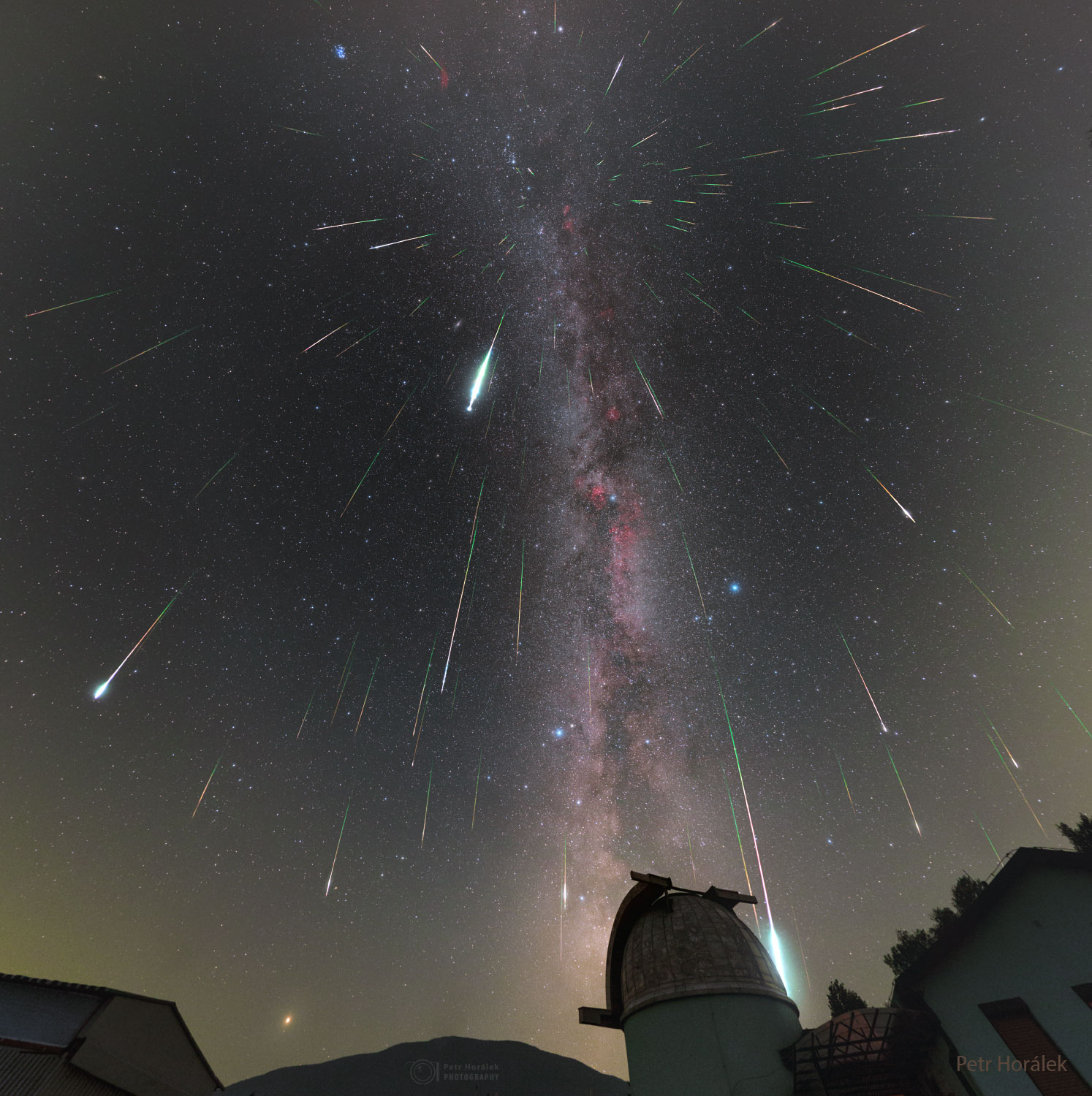
Meteor Shower: Perseids from Perseus
09/08/2023
This is a good week to see meteors. Comet dust will rain down on planet Earth, streaking through dark skies during peak nights of the annual Perseid Meteor Shower. The featured composite image was taken during the 2018 Perseids from the Poloniny Dark Sky Park in Slovakia. The dome of the observatory in the foreground is on the grounds of Kolonica Observatory. Although the comet dust particles travel parallel to each other, the resulting shower meteors clearly seem to radiate from a single point on the sky in the eponymous constellation Perseus. The radiant effect is due to perspective, as the parallel tracks appear to converge at a distance, like train tracks. The Perseid Meteor Shower is expected to reach its highest peak on Saturday after midnight. Since a crescent Moon will rise only very late that night, cloudless skies will be darker than usual, making a high number of faint meteors potentially visible this year.
Copyright: Petr Horálek / Institute of Physics in Opava
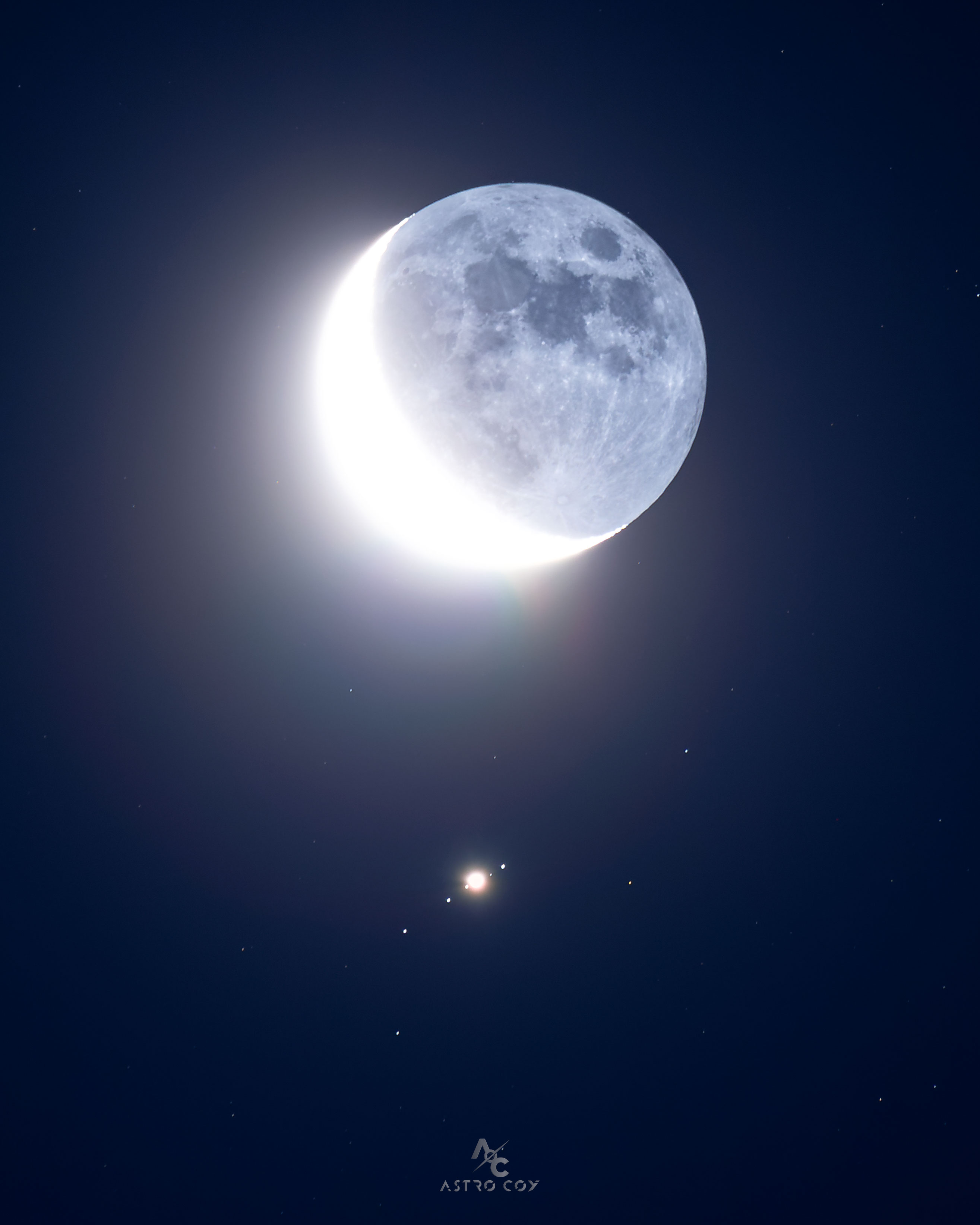
Moon Meets Jupiter
08/08/2023
What's that below the Moon? Jupiter -- and its largest moons. Many skygazers across planet Earth enjoyed the close conjunction of Earth's Moon passing nearly in front of Jupiter in mid-June. The featured image is a single exposure of the event taken from Morón de la Frontera, Spain. The sunlit lunar crescent on the left is overexposed, while the Moon's night side, on the right, is only faintly illuminated by Earthshine. Lined up diagonally below the Moon, left to right, are Jupiter's bright Galilean satellites: Callisto, Ganymede, Io (hard to see as it is very near to Jupiter), and Europa. In fact, Callisto, Ganymede, and Io are larger than Earth's Moon, while Europa is only slightly smaller. NASA's robotic spacecraft Juno is currently orbiting Jupiter and made a close pass near Io only a week ago. If you look up in the night sky tonight, you will again see two of the brightest objects angularly close together -- because tonight is another Moon-Jupiter conjunction.
Copyright: Jordi L. Coy
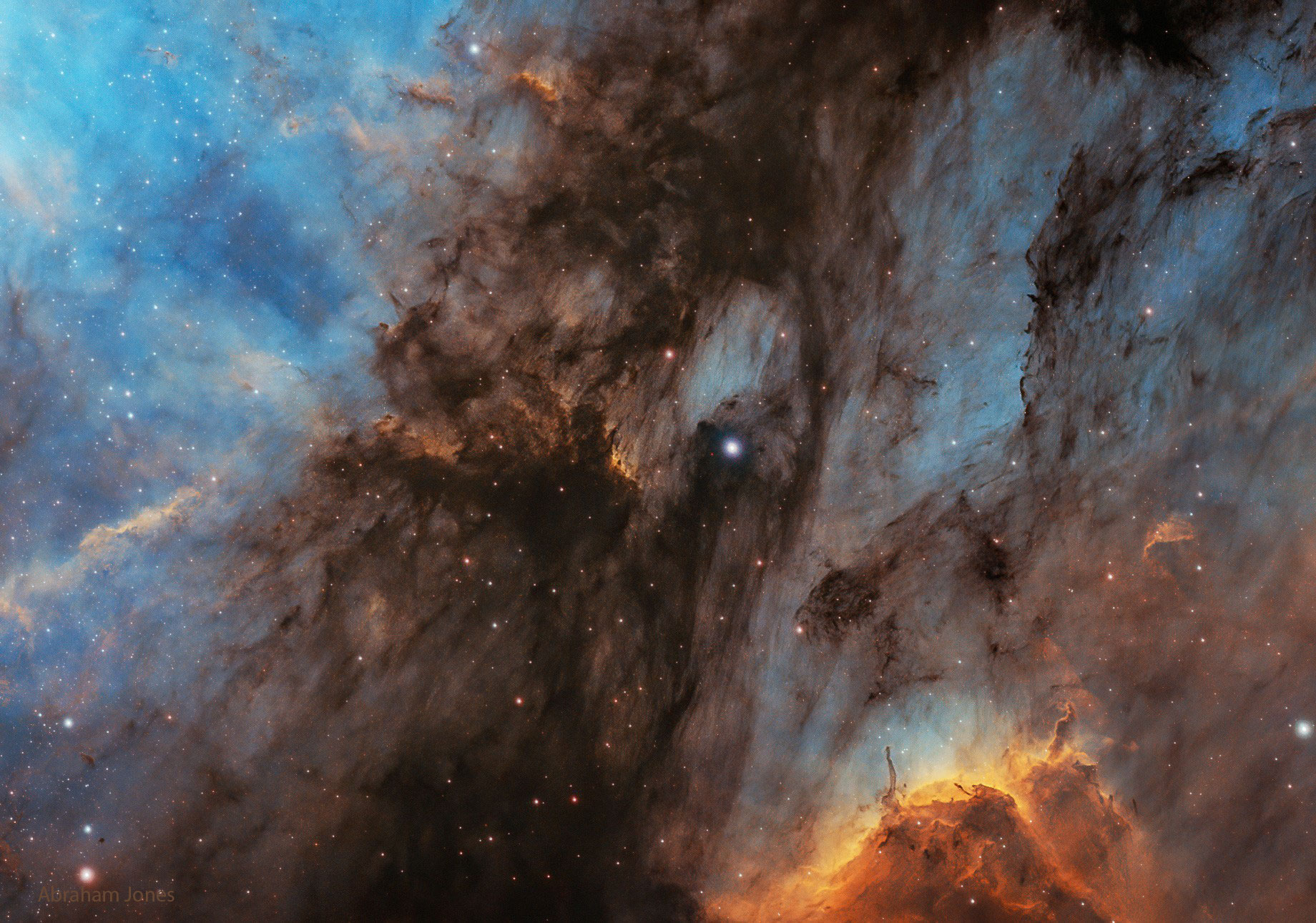
The Pelican Nebula in Gas, Dust, and Stars
07/08/2023
The Pelican Nebula is slowly being transformed. IC 5070 (the official designation) is divided from the larger North America Nebula by a molecular cloud filled with dark dust. The Pelican, however, receives much study because it is a particularly active mix of star formation and evolving gas clouds. The featured picture was produced in three specific colors -- light emitted by sulfur, hydrogen, and oxygen -- that can help us to better understand these interactions. The light from young energetic stars is slowly transforming the cold gas to hot gas, with the advancing boundary between the two, known as an ionization front, visible in bright orange on the right. Particularly dense tentacles of cold gas remain. Millions of years from now, the Pelican nebula, bounded by dark nebula LDN 935, might no longer be known as the Pelican, as the balance and placement of stars and gas will surely leave something that appears completely different.
Copyright: Abe Jones
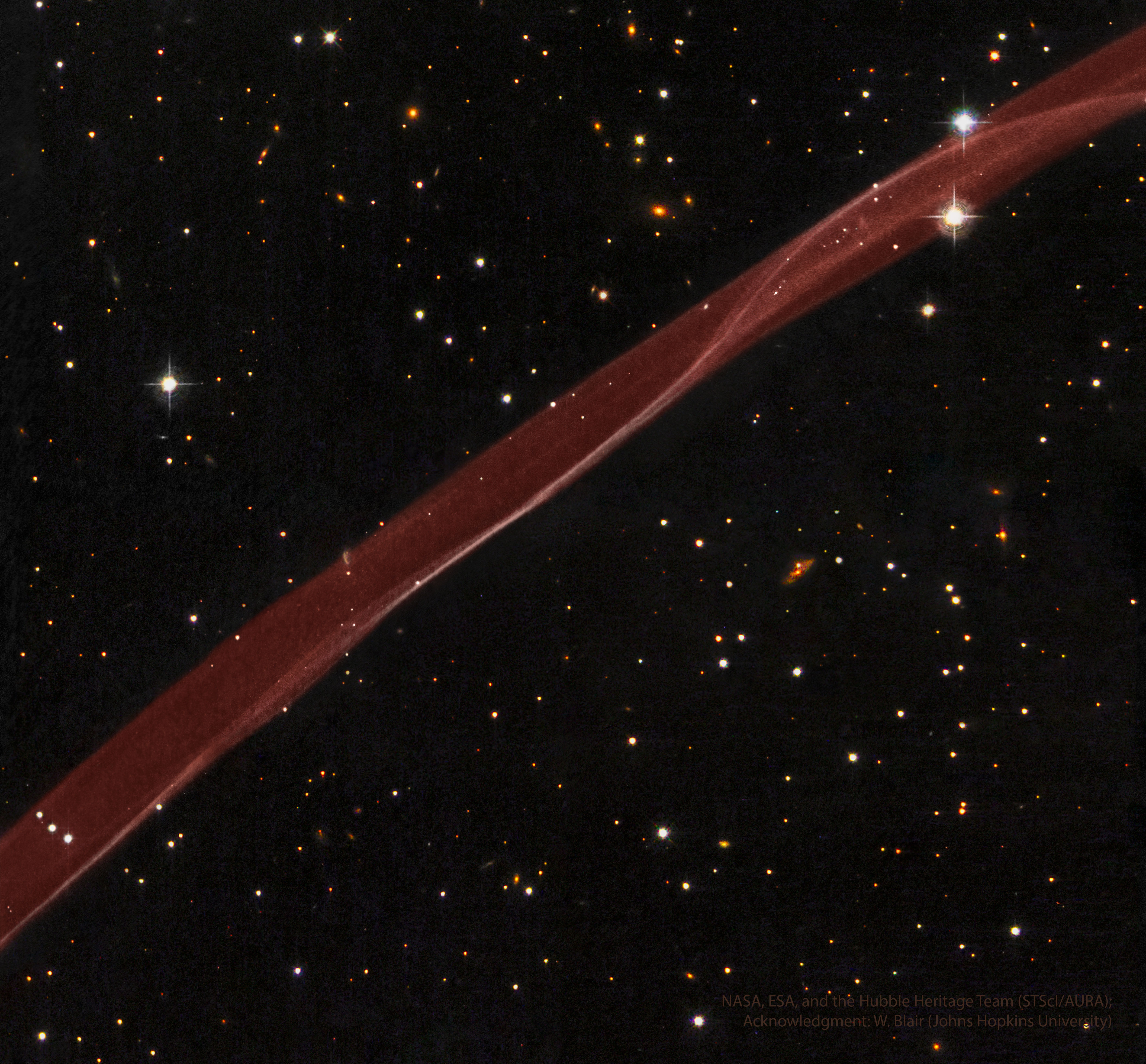
SN 1006: A Supernova Ribbon from Hubble
06/08/2023
What created this unusual space ribbon? The answer: one of the most violent explosions ever witnessed by ancient humans. Back in the year 1006 AD, light reached Earth from a stellar explosion in the constellation of the Wolf (Lupus), creating a "guest star" in the sky that appeared brighter than Venus and lasted for over two years. The supernova, now cataloged at SN 1006, occurred about 7,000 light years away and has left a large remnant that continues to expand and fade today. Pictured here is a small part of that expanding supernova remnant dominated by a thin and outwardly moving shock front that heats and ionizes surrounding ambient gas. The supernova remnant SN 1006 now has a diameter of nearly 60 light years.
Copyright: NASA
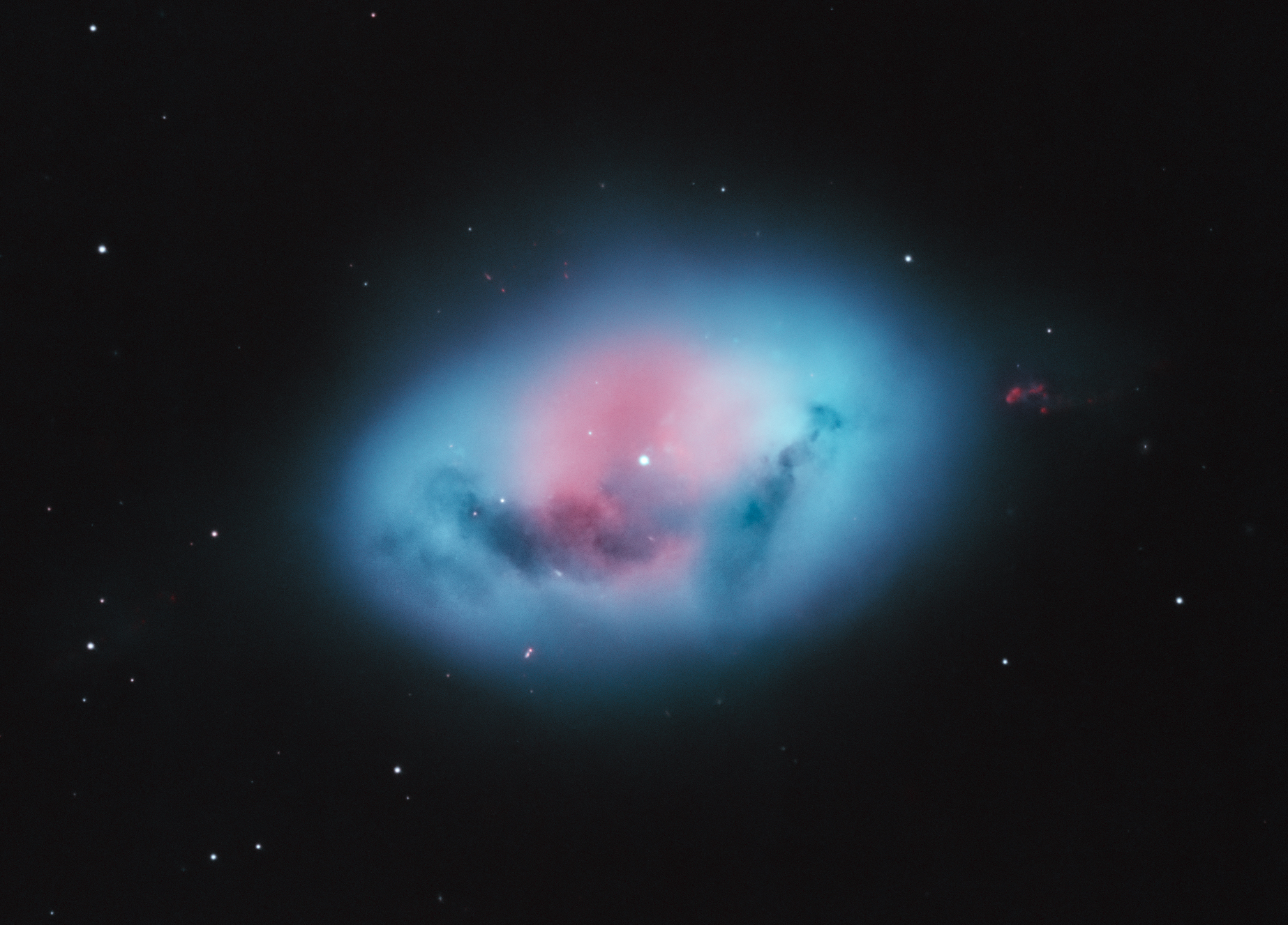
NGC 1360: The Robin's Egg Nebula
05/08/2023
This pretty nebula lies some 1,500 light-years away, its shape and color in this telescopic view reminiscent of a robin's egg. The cosmic cloud spans about 3 light-years, nestled securely within the boundaries of the southern constellation Fornax. Recognized as a planetary nebula, egg-shaped NGC 1360 doesn't represent a beginning though. Instead it corresponds to a brief and final phase in the evolution of an aging star. In fact, visible at the center of the nebula, the central star of NGC 1360 is known to be a binary star system likely consisting of two evolved white dwarf stars, less massive but much hotter than the Sun. Their intense and otherwise invisible ultraviolet radiation has stripped away electrons from the atoms in their mutually surrounding gaseous shroud. The predominant blue-green hue of NGC 1360 seen here is the strong emission produced as electrons recombine with doubly ionized oxygen atoms.
Copyright: Dong Liang
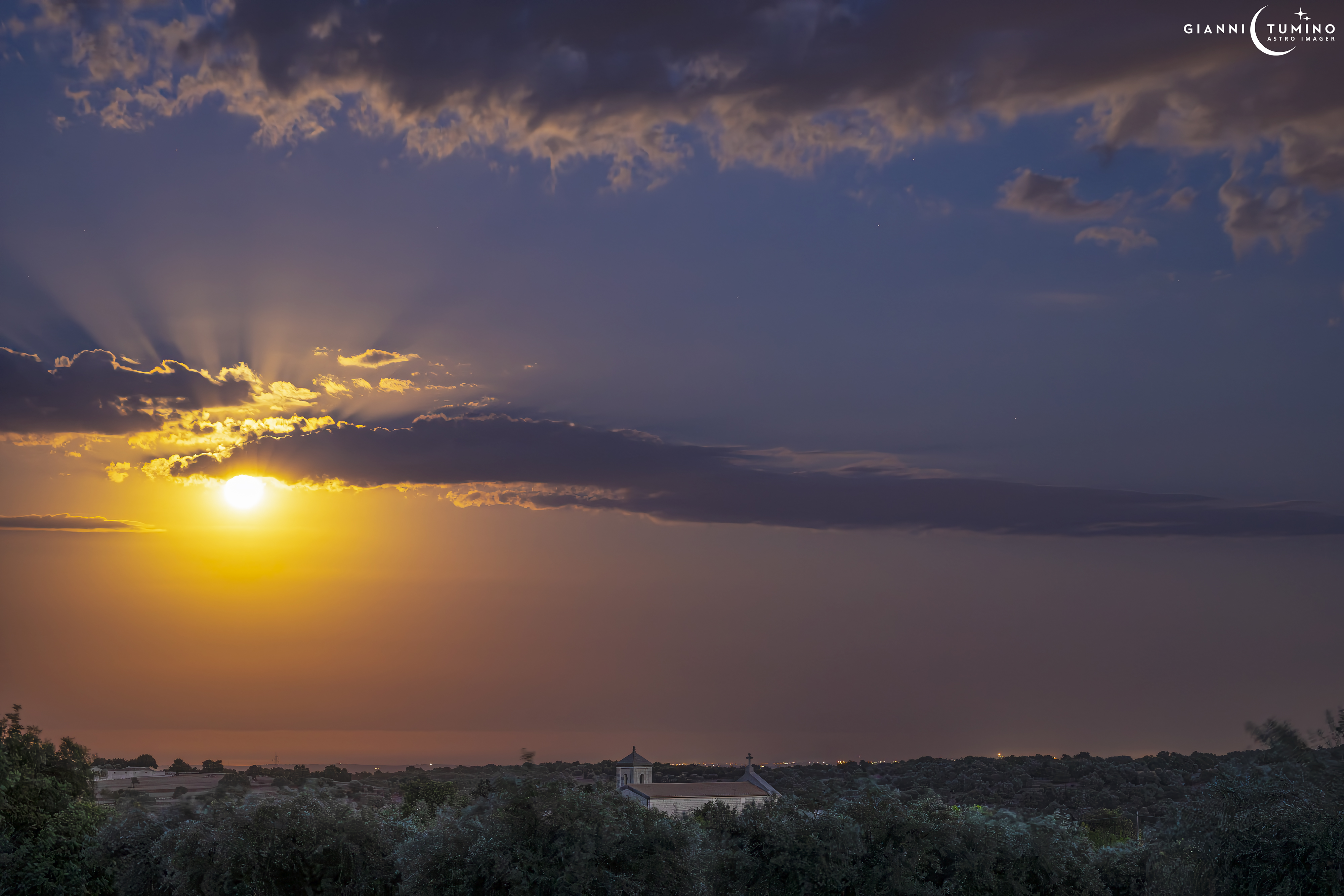
Moonrays of August
04/08/2023
A Full Moon rose as the Sun set on August 1. Near perigee, the closest point in its almost moonthly orbit, the brighter than average lunar disk illuminated night skies around planet Earth as the second supermoon of 2023. Seen here above Ragusa, Sicily, cloud banks cast diverging shadows through the supermoonlit skies, creating dramatic lunar crepuscular rays. The next Full Moon in 2023 will also shine on an August night. Rising as the Sun sets on August 30/31, this second Full Moon in a month is known as a Blue Moon. Blue moons occur only once every 2 or 3 years because lunar phases take almost a calendar month (29.5 days) to go through a complete cycle. But August's Blue Moon will also be near perigee, the third supermoon in 2023.
Copyright: Gianni Tumino
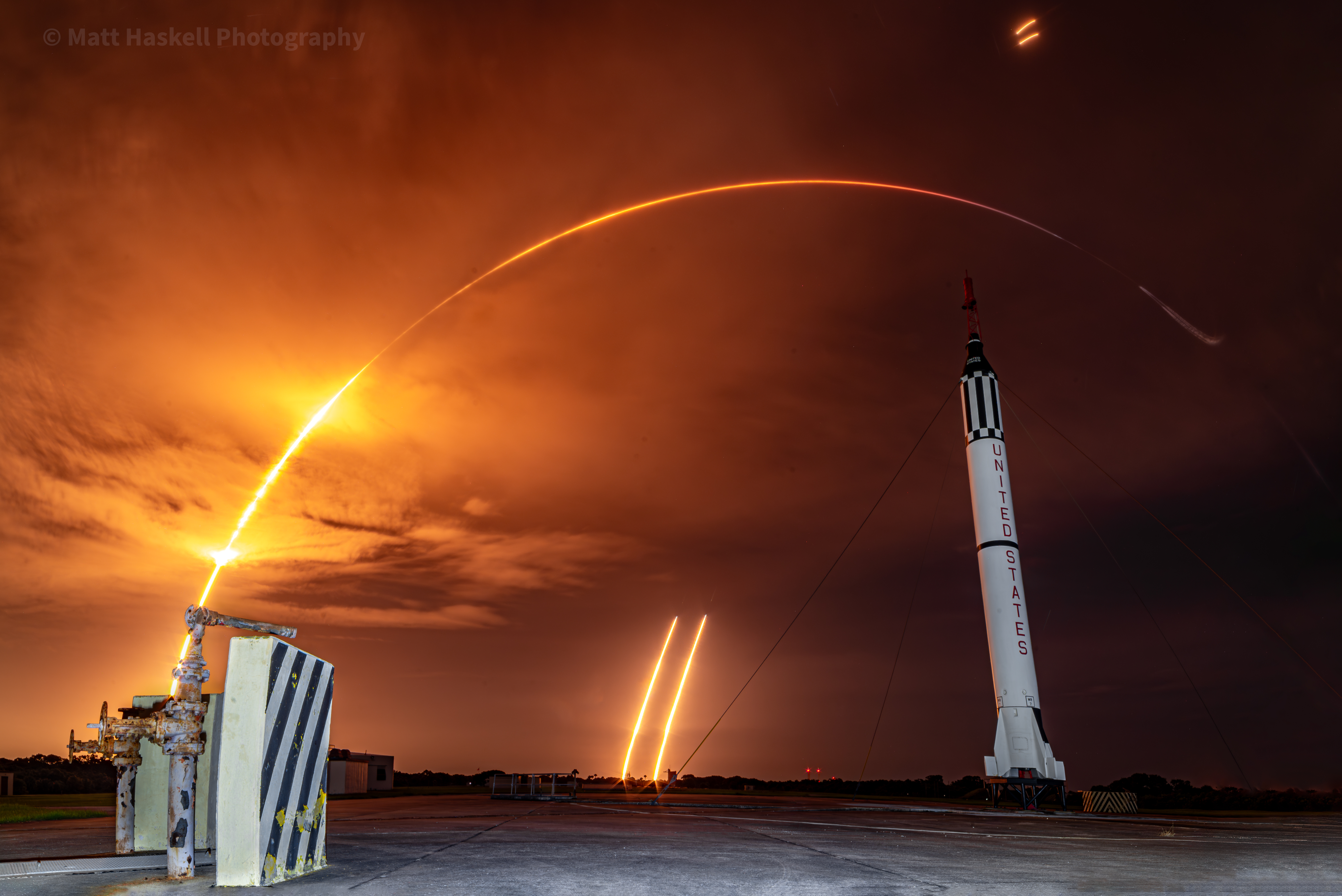
The Falcon and the Redstone
03/08/2023
In a photo from the early hours of July 29 (UTC), a Redstone rocket and Mercury capsule are on display at Cape Canaveral Launch Complex 5. Beyond the Redstone, the 8 minute long exposure has captured the arcing launch streak of a SpaceX Falcon Heavy rocket. The Falcon's heavy communications satellite payload, at a record setting 9 metric tons, is bound for geosynchronous orbit some 22,000 miles above planet Earth. The historic launch of a Redstone rocket carried astronaut Alan Shepard on a suborbital spaceflight in May 1961 to an altitude of about 116 miles. Near the top of the frame, this Falcon rocket's two reusable side boosters separate and execute brief entry burns. They returned to land side by side at Canaveral's Landing Zone 1 and 2 in the distance.
Copyright: Launch Complex 5

M82: Galaxy with a Supergalactic Wind
02/08/2023
Why is the Cigar Galaxy billowing red smoke? M82, as this starburst galaxy is also known, was stirred up by a recent pass near large spiral galaxy M81. This doesn't fully explain the source of the red-glowing outwardly expanding gas and dust, however. Evidence indicates that this gas and dust is being driven out by the combined emerging particle winds of many stars, together creating a galactic superwind. The dust particles are thought to originate in M82's interstellar medium and are actually similar in size to particles in cigar smoke. The featured photographic mosaic highlights a specific color of red light strongly emitted by ionized hydrogen gas, showing detailed filaments of this gas and dust. The filaments extend for over 10,000 light years. The 12-million light-year distant Cigar Galaxy is the brightest galaxy in the sky in infrared light and can be seen in visible light with a small telescope towards the constellation of the Great Bear (Ursa Major). APOD in world languages: Arabic, Bulgarian, Catalan, Chinese (Beijing), Chinese (Taiwan), Croatian, Czech, Dutch, French, German, Hebrew, Indonesian, Japanese, Montenegrin, Polish, Russian, Serbian, Slovenian, Spanish, Taiwanese, <a href="https://www.uzayd
Copyright: NASA
Η Αστρονομική Εικόνα της Ημέρας από τη NASA (NASA Astronomy Picture of the Day) είναι μια δωρεάν υπηρεσία που παρέχει καθημερινά μια εντυπωσιακή εικόνα από το σύμπαν, την λήψη της οποίας έχει πραγματοποιήσει κάποιος από τους αστρονόμους της NASA ή από κάποιον από τους δορυφόρους ή τα τηλεσκόπια που η NASA λειτουργεί. Οι εικόνες που εμφανίζονται καλύπτουν μια ευρεία γκάμα από θέματα, συμπεριλαμβανομένων των αστερισμών, των γαλαξιών, των πλανητικών συστημάτων, των κομητών, των αστρικών σωμάτων και των παρατηρητηρίων. Κάθε εικόνα συνοδεύεται από μια σύντομη εξήγηση και πληροφορίες σχετικά με το τι παρατηρείται στην εικόνα.