Η Αστρονομική Εικόνα της Ημέρας από τη NASA
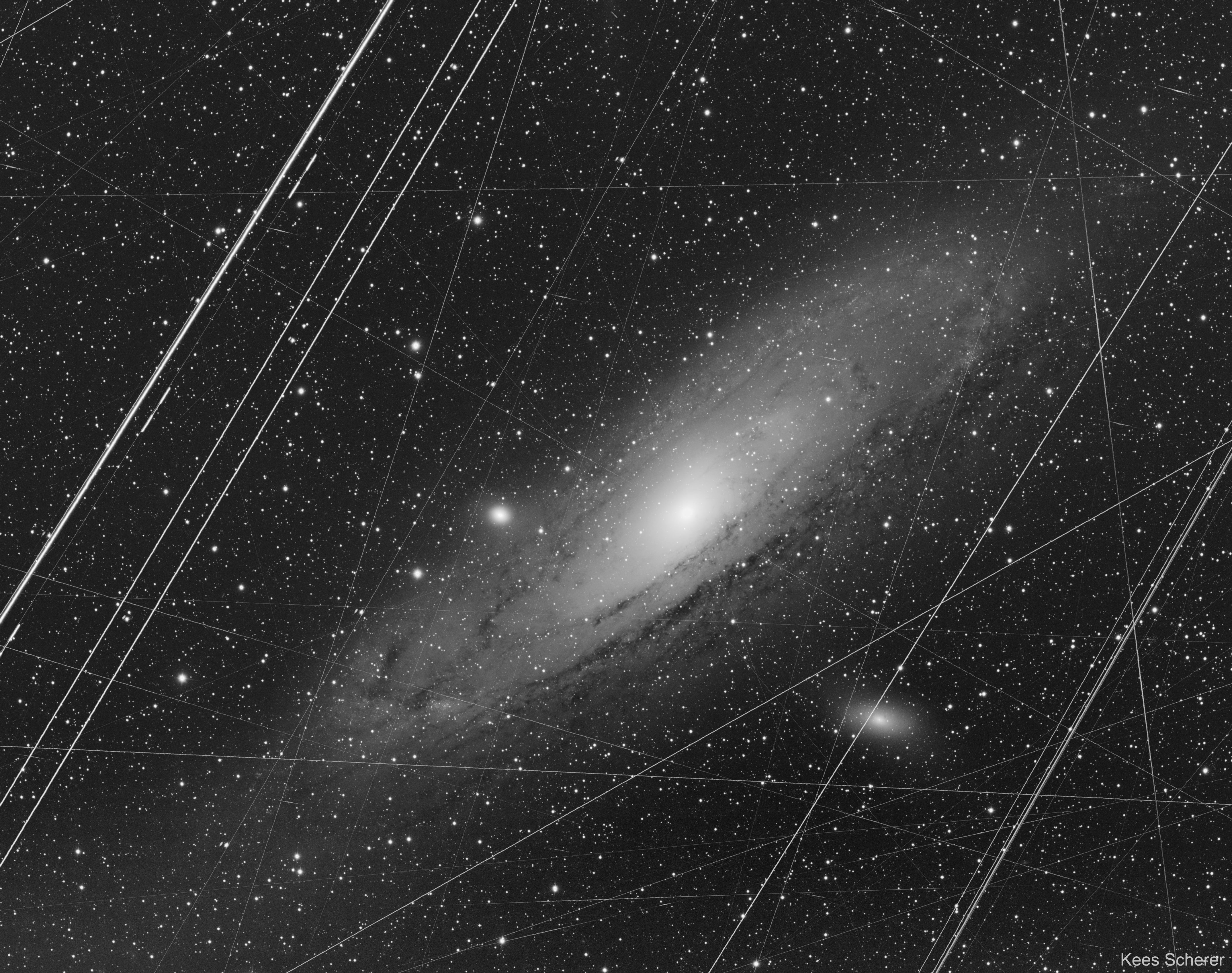
Andromeda before Photoshop
27/09/2026
What does the Andromeda galaxy really look like? The featured image shows how our Milky Way Galaxy's closest major galactic neighbor really appears in a long exposure through Earth's busy skies and with a digital camera that introduces normal imperfections. The picture is a stack of 223 images, each a 300 second exposure, taken from a garden observatory in Portugal during 2019. Obvious image deficiencies include bright parallel airplane trails, long and continuous satellite trails, short cosmic ray streaks, and bad pixels. These imperfections were actually not removed with Photoshop specifically, but rather greatly reduced with a series of computer software packages that included Astro Pixel Processor, DeepSkyStacker, and PixInsight. All of this work was done not to deceive you with a digital fantasy that has little to do with the real likeness of the Andromeda galaxy (M31), but to minimize Earthly artifacts that have nothing to do with the distant galaxy and so better recreate what M31 really does look like. APOD's email for image submissions has changed. Please see: APOD Submissions APOD's main NASA site is moving: From apod.nasa.gov to science.nasa.gov/apod
Copyright: NASA
Προηγούμενες Αστρονομικές Εικόνες της Ημέρας από τη NASA
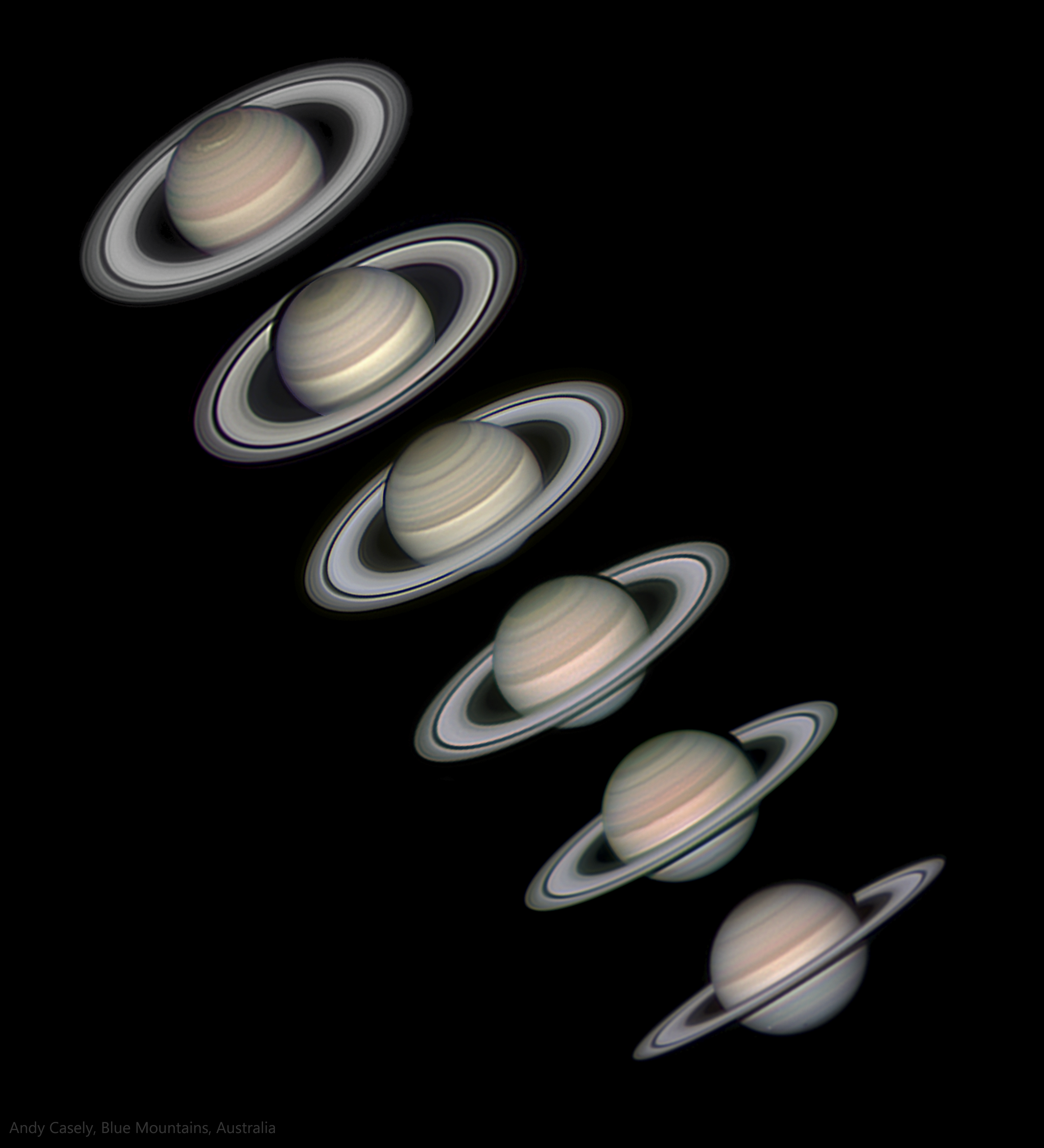
A Season of Saturn
25/08/2023
Ringed planet Saturn will be at its 2023 opposition, opposite the Sun in Earth's skies, on August 27. While that puts the sixth planet from the Sun at its brightest and well-placed for viewing, its beautiful ring system isn't visible to the unaided eye. Still, this sequence of six telescopic images taken a year apart follows both Saturn and rings as seen from inner planet Earth. The gas giant's ring plane tilts from most open in 2018 to approaching edge-on in 2023 (top to bottom). That's summer to nearly the autumn equinox for Saturn's northern hemisphere. In the sharp planetary portraits Saturn's northern hexagon and a large storm system are clearly visible in 2018. In 2023 ice moon Tethys is transiting, casting its shadow across southern hemisphere cloud bands while Saturn's cold blue south pole is emerging from almost a decade of winter darkness.
Copyright: Andy Casely
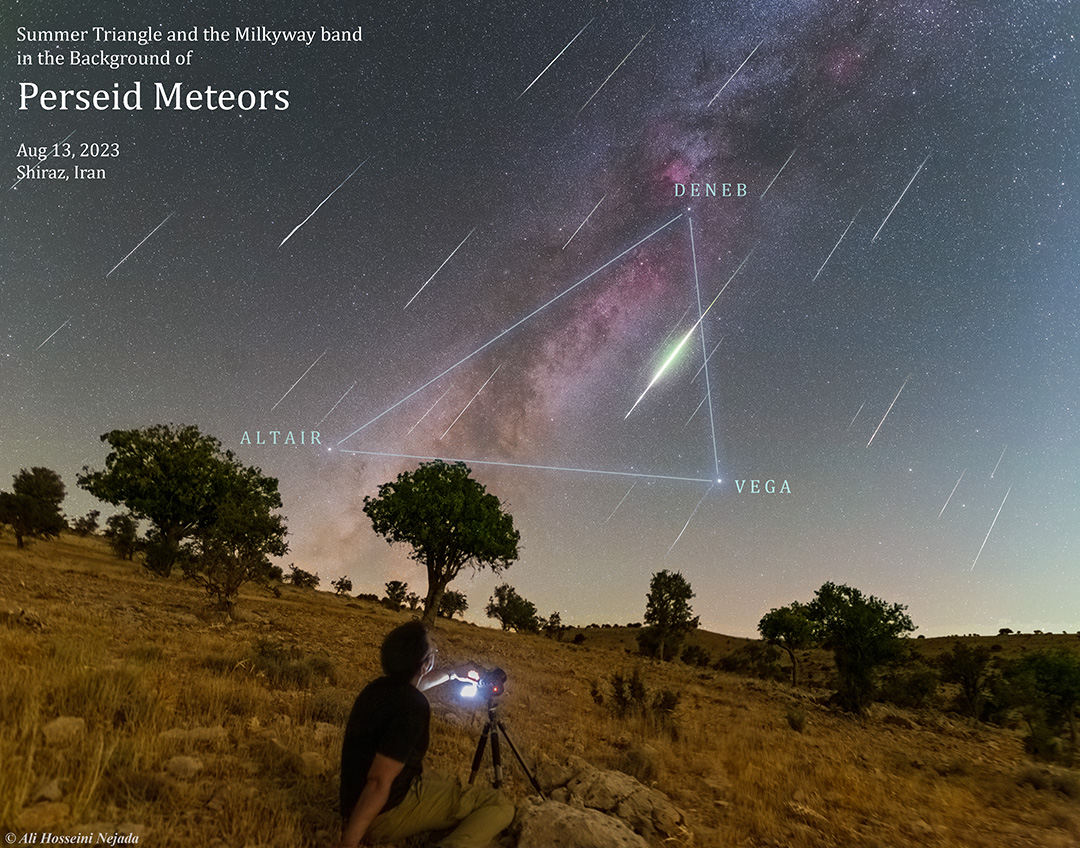
Meteors along the Milky Way
24/08/2023
Under dark and mostly moonless night skies, many denizens of planet Earth were able to watch this year's Perseid meteor shower. Seen from a grassy hillside from Shiraz, Iran these Perseid meteors streak along the northern summer Milky Way before dawn on Sunday, August 13. Frames used to construct the composited image were captured near the active annual meteor shower's peak between 02:00 AM and 04:30 AM local time. Not in this night skyscape, the shower's radiant in the heroic constellation Perseus is far above the camera's field of view. But fans of northern summer nights can still spot a familiar asterism. Formed by bright stars Deneb, Vega, and Altair, the Summer Triangle spans the luminous band of the Milky Way.
Copyright: Under dark
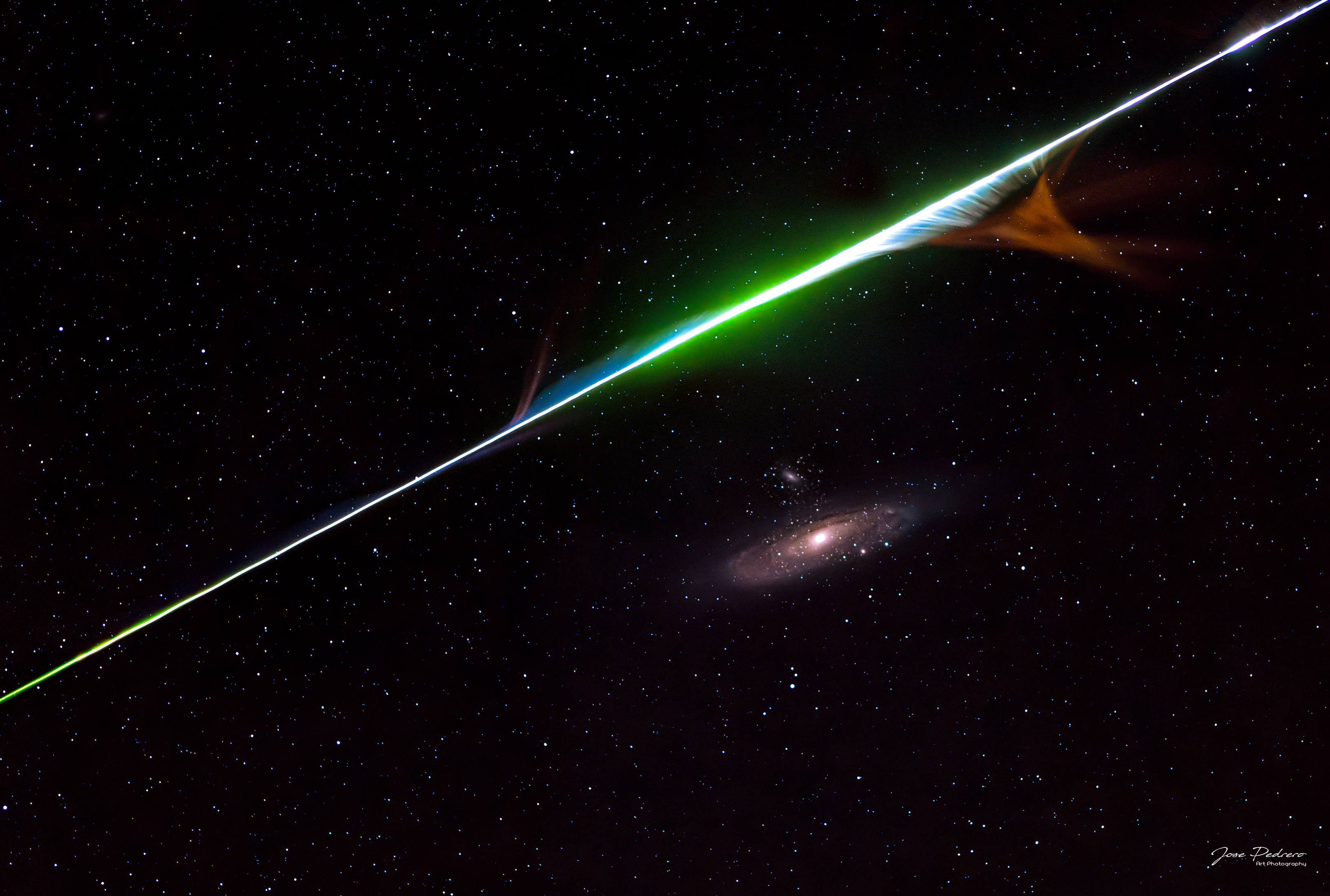
The Meteor and the Galaxy
23/08/2023
It came from outer space. It -- in this case a sand-sized bit of a comet nucleus -- was likely ejected many years ago from Sun-orbiting Comet Swift-Tuttle, but then continued to orbit the Sun alone. When the Earth crossed through this orbit, the piece of comet debris impacted the atmosphere of our fair planet and was seen as a meteor. This meteor deteriorated, causing gases to be emitted that glowed in colors emitted by its component elements. The featured image was taken last week from Castilla La Mancha, Spain, during the peak night of the Perseids meteor shower. The picturesque meteor streak happened to appear in the only one of 50 frames that also included the Andromeda galaxy. Stars dot the frame, each much further away than the meteor. Compared to the stars, the Andromeda galaxy (M31) is, again, much further away.
Copyright: Jose Pedrero
The Pistachio Nebula
22/08/2023
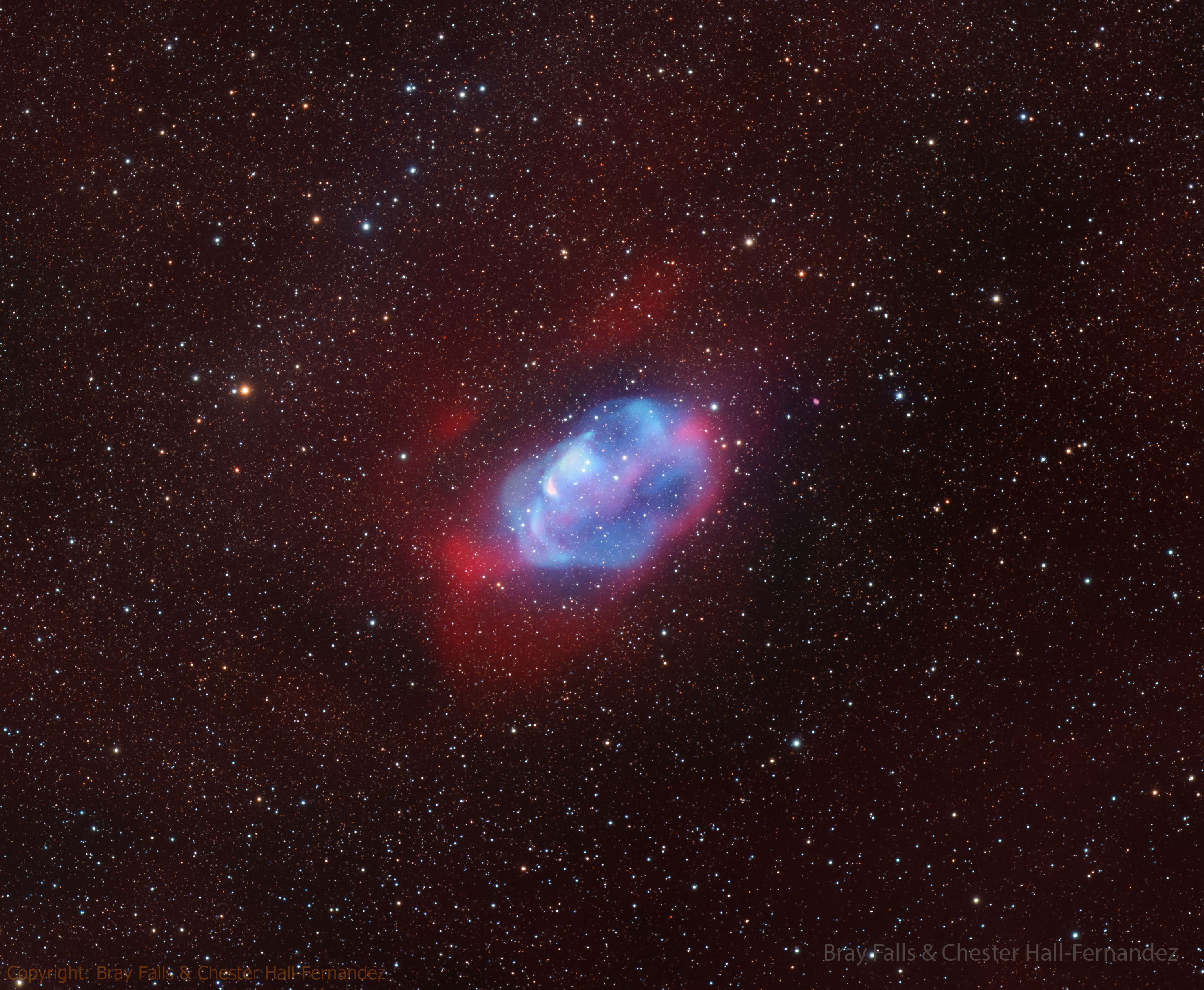
This nebula had never been noted before. Newly discovered nebulas are usually angularly small and found by professionals using large telescopes. In contrast, the Pistachio Nebula was discovered by dedicated amateurs and, although faint, is nearly the size of the full Moon. In modern times, amateurs with even small telescopes can create long exposures over sky areas much larger than most professional telescopes can see. They can therefore discover both previously unknown areas of extended emission around known objects, as well as entirely unknown objects, like nebulas. The pictured Pistachio Nebula is shown in oxygen emission (blue) and hydrogen emission (red). The nature of the hot central star is currently unknown, and the nebula might be labeled a planetary nebula if it turns out to be a white dwarf star. The featured image is a composite of over 70 hours of exposure taken in early June under the dark skies of Namibia.
Copyright: Bray Falls & Chester Hall-Fernandez
Introducing Comet Nishimura
21/08/2023
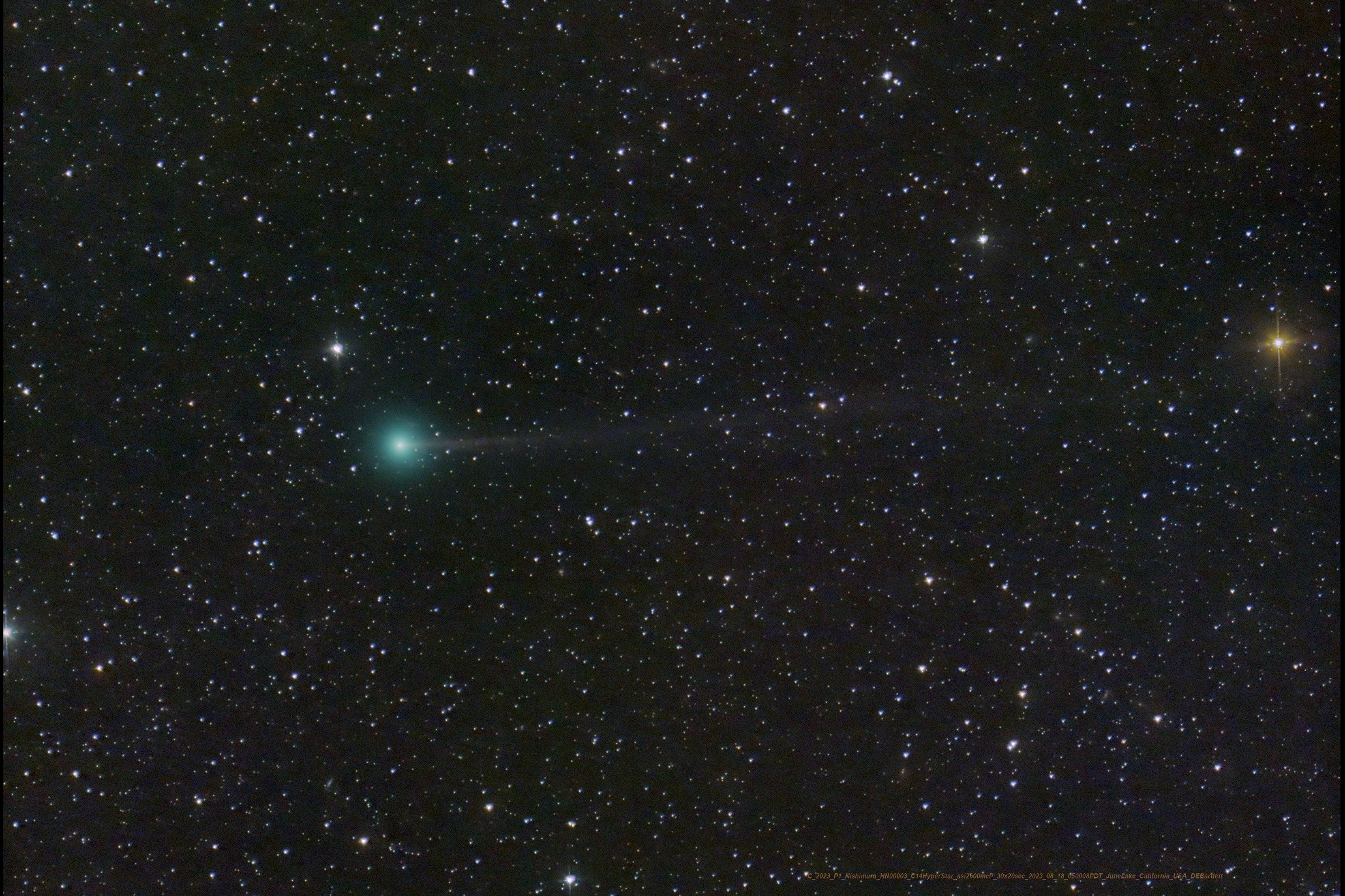
Will Comet Nishimura become visible to the unaided eye? Given the unpredictability of comets, no one can say for sure, but it currently seems like a good bet. The comet was discovered only ten days ago by Hideo Nishimura during 30-second exposures with a standard digital camera. Since then, C/2023 P1 Nishimura has increased in brightness and its path across the inner Solar System determined. As the comet dives toward the Sun, it will surely continue to intensify and possibly become a naked-eye object in early September. A problem is that the comet will also be angularly near the Sun, so it will only be possible to see it near sunset or sunrise. The comet will get so close to the Sun -- inside the orbit of planet Mercury -- that its nucleus may break up. Pictured, Comet Nishimura was imaged three days ago from June Lake, California, USA while sporting a green coma and a thin tail.
Copyright: Dan Bartlett
A Roll Cloud Over Wisconsin
20/08/2023
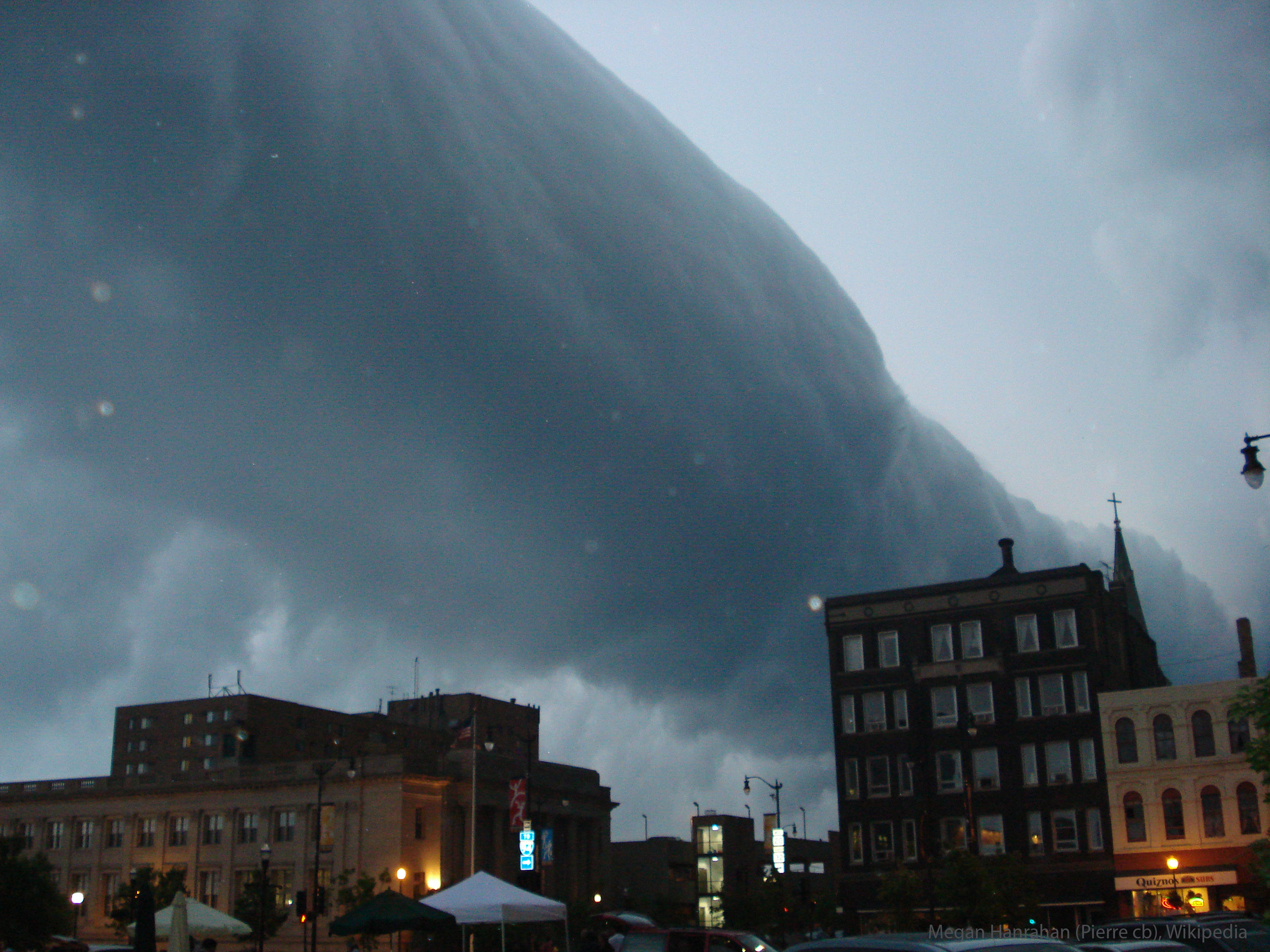
What kind of cloud is this? A type of arcus cloud called a roll cloud. These rare long clouds may form near advancing cold fronts. In particular, a downdraft from an advancing storm front can cause moist warm air to rise, cool below its dew point, and so form a cloud. When this happens uniformly along an extended front, a roll cloud may form. Roll clouds may actually have air circulating along the long horizontal axis of the cloud. A roll cloud is not thought to be able to morph into a tornado. Unlike a similar shelf cloud, a roll cloud is completely detached from their parent cumulonimbus cloud. Pictured here, a roll cloud extends far into the distance as a storm approaches in 2007 in Racine, Wisconsin, USA.
Copyright: NASA
Ringed Ice Giant Neptune
19/08/2023
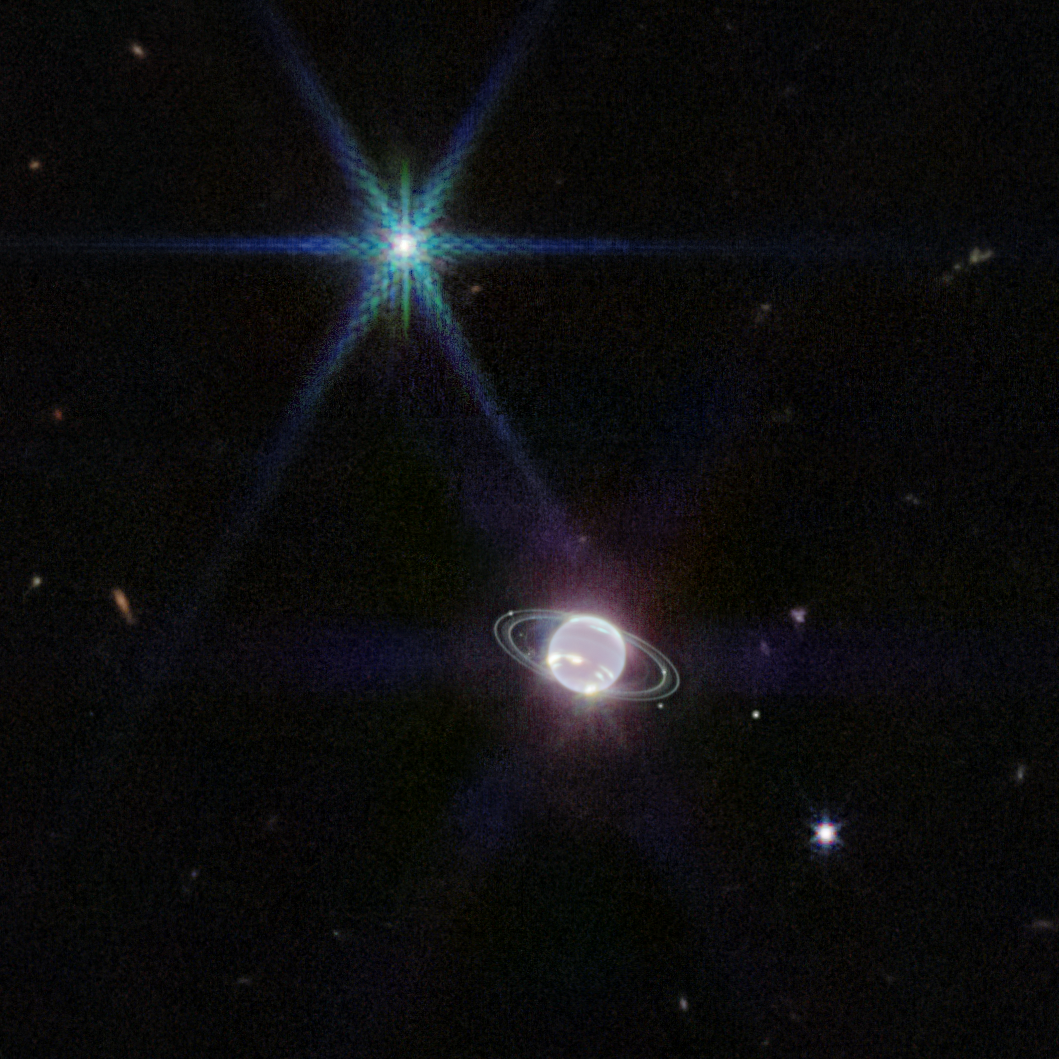
Ringed ice giant Neptune lies near the center of this sharp near-infrared image from the James Webb Space Telescope. The dim and distant world is the farthest planet from the Sun, about 30 times farther away than planet Earth. But in the stunning Webb view, the planet's dark and ghostly appearance is due to atmospheric methane that absorbs infrared light. High altitude clouds that reach above most of Neptune's absorbing methane easily stand out in the image though. Coated with frozen nitrogen, Neptune's largest moon Triton is brighter than Neptune in reflected sunlight, seen at the upper left sporting the Webb telescope's characteristic diffraction spikes. Including Triton, seven of Neptune's 14 known moons can be identified in the field of view. Neptune's faint rings are striking in this space-based planetary portrait. Details of the complex ring system are seen here for the first time since Neptune was visited by the Voyager 2 spacecraft in August 1989.
Copyright: NASA
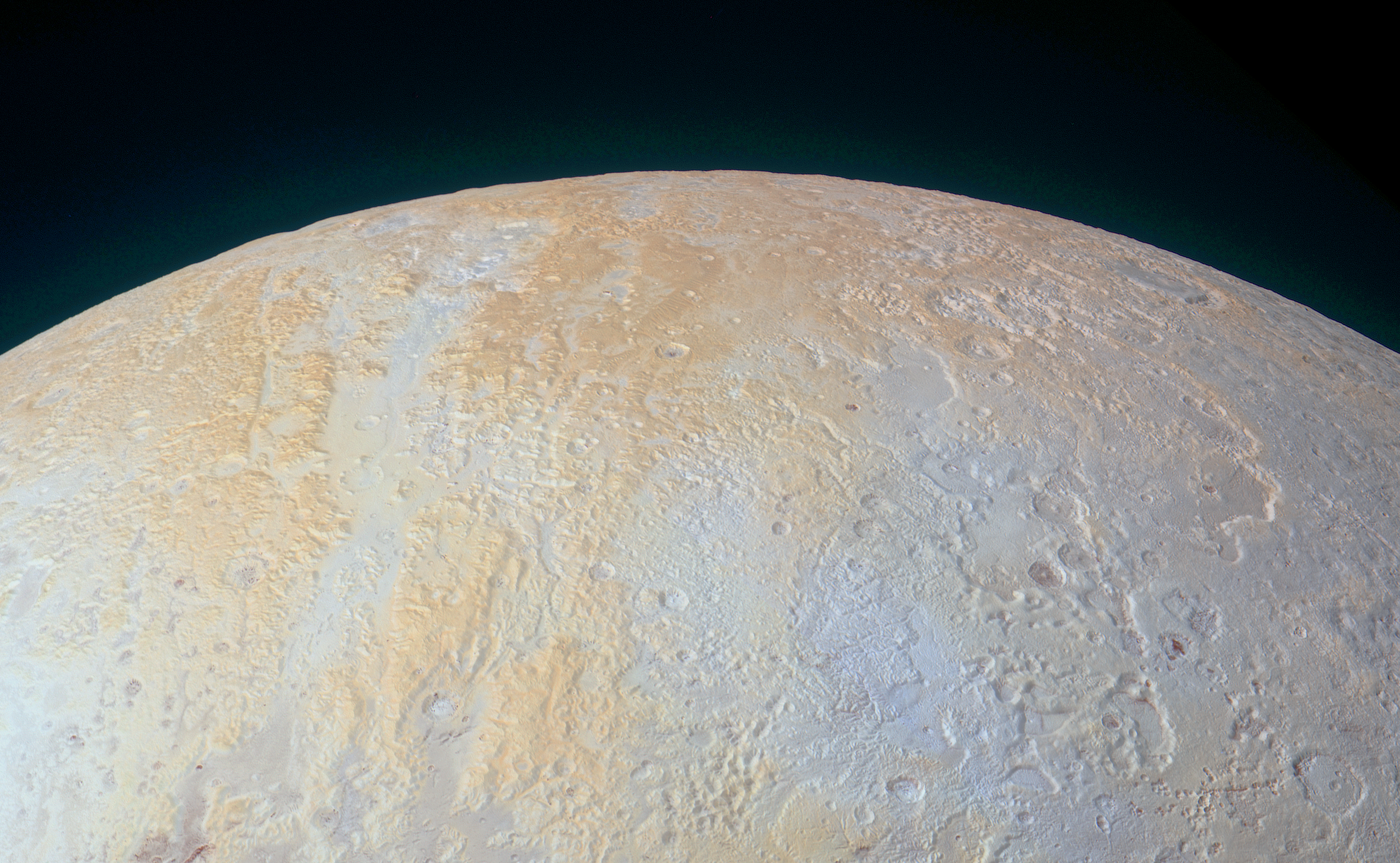
Northern Pluto
18/08/2023
Gaze across the frozen canyons of northern Pluto in this contrast enhanced color scene. The image data used to construct it was acquired in July 2015 by the New Horizons spacecraft as it made the first reconnaissance flight through the remote Pluto system six billion kilometers from the Sun. Now known as Lowell Regio, the region was named for Percival Lowell, founder of the Lowell Observatory. Also famous for his speculation that there were canals on Mars, Lowell started the search that ultimately led to Pluto's discovery in 1930 by Clyde Tombaugh. In this frame Pluto's North Pole is above and left of center. The pale bluish floor of the broad canyon on the left is about 70 kilometers (45 miles) wide, running vertically toward the south. Higher elevations take on a yellowish hue. New Horizon's measurements were used to determine that in addition to nitrogen ice, methane ice is abundant across Lowell Regio. So far, Pluto is the only Solar System world named by an 11-year-old girl.
Copyright: NASA
Η Αστρονομική Εικόνα της Ημέρας από τη NASA (NASA Astronomy Picture of the Day) είναι μια δωρεάν υπηρεσία που παρέχει καθημερινά μια εντυπωσιακή εικόνα από το σύμπαν, την λήψη της οποίας έχει πραγματοποιήσει κάποιος από τους αστρονόμους της NASA ή από κάποιον από τους δορυφόρους ή τα τηλεσκόπια που η NASA λειτουργεί. Οι εικόνες που εμφανίζονται καλύπτουν μια ευρεία γκάμα από θέματα, συμπεριλαμβανομένων των αστερισμών, των γαλαξιών, των πλανητικών συστημάτων, των κομητών, των αστρικών σωμάτων και των παρατηρητηρίων. Κάθε εικόνα συνοδεύεται από μια σύντομη εξήγηση και πληροφορίες σχετικά με το τι παρατηρείται στην εικόνα.