Η Αστρονομική Εικόνα της Ημέρας από τη NASA
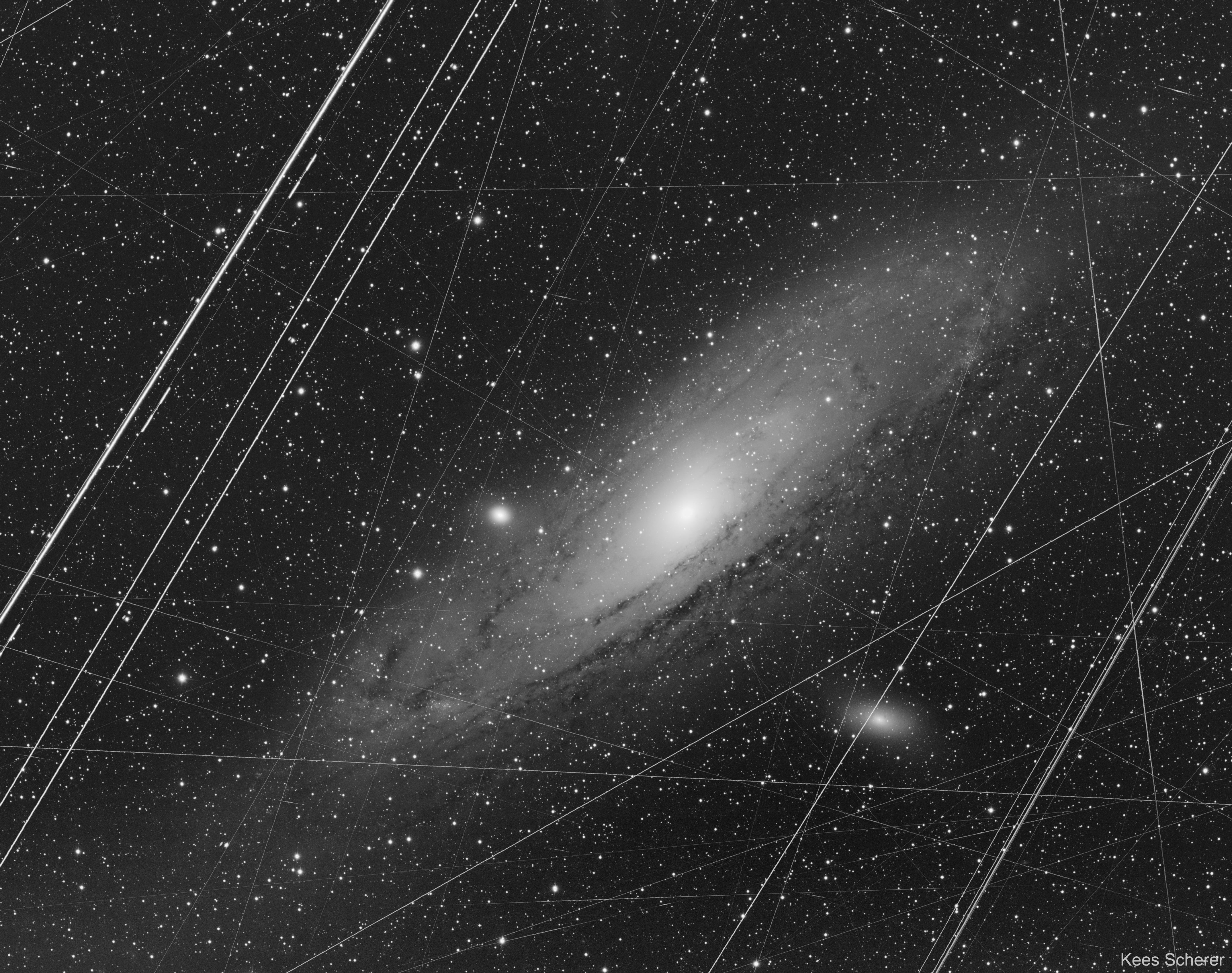
Andromeda before Photoshop
27/09/2026
What does the Andromeda galaxy really look like? The featured image shows how our Milky Way Galaxy's closest major galactic neighbor really appears in a long exposure through Earth's busy skies and with a digital camera that introduces normal imperfections. The picture is a stack of 223 images, each a 300 second exposure, taken from a garden observatory in Portugal during 2019. Obvious image deficiencies include bright parallel airplane trails, long and continuous satellite trails, short cosmic ray streaks, and bad pixels. These imperfections were actually not removed with Photoshop specifically, but rather greatly reduced with a series of computer software packages that included Astro Pixel Processor, DeepSkyStacker, and PixInsight. All of this work was done not to deceive you with a digital fantasy that has little to do with the real likeness of the Andromeda galaxy (M31), but to minimize Earthly artifacts that have nothing to do with the distant galaxy and so better recreate what M31 really does look like. APOD's email for image submissions has changed. Please see: APOD Submissions APOD's main NASA site is moving: From apod.nasa.gov to science.nasa.gov/apod
Copyright: NASA
Προηγούμενες Αστρονομικές Εικόνες της Ημέρας από τη NASA
IC 4592: The Blue Horsehead Reflection Nebula
26/09/2023
Do you see the horse's head? What you are seeing is not the famous Horsehead nebula toward Orion, but rather a fainter nebula that only takes on a familiar form with deeper imaging. The main part of the here-imaged molecular cloud complex is reflection nebula IC 4592. Reflection nebulas are made up of very fine dust that normally appears dark but can look quite blue when reflecting the visible light of energetic nearby stars. In this case, the source of much of the reflected light is a star at the eye of the horse. That star is part of Nu Scorpii, one of the brighter star systems toward the constellation of the Scorpion (Scorpius). A second reflection nebula dubbed IC 4601 is visible surrounding two stars above and to the right of the image center.
Copyright: Antoine & Dalia Grelin
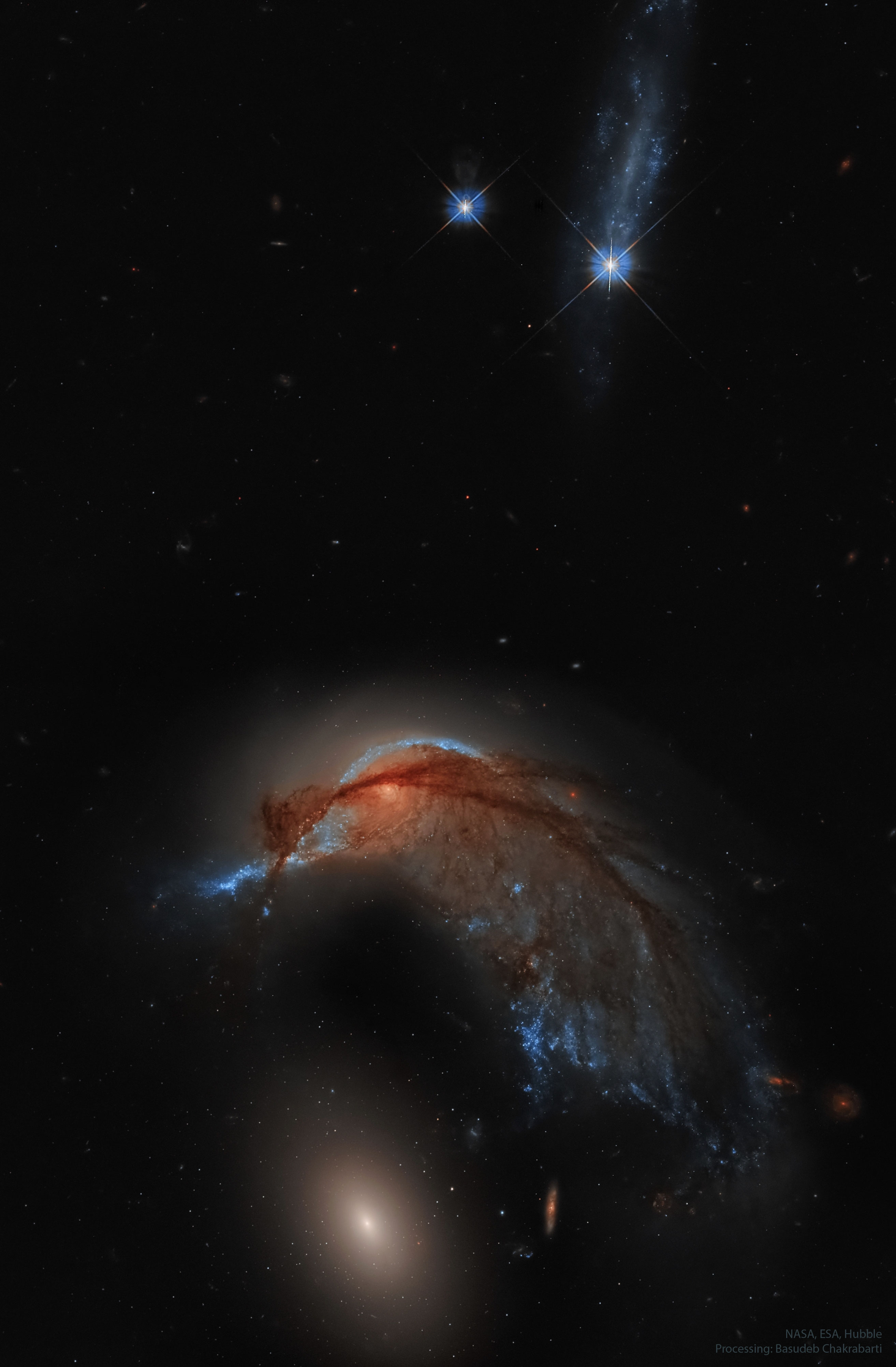
Arp 142: The Hummingbird Galaxy
25/09/2023
What's happening to this spiral galaxy? Just a few hundred million years ago, NGC 2936, the upper of the two large galaxies shown at the bottom, was likely a normal spiral galaxy -- spinning, creating stars -- and minding its own business. But then it got too close to the massive elliptical galaxy NGC 2937, just below, and took a turn. Sometimes dubbed the Hummingbird Galaxy for its iconic shape, NGC 2936 is not only being deflected but also being distorted by the close gravitational interaction. Behind filaments of dark interstellar dust, bright blue stars form the nose of the hummingbird, while the center of the spiral appears as an eye. Alternatively, the galaxy pair, together known as Arp 142, look to some like Porpoise or a penguin protecting an egg. The featured re-processed image showing Arp 142 in great detail was taken recently by the Hubble Space Telescope. Arp 142 lies about 300 million light years away toward the constellation of the Water Snake (Hydra). In a billion years or so the two galaxies will likely merge into one larger galaxy.
Copyright: NASA
A Ring of Fire Sunrise Solar Eclipse
24/09/2023
What's rising above the horizon behind those clouds? It's the Sun. Most sunrises don't look like this, though, because most sunrises don't include the Moon. In the early morning of 2013 May 10, however, from Western Australia, the Moon was between the Earth and the rising Sun. At times, it would be hard for the uninformed to understand what was happening. In an annular eclipse, the Moon is too far from the Earth to block the entire Sun, and at most leaves a ring of fire where sunlight pours out around every edge of the Moon. The featured time-lapse video also recorded the eclipse through the high refraction of the Earth's atmosphere just above the horizon, making the unusual rising Sun and Moon appear also flattened. As the video continues, the Sun continues to rise, while the Sun and Moon begin to separate. The next annular solar eclipse will occur in less than three weeks. On Saturday, October 14, a ring of fire will be visible through clear skies from a thin swath crossing both North and South America. Tour the Universe: Random APOD Generator
Copyright: NASA
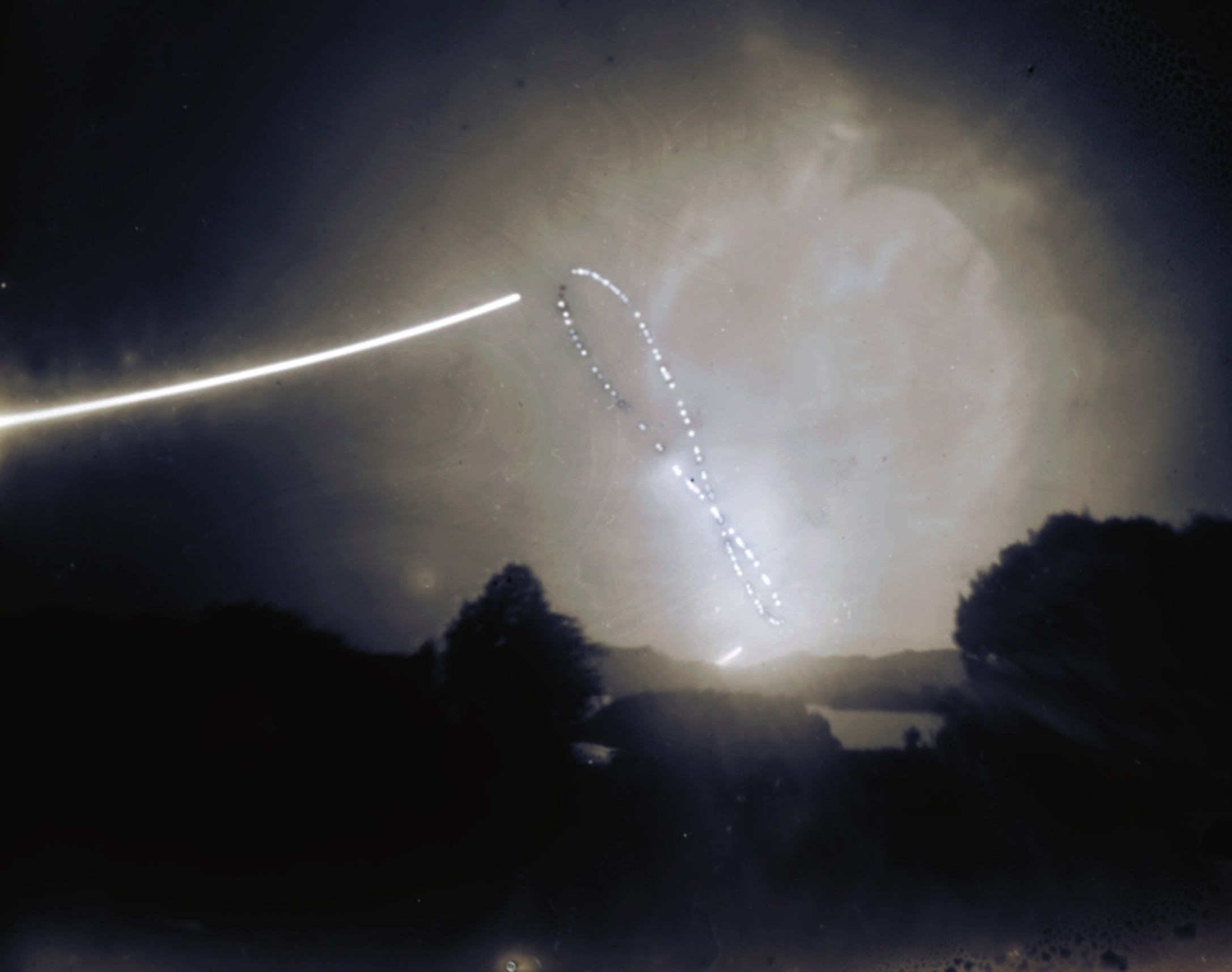
Afternoon Analemma
23/09/2023
An analemma is that figure-8 curve you get when you mark the position of the Sun at the same time each day for one year. To make this one, a 4x5 pinhole camera was set up looking north in southern New Zealand skies. The shutter was briefly opened each clear day in the afternoon at 4pm local time exposing the same photosensitized glass plate for the year spanning September 23, 2022 to September 19, 2023. On two days, the winter and summer solstices, the shutter was opened again 15 minutes after the main exposure and remained open until sunset to create the sun trails at the bottom and top of the curve. The equinox dates correspond to positions in the middle of the curve, not the crossover point. Of course, the curve itself is inverted compared to an analemma traced from the northern hemisphere. And while fall begins today at the Autumnal Equinox for the northern hemisphere, it's the Spring Equinox in the south.
Copyright: Ian Griffin
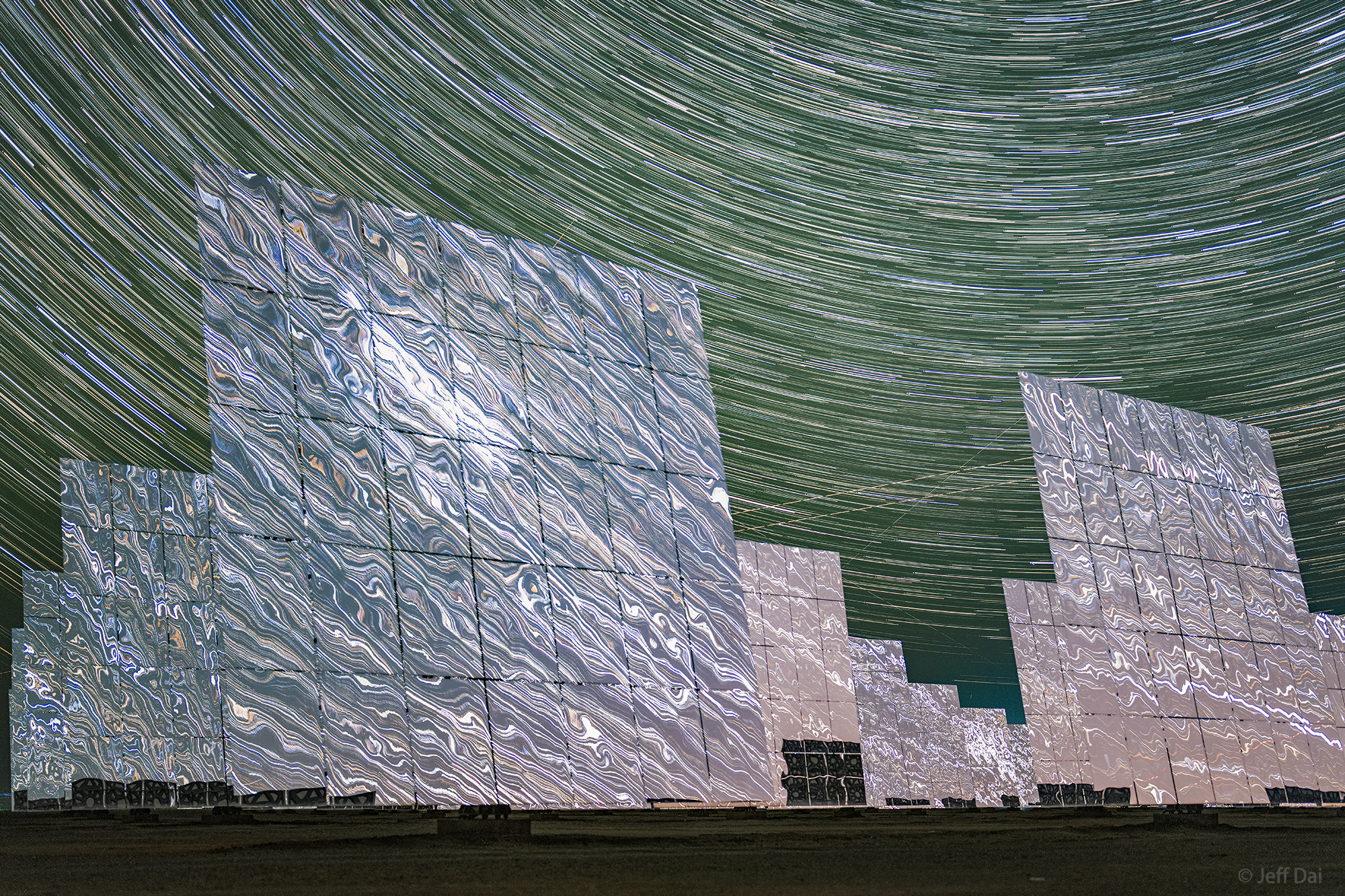
Cosmos in Reflection
22/09/2023
During the day, over 12,000 large mirrors reflect sunlight at the 100-megawatt, molten-salt, solar thermal power plant at the western edge of the Gobi desert near Dunhuang, Gansu Province, China. Individual mirror panels turn to track the sun like sunflowers. They conspire to act as a single super mirror reflecting the sunlight toward a fixed position, the power station's central tower. During the night the mirrors stand motionless though. They reflect the light of the countless distant stars, clusters and nebulae of the Milky Way and beyond. This sci-fi night skyscape was created with a camera fixed to a tripod near the edge of the giant mirror matrix on September 15. The camera's combined sequence of digital exposures captures concentric arcs of celestial star trails through the night with star trails in surreal mirrored reflection.
Copyright: Jeff Dai
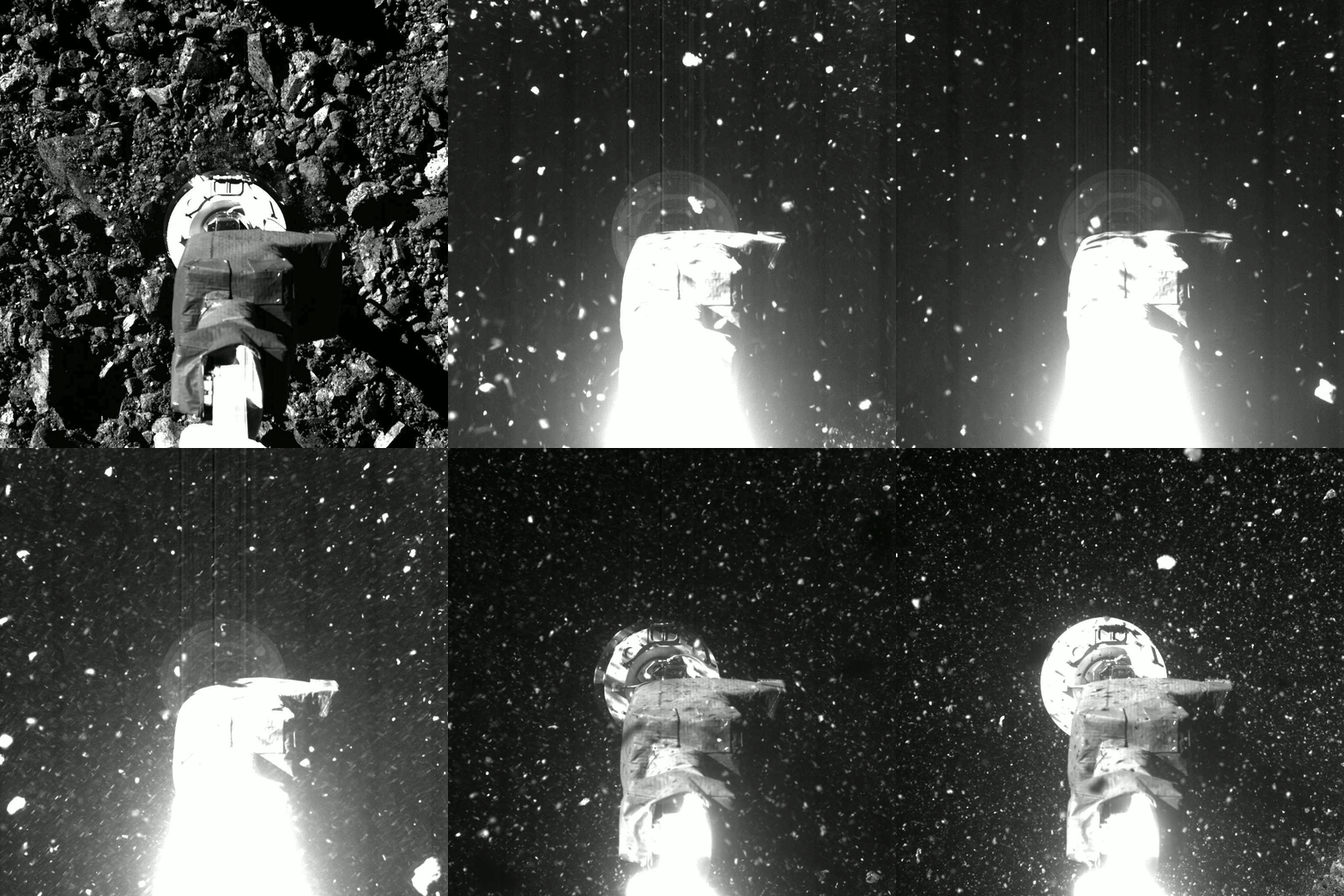
Tagging Bennu
21/09/2023
The OSIRIS-REx spacecraft's arm reached out and touched asteroid 101955 Bennu on October 20, 2020, after a careful approach to the small, near-Earth asteroid's boulder-strewn surface. Dubbed a Touch-And-Go (TAG) sampling event, the 30 centimeter wide sampling head (TAGSAM) appears to crush some of the rocks in this close-up recorded by the spacecraft's SamCam. The image was snapped just after surface contact some 321 million kilometers from planet Earth. One second later, the spacecraft fired nitrogen gas from a bottle to blow a substantial amount of Bennu's regolith into the sampling head, collecting the loose surface material. And now, nearly three years later, on Sunday, September 24, that sample of asteroid Bennu is scheduled to arrive on planet Earth. The sample return capsule will be dropped off by the OSIRIS-Rex spacecraft as it makes a close flyby of Earth. Twenty minutes after the drop-off, the spacecraft will fire its thrusters to divert past Earth and continue on to orbit near-Earth asteroid 99942 Apophis.
Copyright: NASA
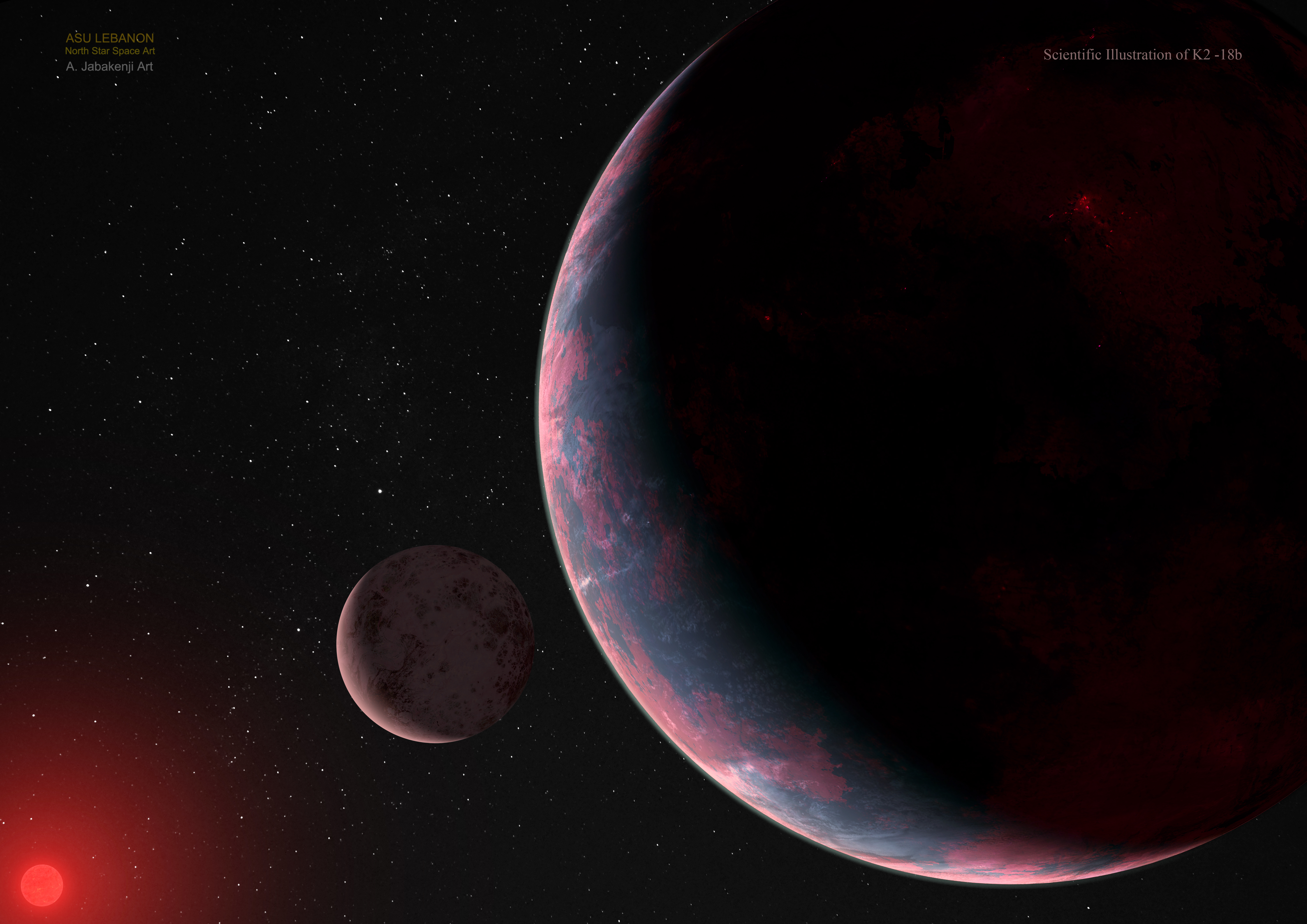
Methane Discovered on Distant Exoplanet
20/09/2023
Where else might life exist? One of humanity's great outstanding questions, locating planets where extrasolar life might survive took a step forward in 2019 with the discovery of a significant amount of water vapor in the atmosphere of distant exoplanet K2-18b. The planet and its parent star, K2-18, lie about 124 light years away toward the constellation of the Lion (Leo). The exoplanet is significantly larger and more massive than our Earth, but orbits in the habitable zone of its home star. K2-18, although more red than our Sun, shines in K2-18b's sky with a brightness similar to the Sun in Earth's sky. The 2019 discovery of atmospheric water was made in data from three space telescopes: Hubble, Spitzer, and Kepler, by noting the absorption of water-vapor colors when the planet moved in front of the star. Now in 2023, further observations by the Webb Space Telescope in infrared light have uncovered evidence of other life-indicating molecules -- including methane. The featured illustration imagines exoplanet K2-18b on the far right orbited by a moon (center), which together orbit a red dwarf star depicted on the lower left.
Copyright: NASA
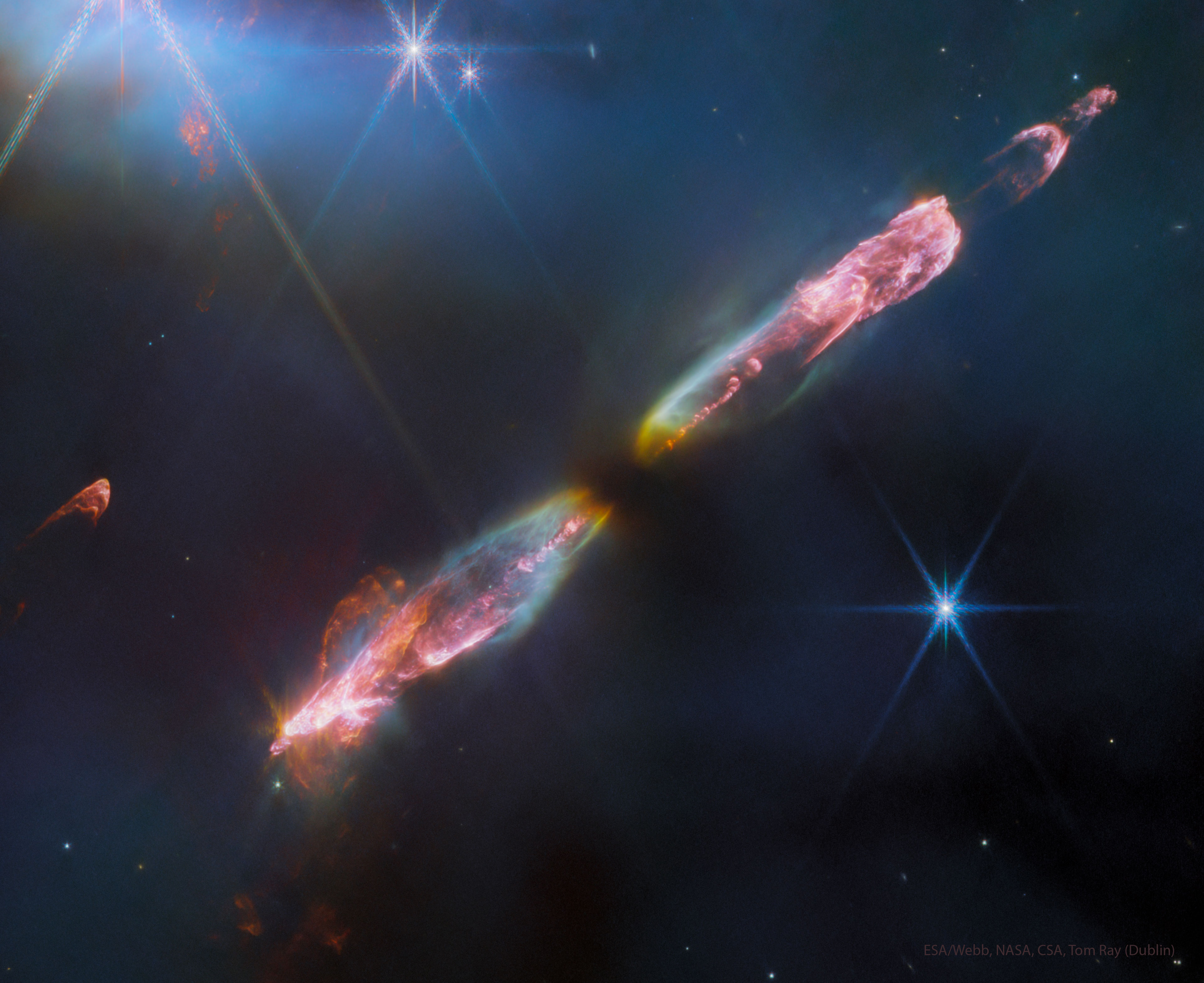
HH 211: Jets from a Forming Star
19/09/2023
Do stars always create jets as they form? No one is sure. As a gas cloud gravitationally contracts, it forms a disk that can spin too fast to continue contracting into a protostar. Theorists hypothesize that this spin can be reduced by expelling jets. This speculation coincides with known Herbig-Haro (HH) objects, young stellar objects seen to emit jets -- sometimes in spectacular fashion. Pictured is Herbig-Haro 211, a young star in formation recently imaged by the Webb Space Telescope (JWST) in infrared light and in great detail. Along with the two narrow beams of particles, red shock waves can be seen as the outflows impact existing interstellar gas. The jets of HH 221 will likely change shape as they brighten and fade over the next 100,000 years, as research into the details of star formation continues.
Copyright: NASA
Η Αστρονομική Εικόνα της Ημέρας από τη NASA (NASA Astronomy Picture of the Day) είναι μια δωρεάν υπηρεσία που παρέχει καθημερινά μια εντυπωσιακή εικόνα από το σύμπαν, την λήψη της οποίας έχει πραγματοποιήσει κάποιος από τους αστρονόμους της NASA ή από κάποιον από τους δορυφόρους ή τα τηλεσκόπια που η NASA λειτουργεί. Οι εικόνες που εμφανίζονται καλύπτουν μια ευρεία γκάμα από θέματα, συμπεριλαμβανομένων των αστερισμών, των γαλαξιών, των πλανητικών συστημάτων, των κομητών, των αστρικών σωμάτων και των παρατηρητηρίων. Κάθε εικόνα συνοδεύεται από μια σύντομη εξήγηση και πληροφορίες σχετικά με το τι παρατηρείται στην εικόνα.