Η Αστρονομική Εικόνα της Ημέρας από τη NASA
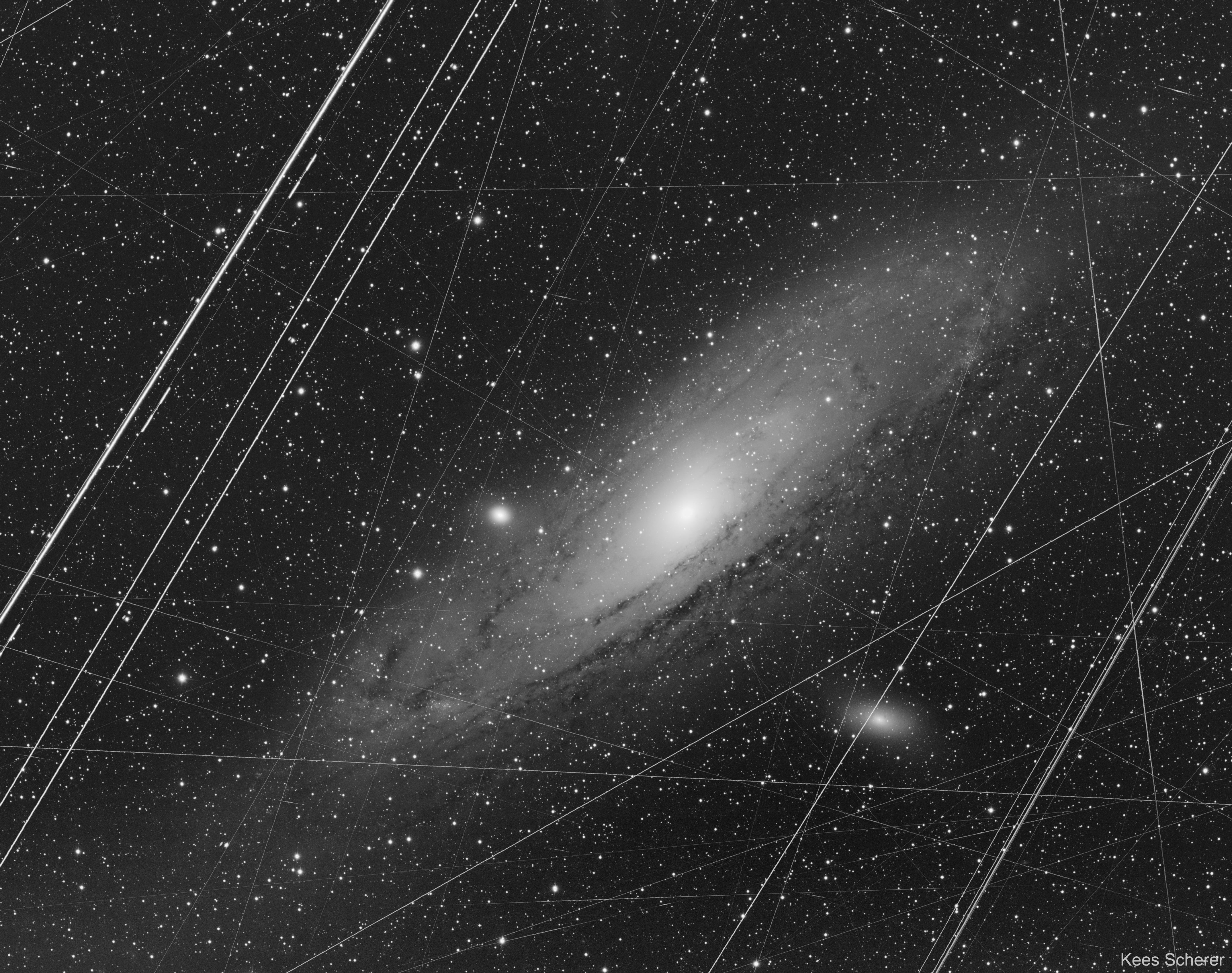
Andromeda before Photoshop
27/09/2026
What does the Andromeda galaxy really look like? The featured image shows how our Milky Way Galaxy's closest major galactic neighbor really appears in a long exposure through Earth's busy skies and with a digital camera that introduces normal imperfections. The picture is a stack of 223 images, each a 300 second exposure, taken from a garden observatory in Portugal during 2019. Obvious image deficiencies include bright parallel airplane trails, long and continuous satellite trails, short cosmic ray streaks, and bad pixels. These imperfections were actually not removed with Photoshop specifically, but rather greatly reduced with a series of computer software packages that included Astro Pixel Processor, DeepSkyStacker, and PixInsight. All of this work was done not to deceive you with a digital fantasy that has little to do with the real likeness of the Andromeda galaxy (M31), but to minimize Earthly artifacts that have nothing to do with the distant galaxy and so better recreate what M31 really does look like. APOD's email for image submissions has changed. Please see: APOD Submissions APOD's main NASA site is moving: From apod.nasa.gov to science.nasa.gov/apod
Copyright: NASA
Προηγούμενες Αστρονομικές Εικόνες της Ημέρας από τη NASA
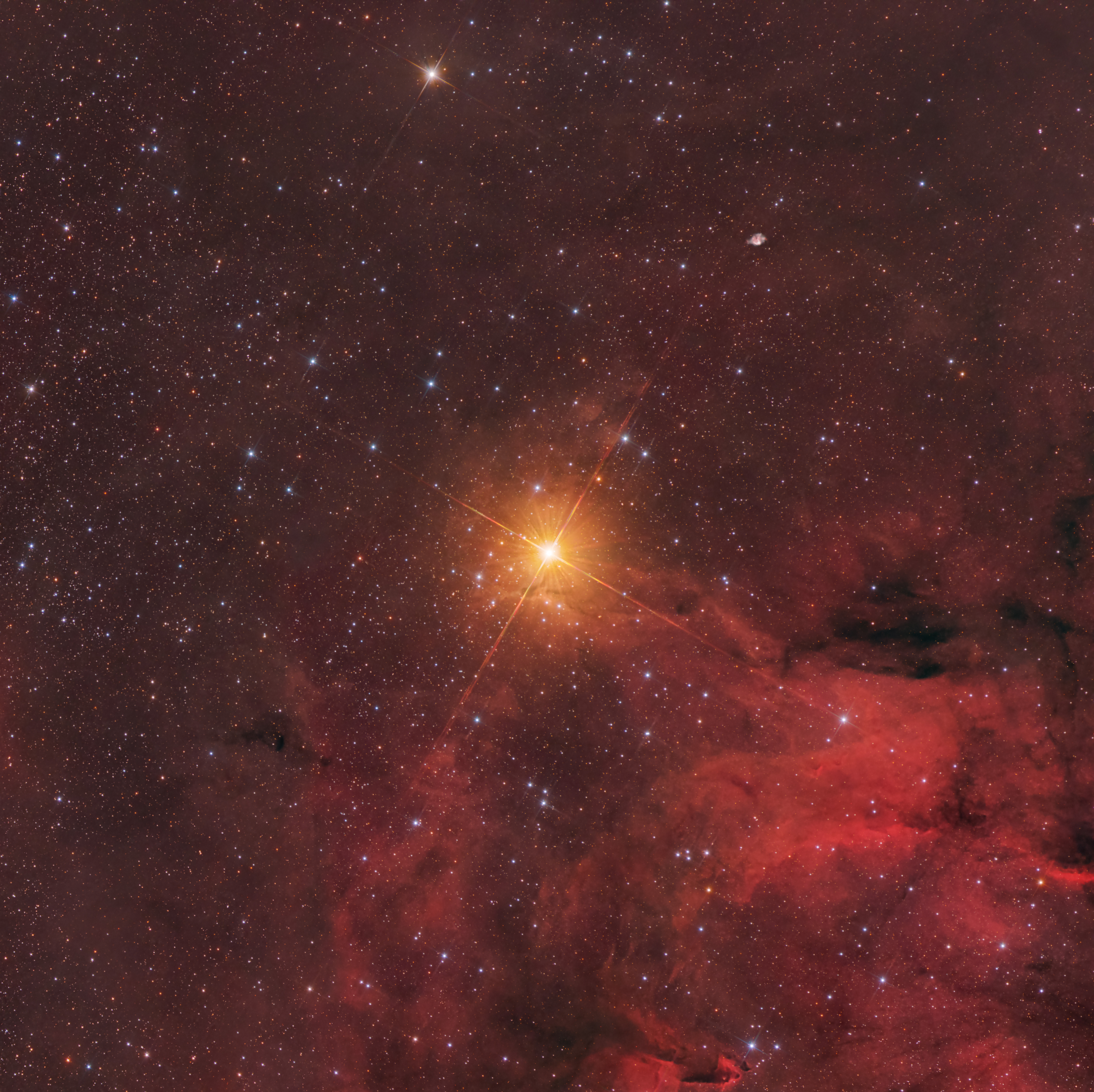
Mu Cephei
12/10/2023
Mu Cephei is a very large star. An M-class supergiant some 1500 times the size of the Sun, it is one of the largest stars visible to the unaided eye, and even one of the largest in the entire Galaxy. If it replaced the Sun in our fair Solar System, Mu Cephei would easily engulf Mars and Jupiter. Historically known as Herschel's Garnet Star, Mu Cephei is extremely red. Approximately 2800 light-years distant, the supergiant is seen near the edge of reddish emission nebula IC 1396 toward the royal northern constellation Cepheus in this telescopic view. Much cooler and hence redder than the Sun, this supergiant's light is further reddened by absorption and scattering due to intervening dust within the Milky Way. A well-studied variable star understood to be in a late phase of stellar evolution, Mu Cephei is a massive star too, destined to ultimately explode as a core-collapse supernova.
Copyright: David Cruz
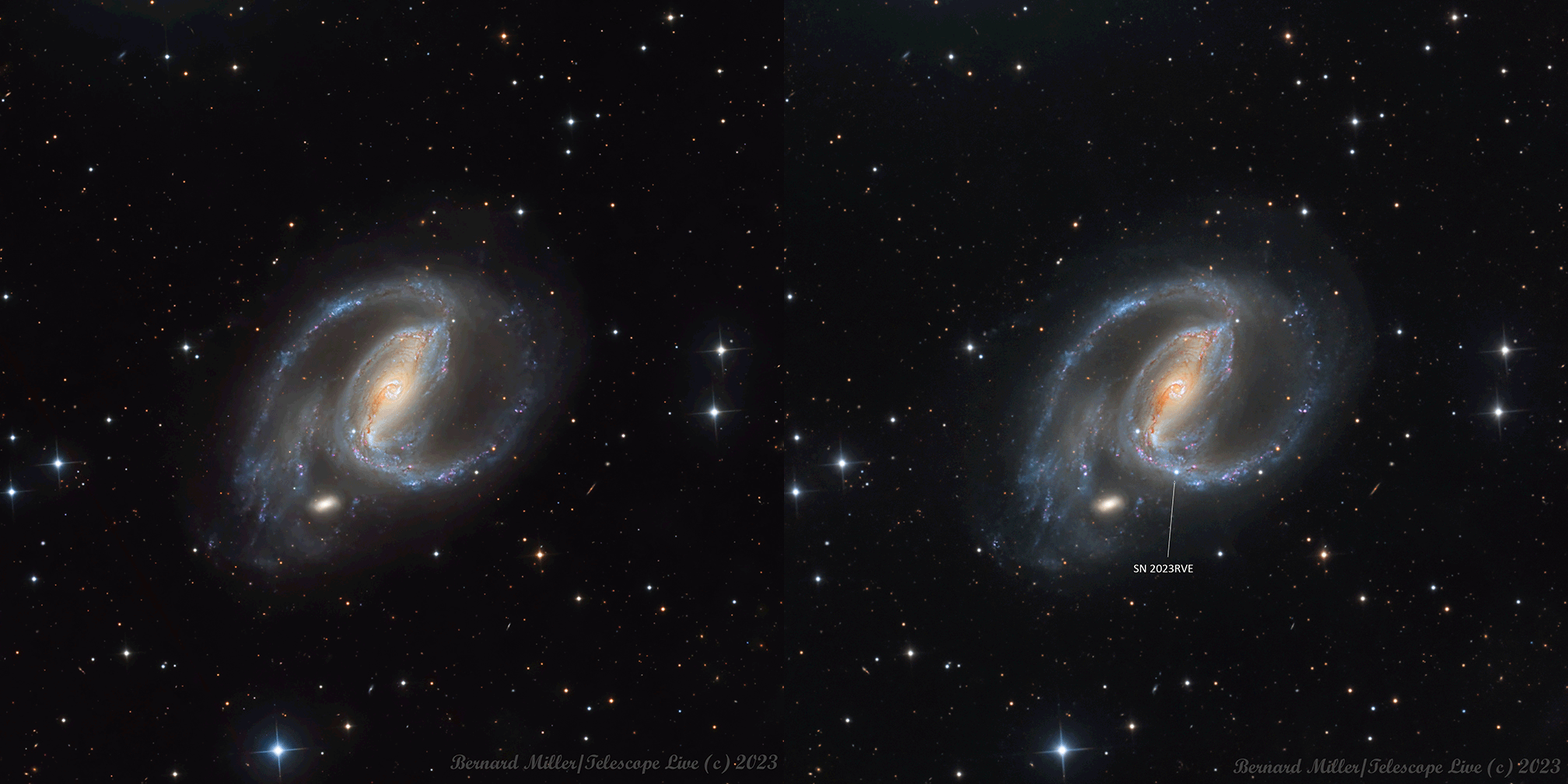
NGC 1097: Spiral Galaxy with Supernova
11/10/2023
What's happening in the lower arm of this spiral galaxy? A supernova. Last month, supernova SN 2023rve was discovered with UAE's Al-Khatim Observatory and later found to be consistent with the death explosion of a massive star, possibly leaving behind a black hole. Spiral galaxy NGC 1097 is a relatively close 45 million light years away and visible with a small telescope toward the southern constellation of the Furnace (Fornax). The galaxy is notable not only for its picturesque spiral arms, but also for faint jets consistent with ancient star streams left over from a galactic collision -- possibly with the small galaxy seen between its arms on the lower left. The featured image highlights the new supernova by blinking between two exposures taken several months apart. Finding supernovas in nearby galaxies can be important in determining the scale and expansion rate of our entire universe -- a topic currently of unexpected tension and much debate. APOD editor to speak: in Houghton, Michigan on Thursday, October 12 at 6 pm
Copyright: NASA
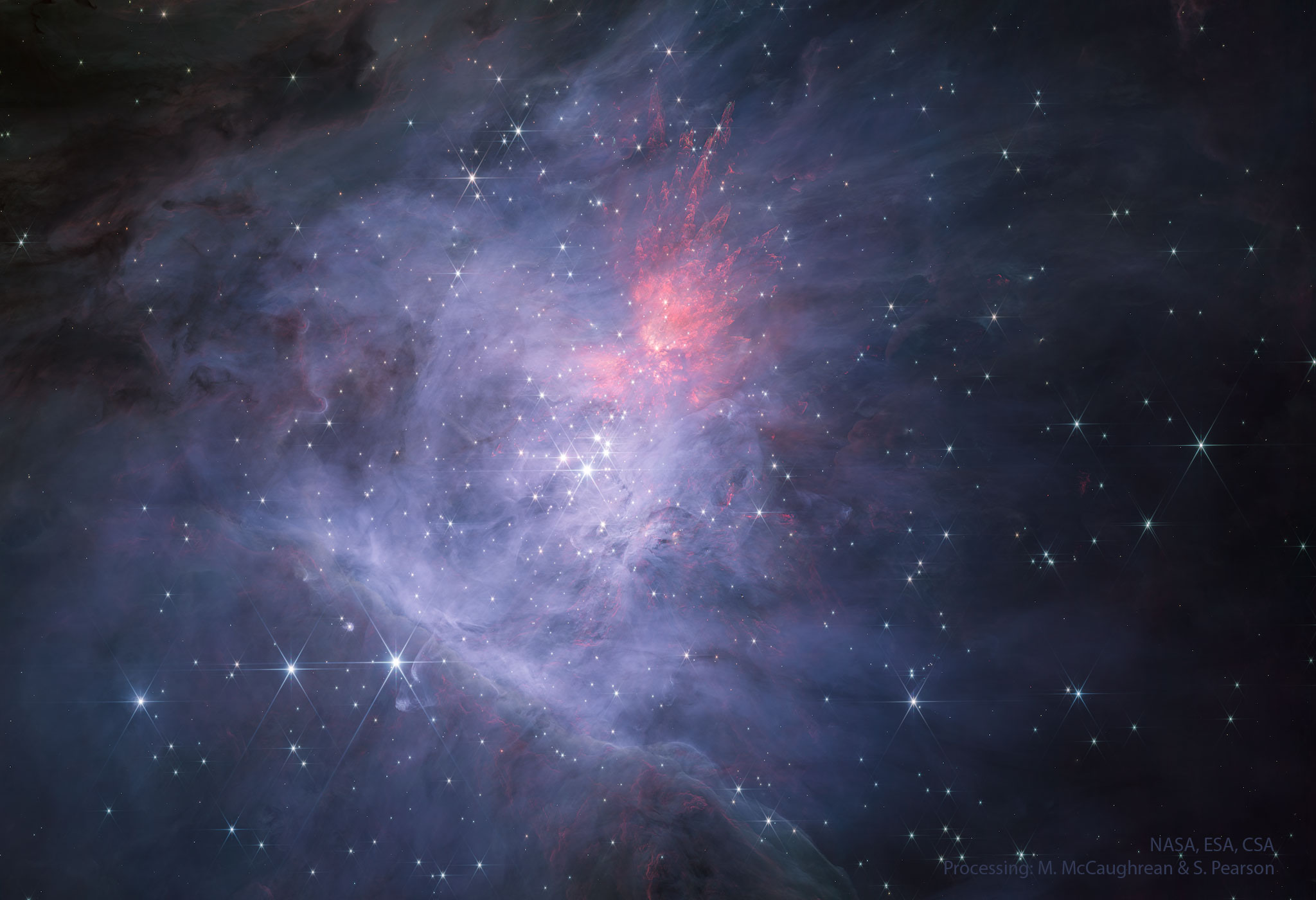
Hidden Orion from Webb
10/10/2023
The Great Nebula in Orion has hidden stars. To the unaided eye in visible light, it appears as a small fuzzy patch in the constellation of Orion. But this image was taken by the Webb Space Telescope in a representative-color composite of red and very near infrared light. It confirms with impressive detail that the Orion Nebula is a busy neighborhood of young stars, hot gas, and dark dust. The rollover image shows the same image in representative colors further into the near infrared. The power behind much of the Orion Nebula (M42) is the Trapezium - a cluster of bright stars near the nebula's center. The diffuse and filamentary glow surrounding the bright stars is mostly heated interstellar dust. Detailed inspection of these images shows an unexpectedly large number of Jupiter-Mass Binary Objects (JuMBOs), pairs of Jupiter-mass objects which might give a clue to how stars are forming. The whole Orion Nebula cloud complex, which includes the Horsehead Nebula, will slowly disperse over the next few million years. APOD editor to speak: in Houghton, Michigan on Thursday, October 12 at 6 pm
Copyright: NASA
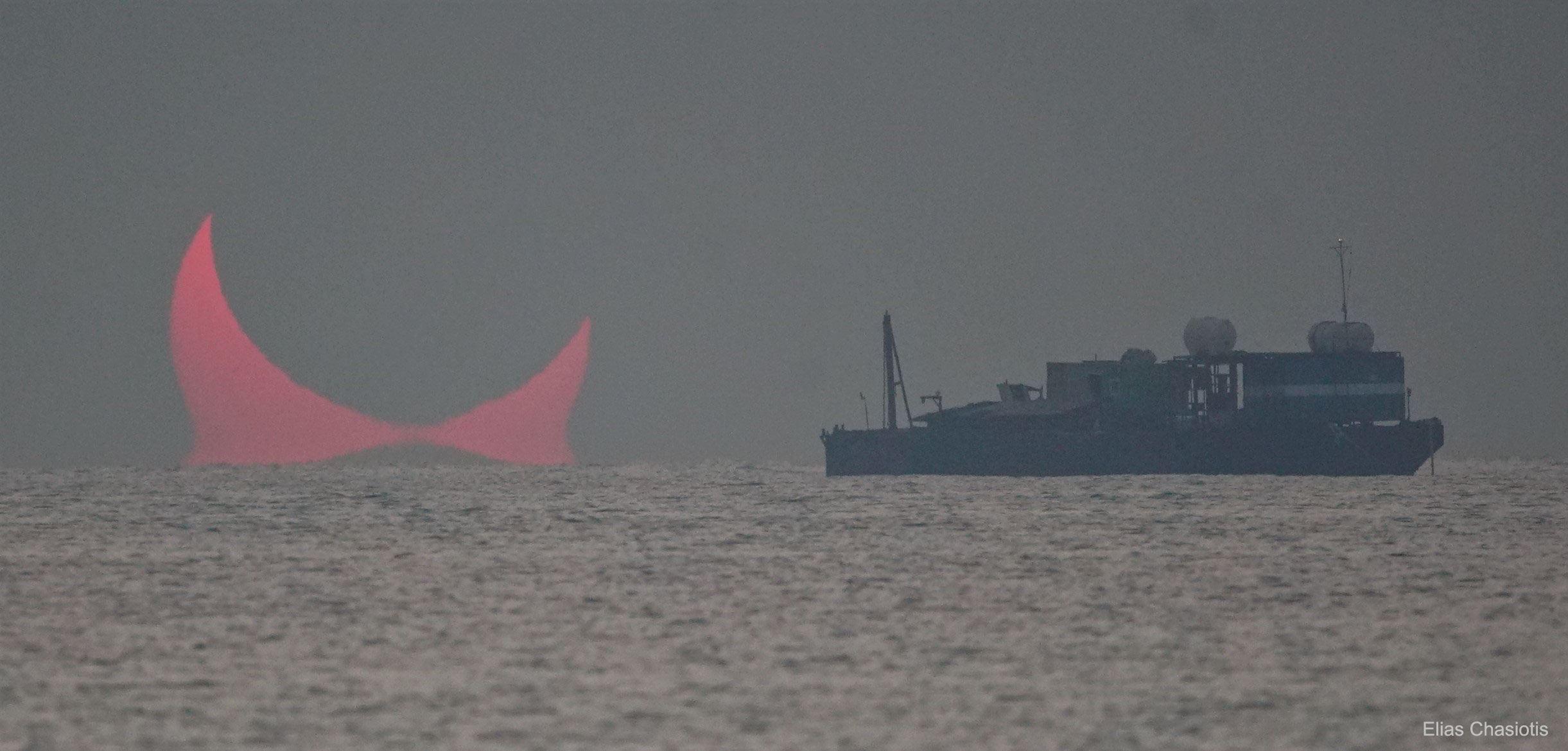
A Distorted Sunrise Eclipse
09/10/2023
Yes, but have you ever seen a sunrise like this? Here, after initial cloudiness, the Sun appeared to rise in two pieces and during a partial eclipse in 2019, causing the photographer to describe it as the most stunning sunrise of his life. The dark circle near the top of the atmospherically-reddened Sun is the Moon -- but so is the dark peak just below it. This is because along the way, the Earth's atmosphere had a layer of unusually warm air over the sea which acted like a gigantic lens and created a second image. For a normal sunrise or sunset, this rare phenomenon of atmospheric optics is known as the Etruscan vase effect. The featured picture was captured in December 2019 from Al Wakrah, Qatar. Some observers in a narrow band of Earth to the east were able to see a full annular solar eclipse -- where the Moon appears completely surrounded by the background Sun in a ring of fire. The next solar eclipse, also an annular eclipse for well-placed observers, will occur this coming Saturday. APOD editor to speak: in Houghton, Michigan on Thursday, October 12 at 6 pm
Copyright: Elias Chasiotis
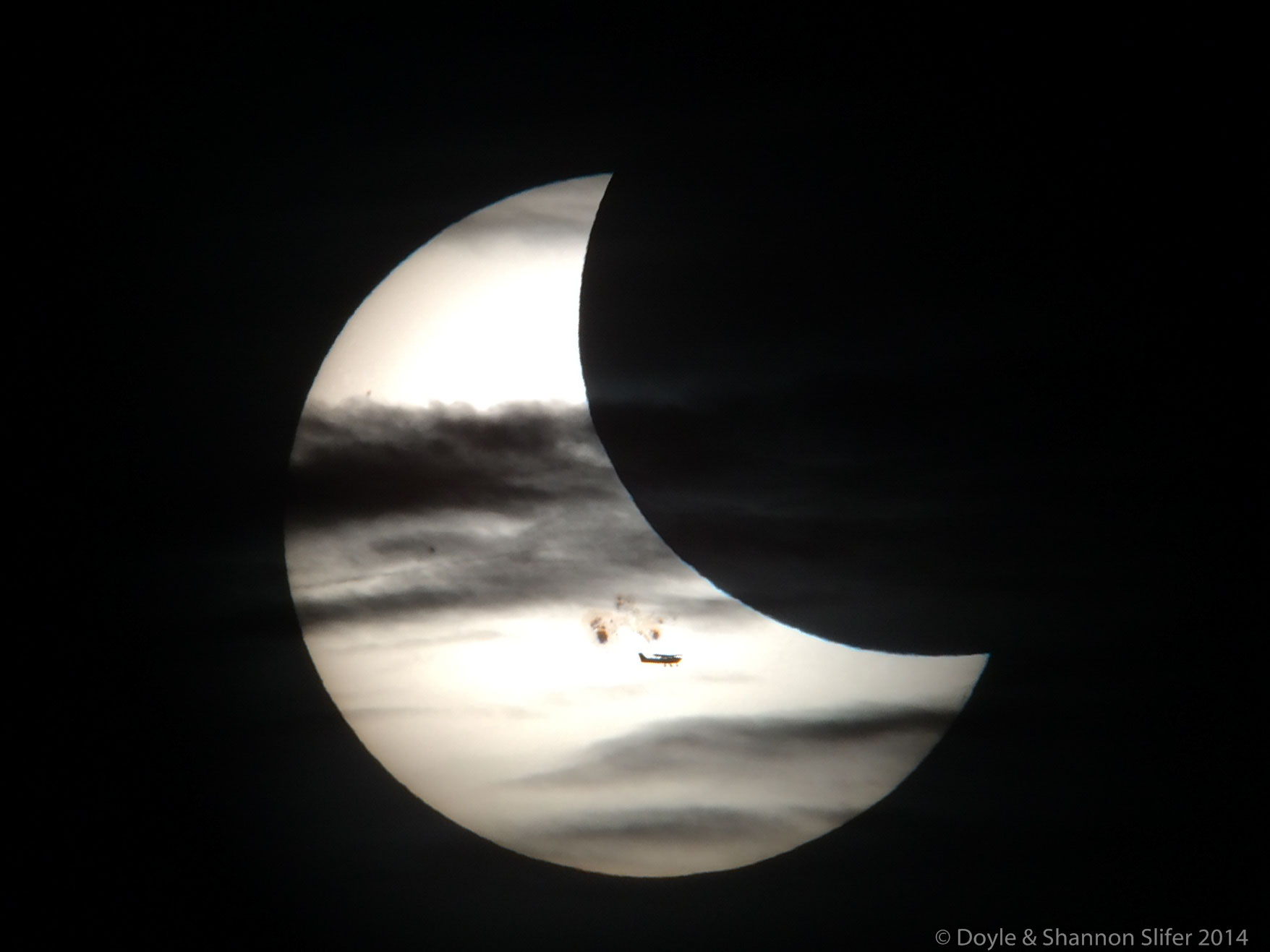
Plane, Clouds, Moon, Spots, Sun
08/10/2023
What's that in front of the Sun? The closest object is an airplane, visible just below the Sun's center and caught purely by chance. Next out are numerous clouds in Earth's atmosphere, creating a series of darkened horizontal streaks. Farther out is Earth's Moon, seen as the large dark circular bite on the upper right. Just above the airplane and just below the Sun's surface are sunspots. The main sunspot group captured here, AR 2192, was in 2014 one of the largest ever recorded and had been crackling and bursting with flares since it came around the edge of the Sun a week before. This show of solar silhouettes was unfortunately short-lived. Within a few seconds the plane flew away. Within a few minutes the clouds drifted off. Within a few hours the partial solar eclipse of the Sun by the Moon was over. Fortunately, when it comes to the Sun, even unexpected alignments are surprisingly frequent. Perhaps one will be imaged this Saturday when a new partial solar eclipse will be visible from much of North and South America. APOD editor to speak: in Houghton, Michigan on Thursday, October 12 at 6 pm
Copyright: Doyle and Shannon Slifer
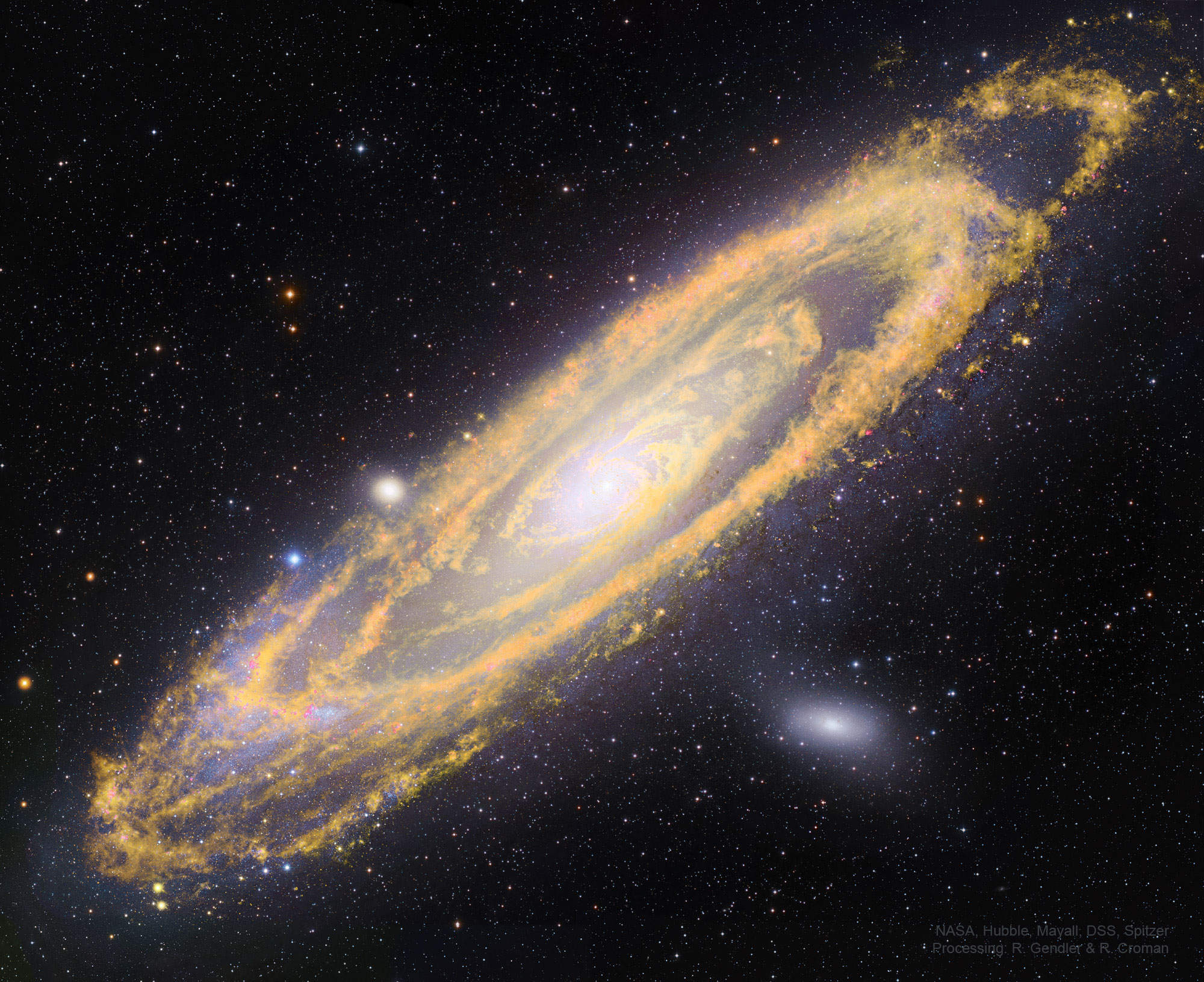
The Once and Future Stars of Andromeda
07/10/2023
This picture of Andromeda shows not only where stars are now, but where stars will be. The big, beautiful Andromeda Galaxy, M31, is a spiral galaxy a mere 2.5 million light-years away. Image data from space-based and ground-based observatories have been combined here to produce this intriguing composite view of Andromeda at wavelengths both inside and outside normally visible light. The visible light shows where M31's stars are now, highlighted in white and blue hues and imaged by the Hubble, Subaru, and Mayall telescopes. The infrared light shows where M31's future stars will soon form, highlighted in orange hues and imaged by NASA's Spitzer Space Telescope. The infrared light tracks enormous lanes of dust, warmed by stars, sweeping along Andromeda's spiral arms. This dust is a tracer of the galaxy's vast interstellar gas, raw material for future star formation. Of course, the new stars will likely form over the next hundred million years or so. That's well before Andromeda merges with our Milky Way Galaxy in about 5 billion years.
Copyright: NASA
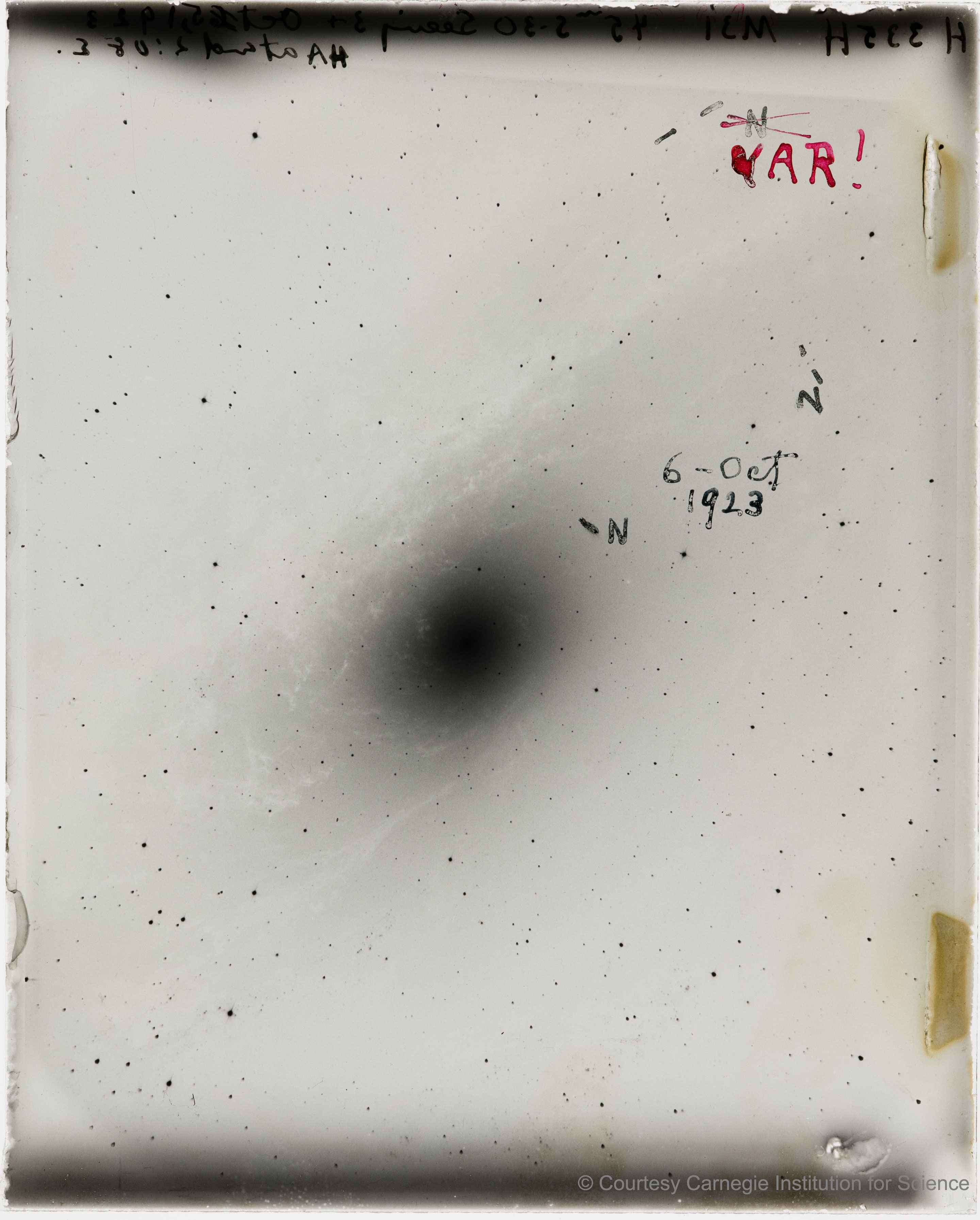
Edwin Hubble Discovers the Universe
06/10/2023
How big is our universe? This question, among others, was debated by two leading astronomers in 1920 in what has since become known as astronomy's Great Debate. Many astronomers then believed that our Milky Way Galaxy was the entire universe. Many others, though, believed that our galaxy was just one of many. In the Great Debate, each argument was detailed, but no consensus was reached. The answer came over three years later with the detected variation of single spot in the Andromeda Nebula, as shown on the original glass discovery plate digitally reproduced here. When Edwin Hubble compared images, he noticed that this spot varied, and on October 6, 1923 wrote "VAR!" on the plate. The best explanation, Hubble knew, was that this spot was the image of a variable star that was very far away. So M31 was really the Andromeda Galaxy -- a galaxy possibly similar to our own. Annotated 100 years ago, the featured image may not be pretty, but the variable spot on it opened a window through which humanity gazed knowingly, for the first time, into a surprisingly vast cosmos.
Copyright: Carnegie Institution for Science
Ring of Fire over Monument Valley
05/10/2023
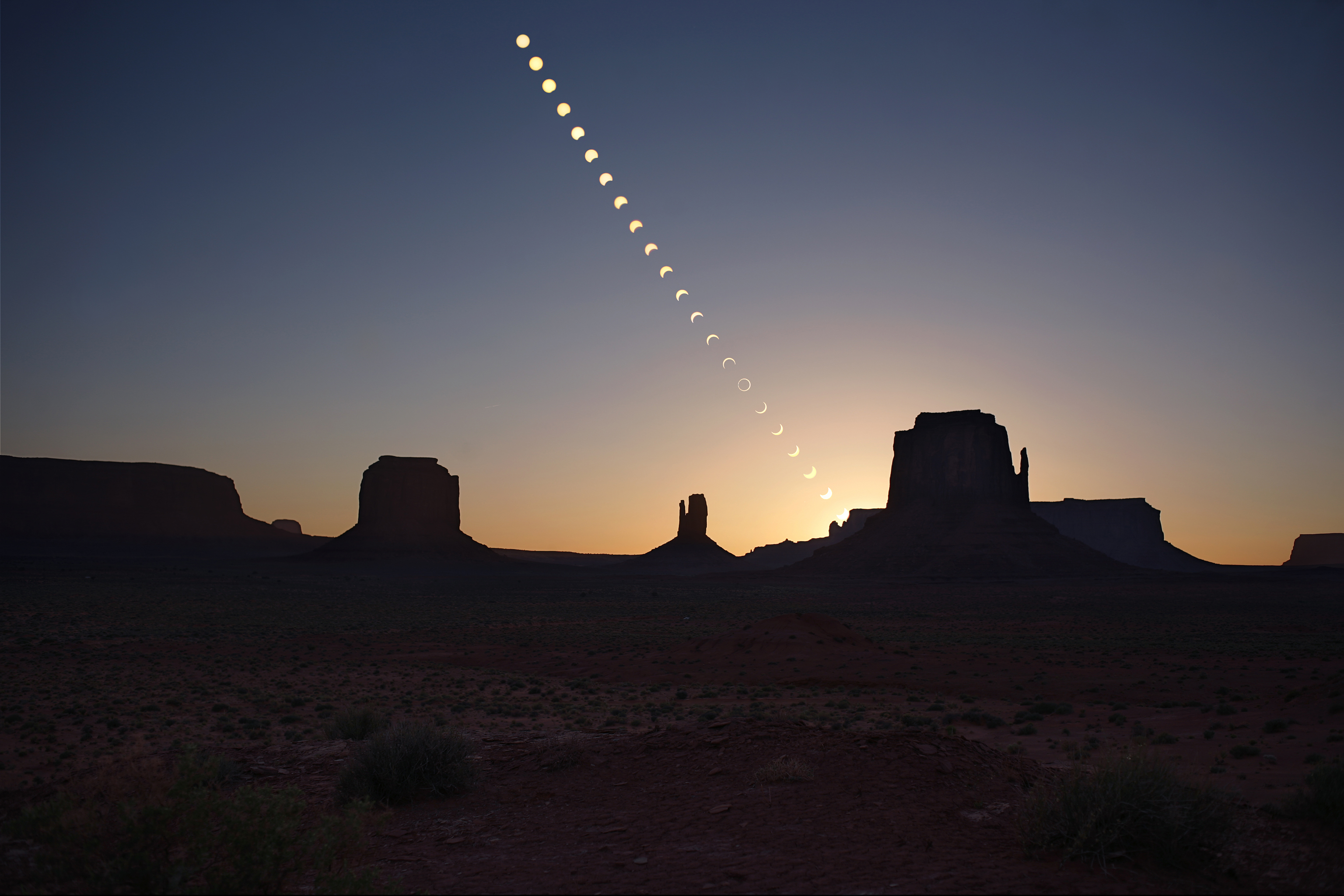
Tracking along a narrow path, the shadow of a new moon will race across North, Central, and South America, on October 14. When viewed from the shadow path the apparent size of the lunar disk will not quite completely cover the Sun though. Instead, the moon in silhouette will appear during the minutes of totality surrounded by a fiery ring, an annular solar eclipse more dramatically known as a ring of fire eclipse. This striking time lapse sequence from May of 2012 illustrates the stages of a ring of fire eclipse. From before eclipse start until sunset, they are seen over the iconic buttes of planet Earth's Monument Valley. Remarkably, the October 14 ring of fire eclipse will also be visible over Monument Valley, beginning after sunrise in the eastern sky.
Copyright: Tunc Tezel
Η Αστρονομική Εικόνα της Ημέρας από τη NASA (NASA Astronomy Picture of the Day) είναι μια δωρεάν υπηρεσία που παρέχει καθημερινά μια εντυπωσιακή εικόνα από το σύμπαν, την λήψη της οποίας έχει πραγματοποιήσει κάποιος από τους αστρονόμους της NASA ή από κάποιον από τους δορυφόρους ή τα τηλεσκόπια που η NASA λειτουργεί. Οι εικόνες που εμφανίζονται καλύπτουν μια ευρεία γκάμα από θέματα, συμπεριλαμβανομένων των αστερισμών, των γαλαξιών, των πλανητικών συστημάτων, των κομητών, των αστρικών σωμάτων και των παρατηρητηρίων. Κάθε εικόνα συνοδεύεται από μια σύντομη εξήγηση και πληροφορίες σχετικά με το τι παρατηρείται στην εικόνα.