Η Αστρονομική Εικόνα της Ημέρας από τη NASA
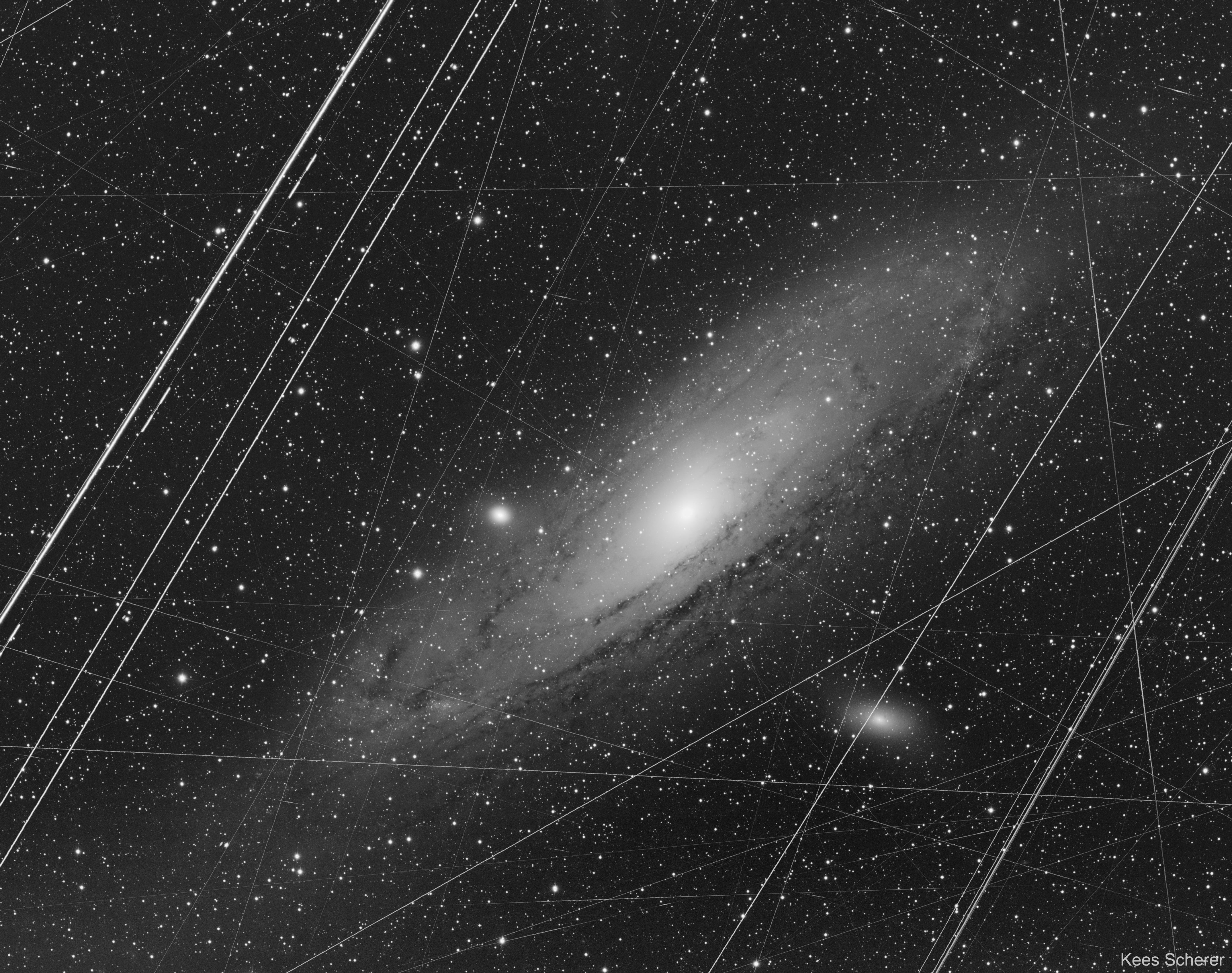
Andromeda before Photoshop
27/09/2026
What does the Andromeda galaxy really look like? The featured image shows how our Milky Way Galaxy's closest major galactic neighbor really appears in a long exposure through Earth's busy skies and with a digital camera that introduces normal imperfections. The picture is a stack of 223 images, each a 300 second exposure, taken from a garden observatory in Portugal during 2019. Obvious image deficiencies include bright parallel airplane trails, long and continuous satellite trails, short cosmic ray streaks, and bad pixels. These imperfections were actually not removed with Photoshop specifically, but rather greatly reduced with a series of computer software packages that included Astro Pixel Processor, DeepSkyStacker, and PixInsight. All of this work was done not to deceive you with a digital fantasy that has little to do with the real likeness of the Andromeda galaxy (M31), but to minimize Earthly artifacts that have nothing to do with the distant galaxy and so better recreate what M31 really does look like. APOD's email for image submissions has changed. Please see: APOD Submissions APOD's main NASA site is moving: From apod.nasa.gov to science.nasa.gov/apod
Copyright: NASA
Προηγούμενες Αστρονομικές Εικόνες της Ημέρας από τη NASA
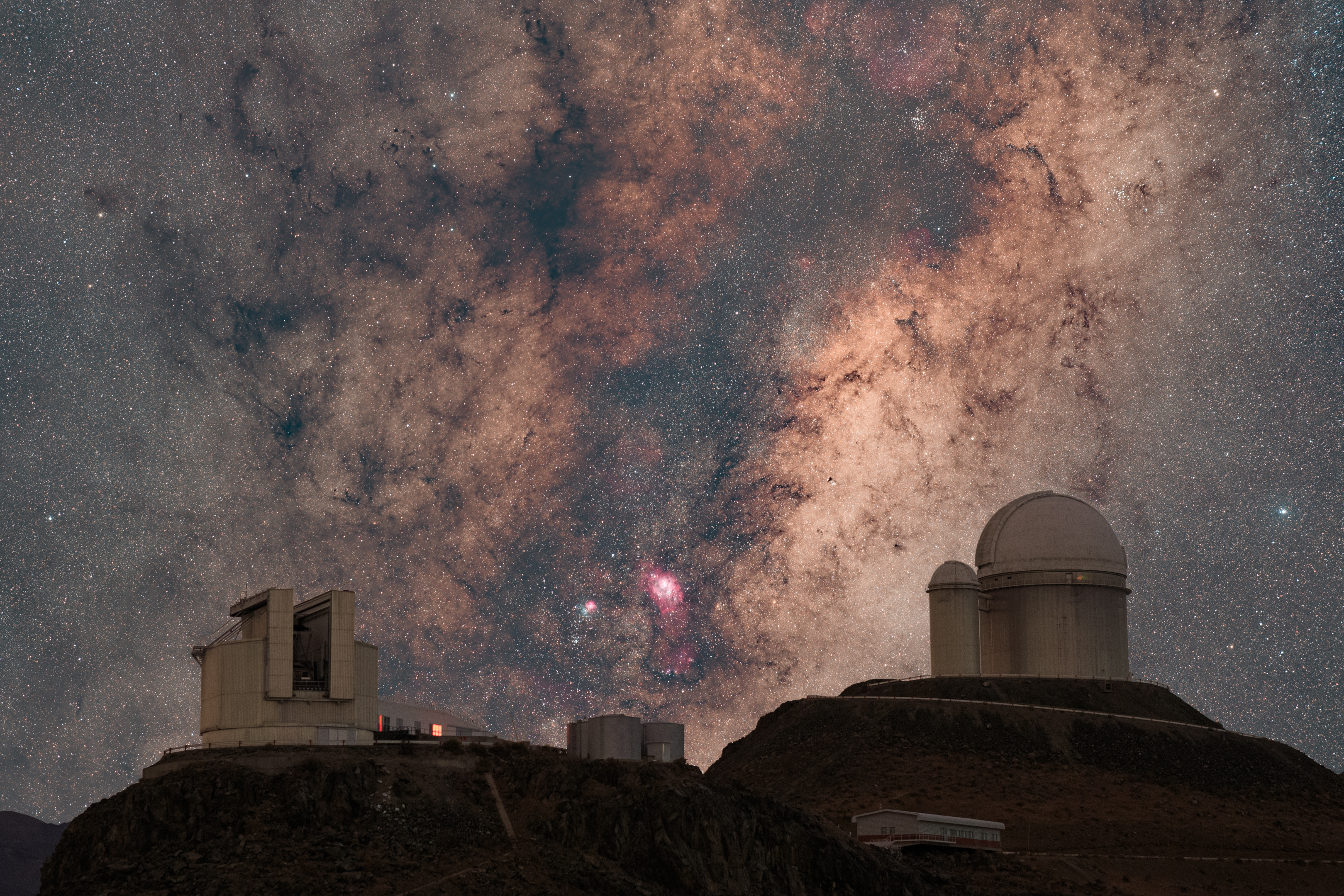
Milky Way Rising
01/12/2023
The core of the Milky Way is rising beyond the Chilean mountain-top La Silla Observatory in this deep night skyscape. Seen toward the constellation Sagittarius, our home galaxy's center is flanked on the left, by the European Southern Observatory's New Technology Telescope which pioneered the use of active optics to accurately control the shape of large telescope mirrors. To the right stands the ESO 3.6-meter Telescope, home of the exoplanet hunting HARPS and NIRPS spectrographs. Between them, the galaxy's central bulge is filled with obscuring clouds of interstellar dust, bright stars, clusters, and nebulae. Prominent reddish hydrogen emission from the star-forming Lagoon Nebula, M8, is near center. The Trifid Nebula, M20, combines blue light of a dusty reflection nebula with reddish emission just left of the cosmic Lagoon. Both are popular stops on telescopic tours of the galactic center. The composited image is a stack of separate exposures for ground and sky made in April 2023, all captured consecutively with the same framing and camera equipment.
Copyright: José Rodrigues
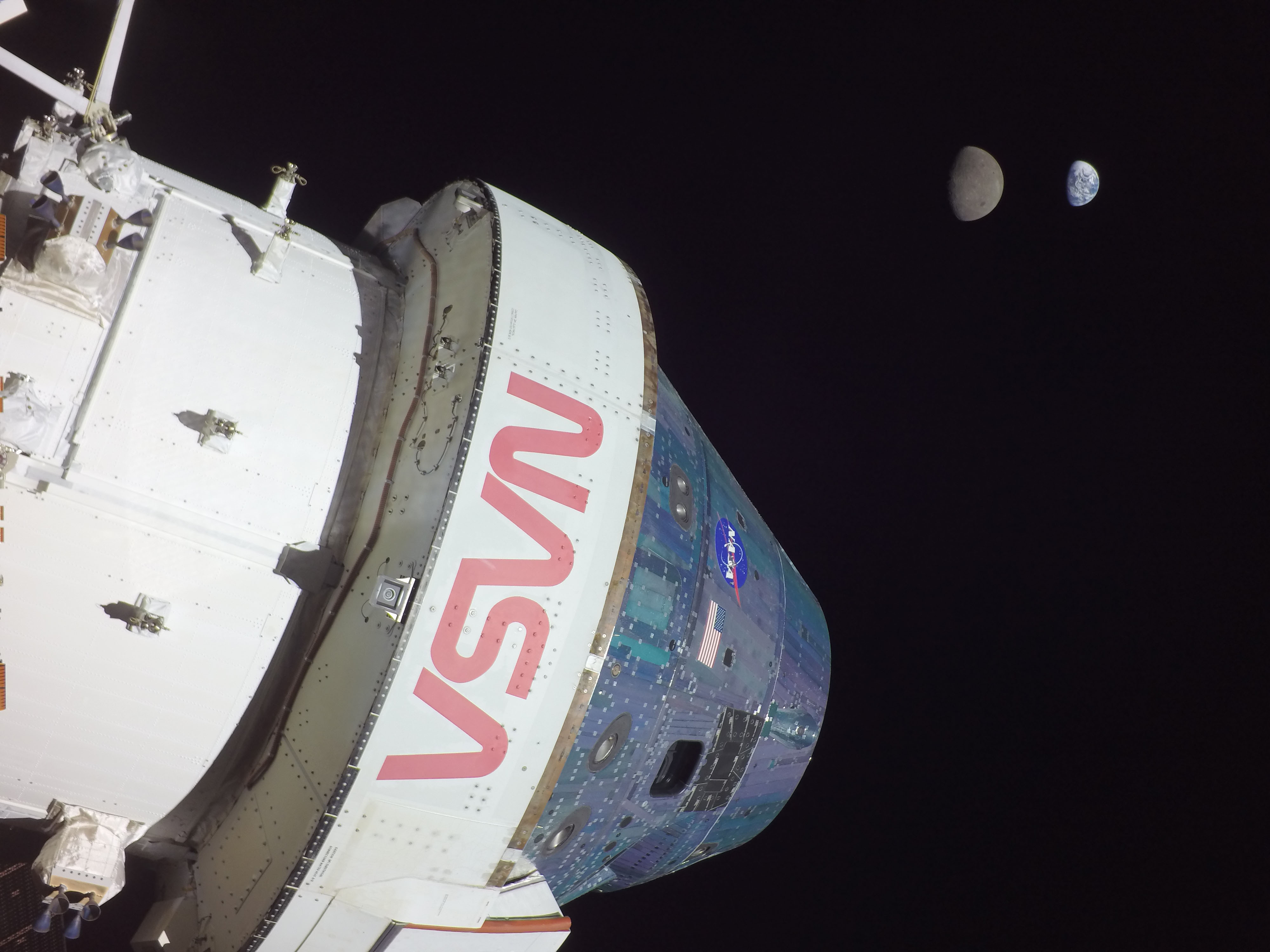
Artemis 1: Flight Day 13
30/11/2023
On flight day 13 (November 28, 2022) of the Artemis I mission, the Orion spacecraft reached its maximum distance from its home world. Over 430,000 kilometers from Earth in a distant retrograde orbit, Orion surpassed the record for most distant spacecraft designed to carry humans. That record was previously set in 1970 during the Apollo 13 mission to the Moon. Both Earth and Moon are in the same field of view in this video frame from Orion on Artemis I mission flight day 13. The planet and its large natural satellite even appear about the same apparent size from the uncrewed spacecraft's perspective.
Copyright: NASA
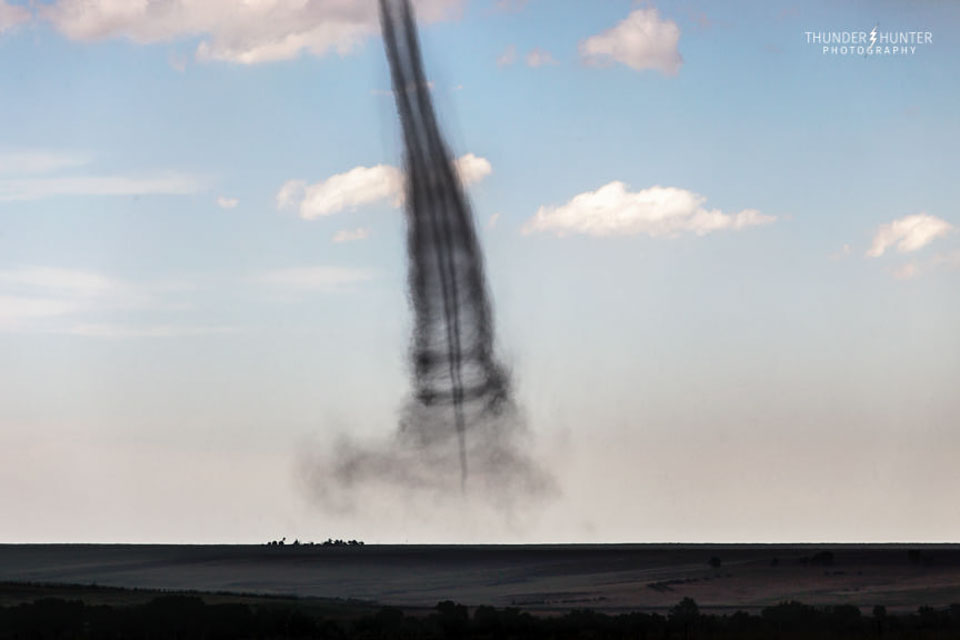
A Landspout Tornado over Kansas
29/11/2023
Could there be a tornado inside another tornado? In general, no. OK, but could there be a tornado inside a wider dust devil? No again, for one reason because tornados comes down from the sky, but dust devils rise up from the ground. What is pictured is a landspout, an unusual type of tornado known to occur on the edge of a violent thunderstorm. The featured landspout was imaged and identified in Kansas, USA, in June 2019 by an experienced storm chaser. The real tornado is in the center, and the outer sheath was possibly created by large dust particles thrown out from the central tornado. So far, the only planet known to create tornados is Earth, although tornado-like activity has been found on the Sun and dust devils are common on Mars. Almost Hyperspace: Random APOD Generator
Copyright: Brad Hannon
Ganymede from Juno
28/11/2023
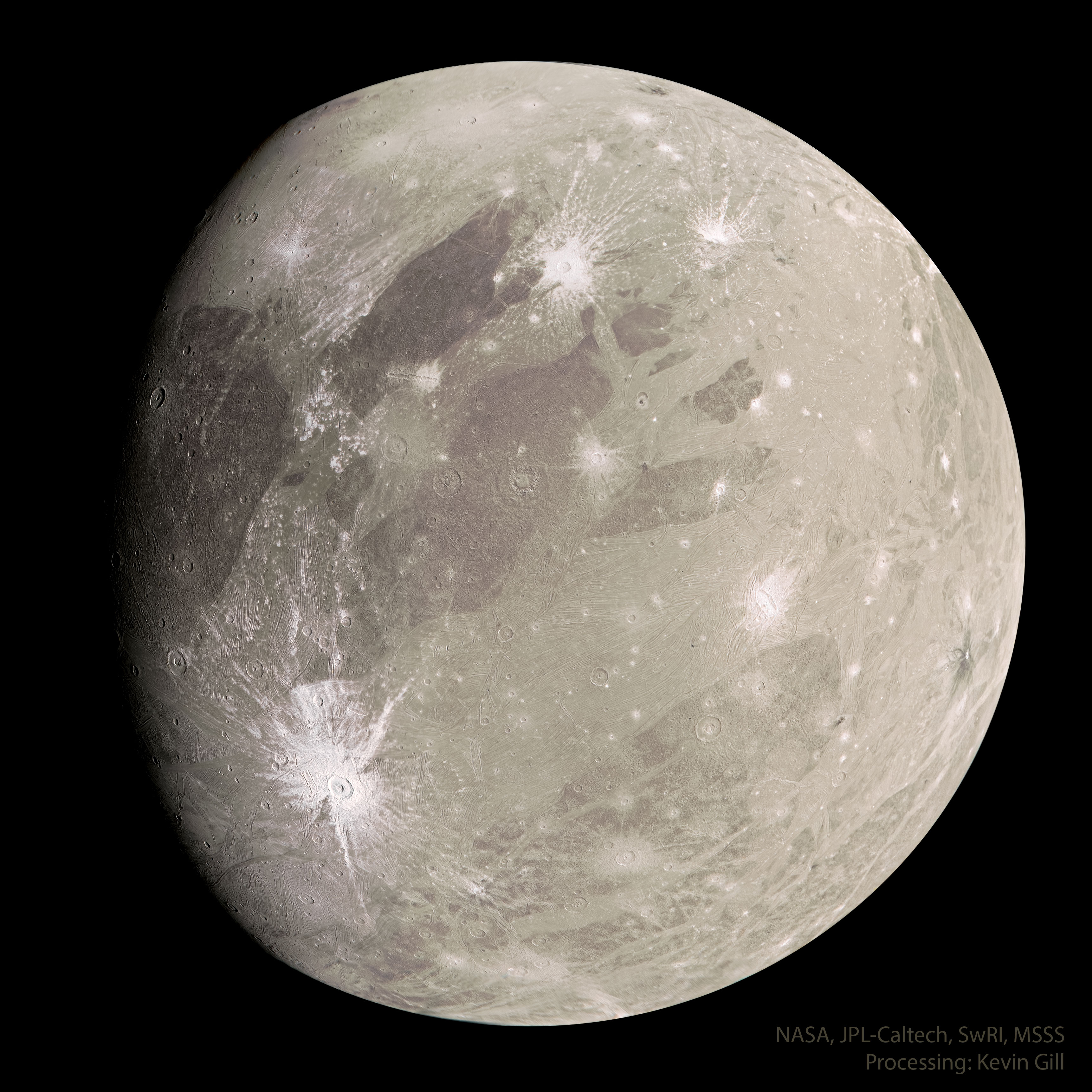
What does the largest moon in the Solar System look like? Jupiter's moon Ganymede, larger than even Mercury and Pluto, has an icy surface speckled with bright young craters overlying a mixture of older, darker, more cratered terrain laced with grooves and ridges. The cause of the grooved terrain remains a topic of research, with a leading hypothesis relating it to shifting ice plates. Ganymede is thought to have an ocean layer that contains more water than Earth -- and might contain life. Like Earth's Moon, Ganymede keeps the same face towards its central planet, in this case Jupiter. The featured image was captured in 2021 by NASA's robotic Juno spacecraft when it passed by the immense moon. The close pass reduced Juno's orbital period around Jupiter from 53 days to 43 days. Juno continues to study the giant planet's high gravity, unusual magnetic field, and complex cloud structures. Follow Podcasts about APOD's Images: on YouTube
Copyright: NASA/JPL-Caltech/SwRI/MSSS; Processing & License: Kevin M. Gill;
LBN 86: The Eagle Ray Nebula
27/11/2023
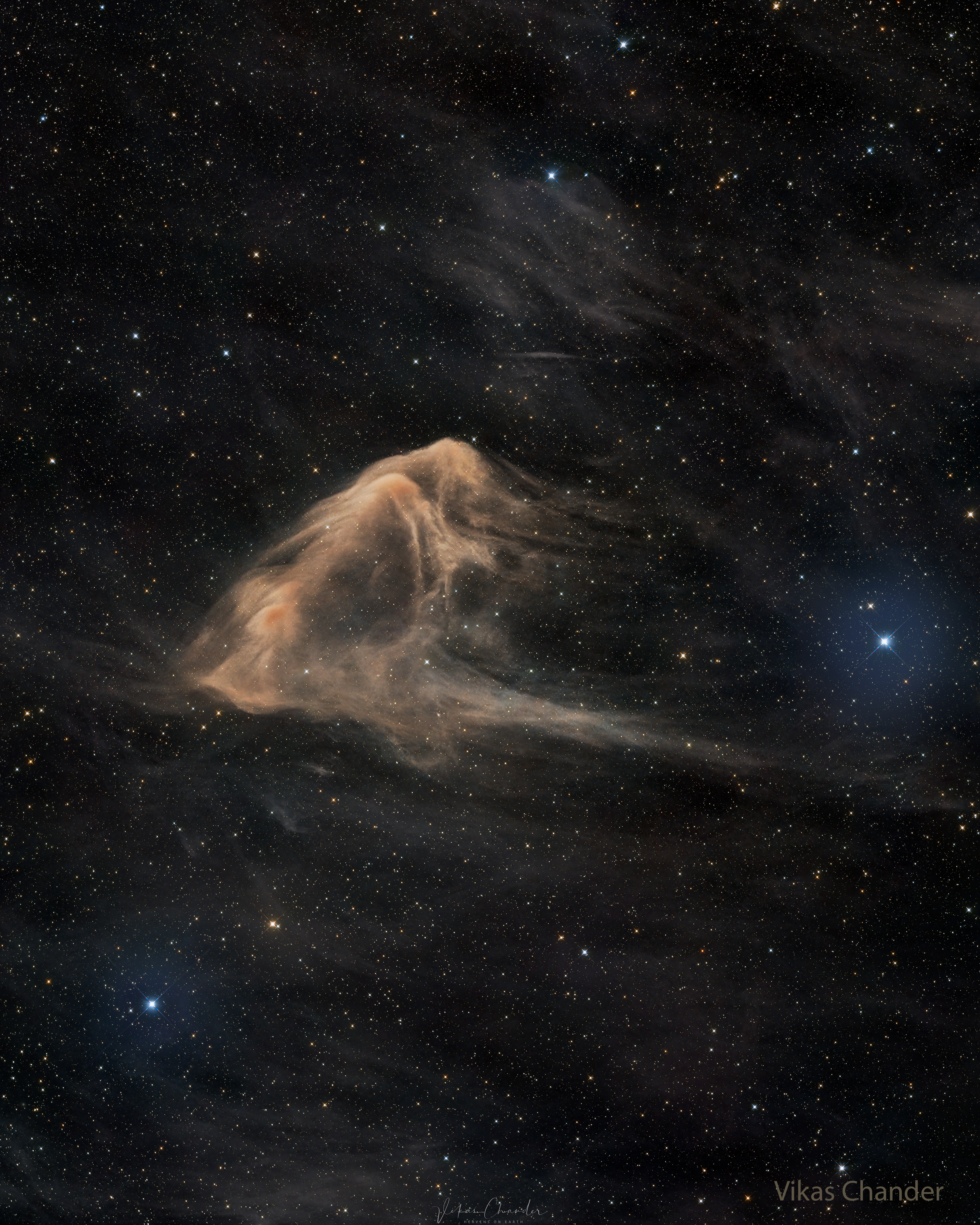
This eagle ray glides across a cosmic sea. Officially cataloged as SH2-63 and LBN 86, the dark nebula is composed of gas and dust that just happens to appear shaped like a common ocean fish. The interstellar dust nebula appears light brown as it blocks and reddens visible light emitted behind it. Dark nebulas glow primarily in infrared light, but also reflect visible light from surrounding stars. The dust in dark nebulas is usually sub-millimeter chunks of carbon, silicon, and oxygen, frequently coated with frozen carbon monoxide and nitrogen. Dark nebulas are also known as molecular clouds because they also contain relatively high amounts of molecular hydrogen and larger molecules. Previously unnamed, the here dubbed Eagle Ray Nebula is normally quite dim but has been imaged clearly over 20-hours through dark skies in Chile. Follow APOD on: Discord
Copyright: Vikas Chander
A Dust Jet from the Surface of Comet 67P
26/11/2023
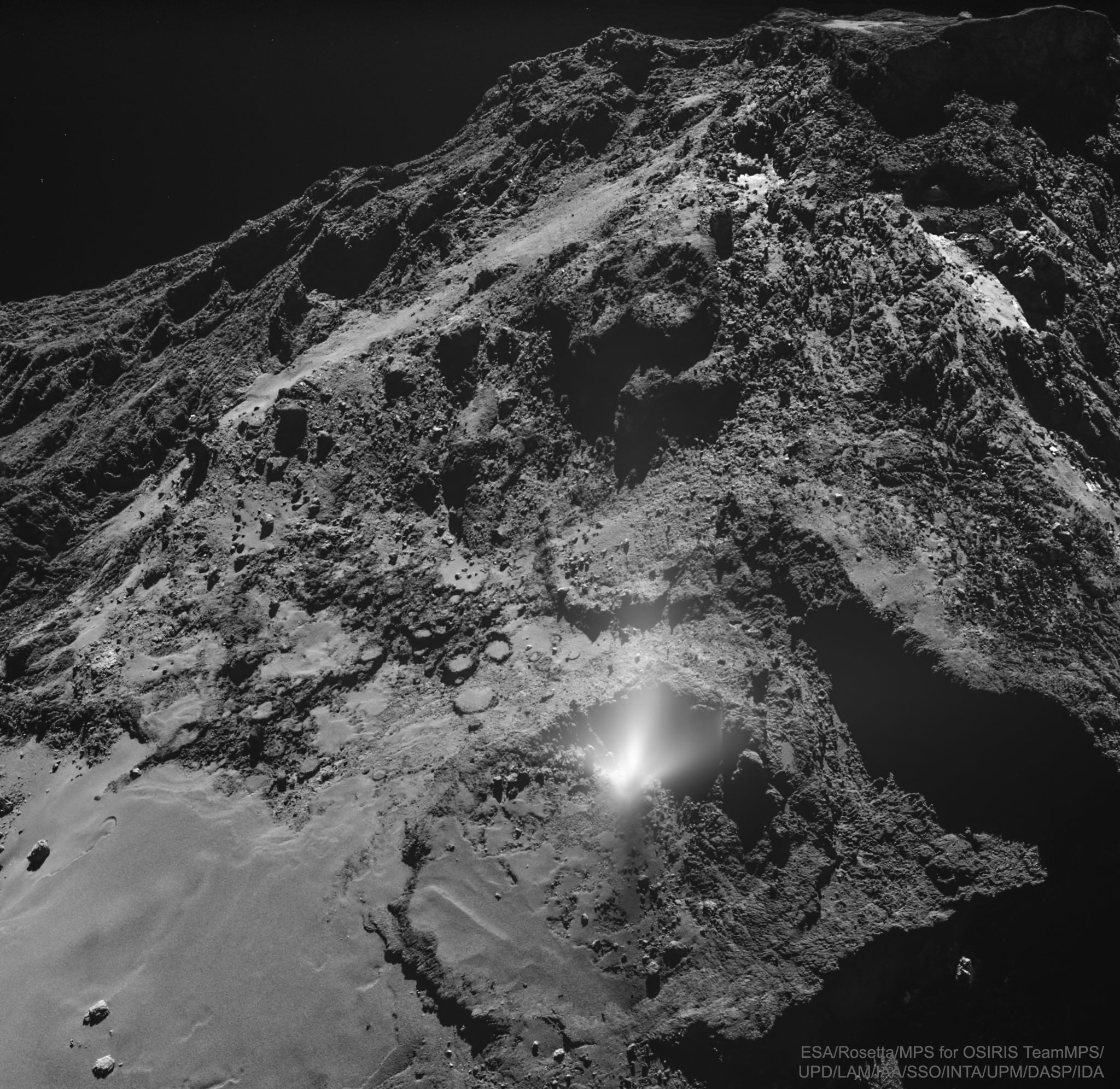
Where do comet tails come from? There are no obvious places on the nuclei of comets from which the jets that create comet tails emanate. In 2016, though, ESA's Rosetta spacecraft not only imaged a jet emerging from Comet 67P/Churyumov-Gerasimenko, but flew right through it. Featured is a telling picture showing a bright plume emerging from a small circular dip bounded on one side by a 10-meter high wall. Analyses of Rosetta data show that the jet was composed of both dust and water-ice. The rugged but otherwise unremarkable terrain indicates that something likely happened far under the porous surface to create the plume. This image was taken about two months before Rosetta's mission ended with a controlled impact onto Comet 67P's surface.
Copyright: NASA
Little Planet Aurora
25/11/2023
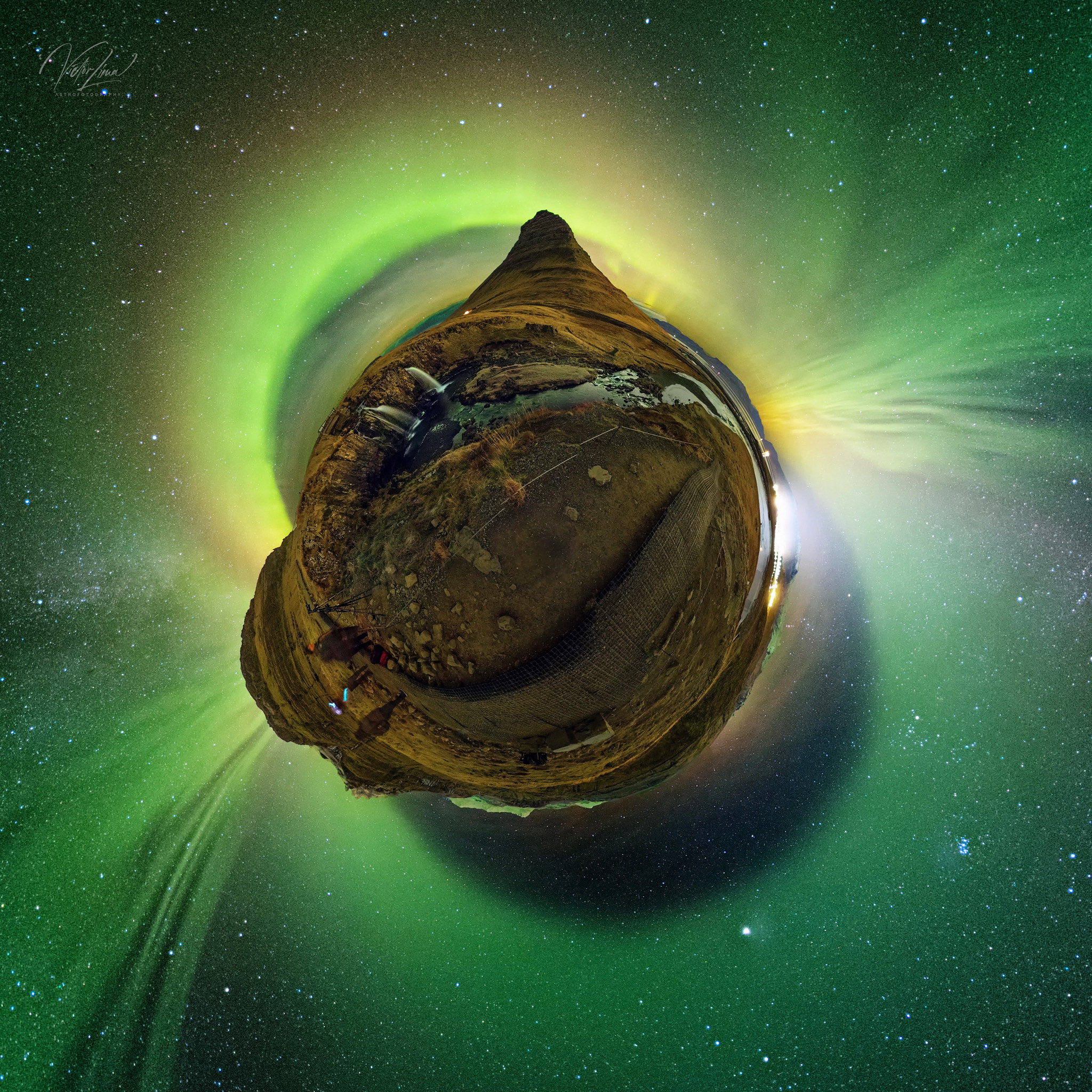
Immersed in an eerie greenish light, this rugged little planet appears to be home to stunning water falls and an impossibly tall mountain. It's planet Earth of course. On the night of November 9 the nadir-centered 360 degree mosaic was captured by digital camera from the Kirkjufell mountain area of western Iceland. Curtains of shimmering Aurora Borealis or Northern Lights provide the pale greenish illumination. The intense auroral display was caused by solar activity that rocked Earth's magnetosphere in early November and produced strong geomagnetic storms. Kirkjufell mountain itself stands at the top of the stereographic projection's circular horizon. Northern hemisphere skygazers will recognize the familiar stars of the Big Dipper just above Kirkjufell's peak. At lower right the compact Pleiades star cluster and truly giant planet Jupiter also shine in this little planet's night sky.
Copyright: Victor Lima
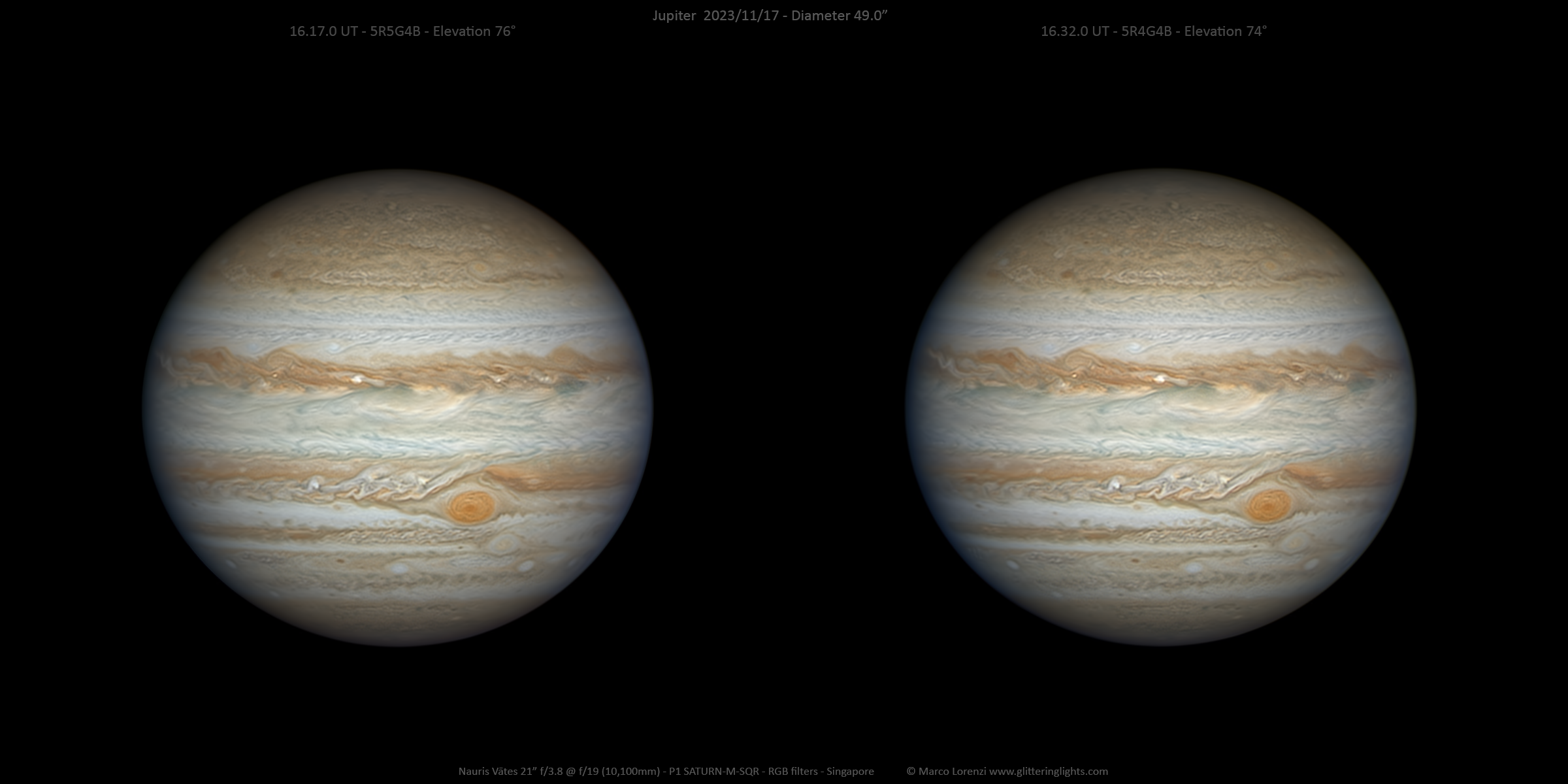
Stereo Jupiter near Opposition
24/11/2023
Jupiter looks sharp in these two rooftop telescope images. Both were captured on November 17 from Singapore, planet Earth, about two weeks after Jupiter's 2023 opposition. Climbing high in midnight skies the giant planet was a mere 33.4 light-minutes from Singapore. That's about 4 astronomical units away. Jupiter's planet girdling dark belts and light zones are visible in remarkable detail, along with the giant world's whitish oval vortices. Its signature Great Red Spot is still prominent in the south. Jupiter rotates rapidly on its axis once every 10 hours. So, based on video frames taken only 15 minutes apart, these images form a stereo pair. Look at the center of the pair and cross your eyes until the separate images come together to see the Solar System's ruling gas giant in 3D.
Copyright: Marco Lorenzi
Η Αστρονομική Εικόνα της Ημέρας από τη NASA (NASA Astronomy Picture of the Day) είναι μια δωρεάν υπηρεσία που παρέχει καθημερινά μια εντυπωσιακή εικόνα από το σύμπαν, την λήψη της οποίας έχει πραγματοποιήσει κάποιος από τους αστρονόμους της NASA ή από κάποιον από τους δορυφόρους ή τα τηλεσκόπια που η NASA λειτουργεί. Οι εικόνες που εμφανίζονται καλύπτουν μια ευρεία γκάμα από θέματα, συμπεριλαμβανομένων των αστερισμών, των γαλαξιών, των πλανητικών συστημάτων, των κομητών, των αστρικών σωμάτων και των παρατηρητηρίων. Κάθε εικόνα συνοδεύεται από μια σύντομη εξήγηση και πληροφορίες σχετικά με το τι παρατηρείται στην εικόνα.