Η Αστρονομική Εικόνα της Ημέρας από τη NASA
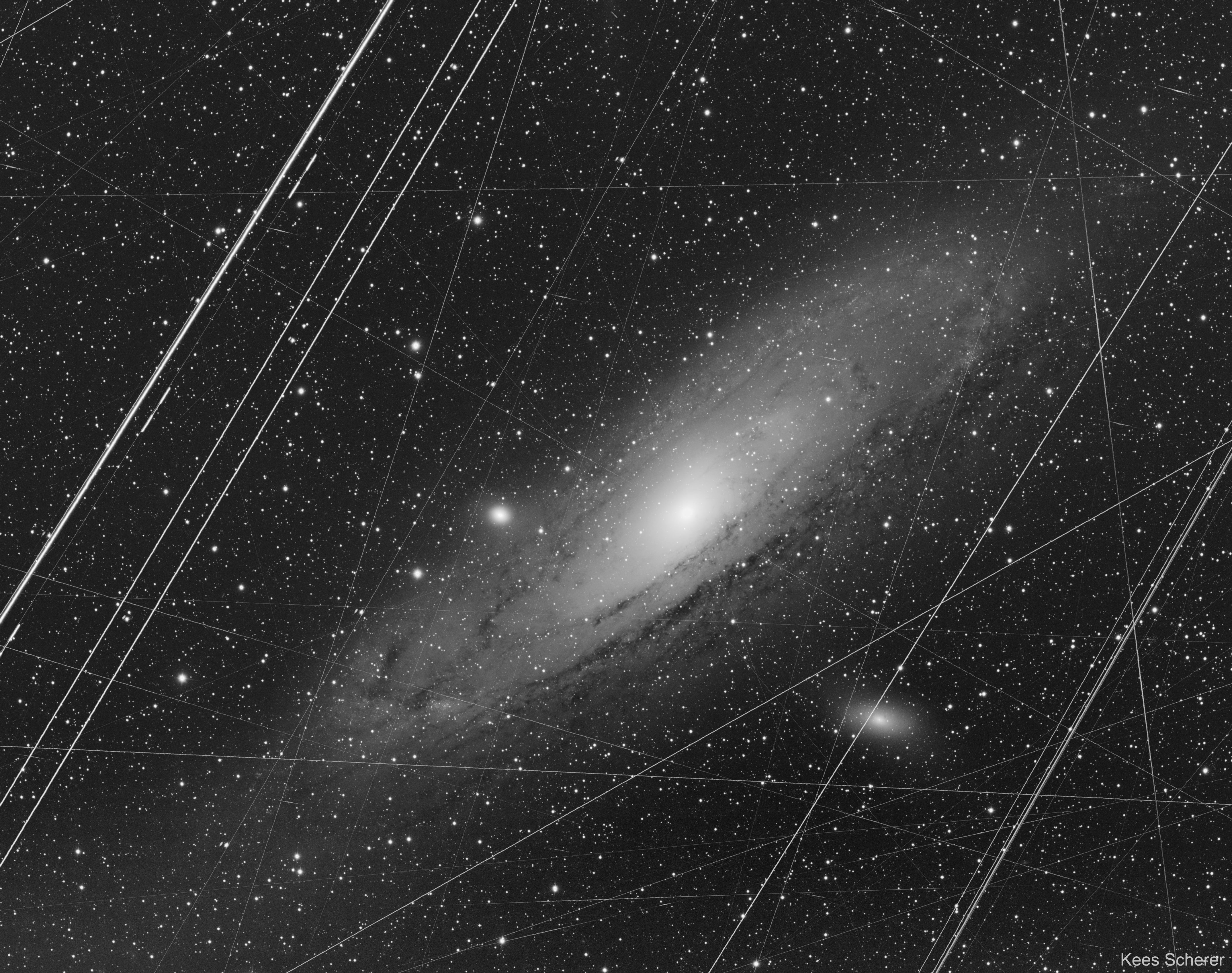
Andromeda before Photoshop
27/09/2026
What does the Andromeda galaxy really look like? The featured image shows how our Milky Way Galaxy's closest major galactic neighbor really appears in a long exposure through Earth's busy skies and with a digital camera that introduces normal imperfections. The picture is a stack of 223 images, each a 300 second exposure, taken from a garden observatory in Portugal during 2019. Obvious image deficiencies include bright parallel airplane trails, long and continuous satellite trails, short cosmic ray streaks, and bad pixels. These imperfections were actually not removed with Photoshop specifically, but rather greatly reduced with a series of computer software packages that included Astro Pixel Processor, DeepSkyStacker, and PixInsight. All of this work was done not to deceive you with a digital fantasy that has little to do with the real likeness of the Andromeda galaxy (M31), but to minimize Earthly artifacts that have nothing to do with the distant galaxy and so better recreate what M31 really does look like. APOD's email for image submissions has changed. Please see: APOD Submissions APOD's main NASA site is moving: From apod.nasa.gov to science.nasa.gov/apod
Copyright: NASA
Προηγούμενες Αστρονομικές Εικόνες της Ημέρας από τη NASA

IC 443: The Jellyfish Nebula
26/12/2023
Why is this jellyfish swimming in a sea of stars? Drifting near bright star Eta Geminorum, seen at the right, the Jellyfish Nebula extends its tentacles from the bright arcing ridge of emission left of center. In fact, the cosmic jellyfish is part of bubble-shaped supernova remnant IC 443, the expanding debris cloud from a massive star that exploded. Light from the explosion first reached planet Earth over 30,000 years ago. Like its cousin in astronomical waters, the Crab Nebula supernova remnant IC 443 is known to harbor a neutron star -- the remnant of the collapsed stellar core. The Jellyfish Nebula is about 5,000 light-years away. At that distance, the featured image would span about 140 light-years across. Your Sky Surprise: What picture did APOD feature on your birthday? (post 1995)
Copyright: David Payne
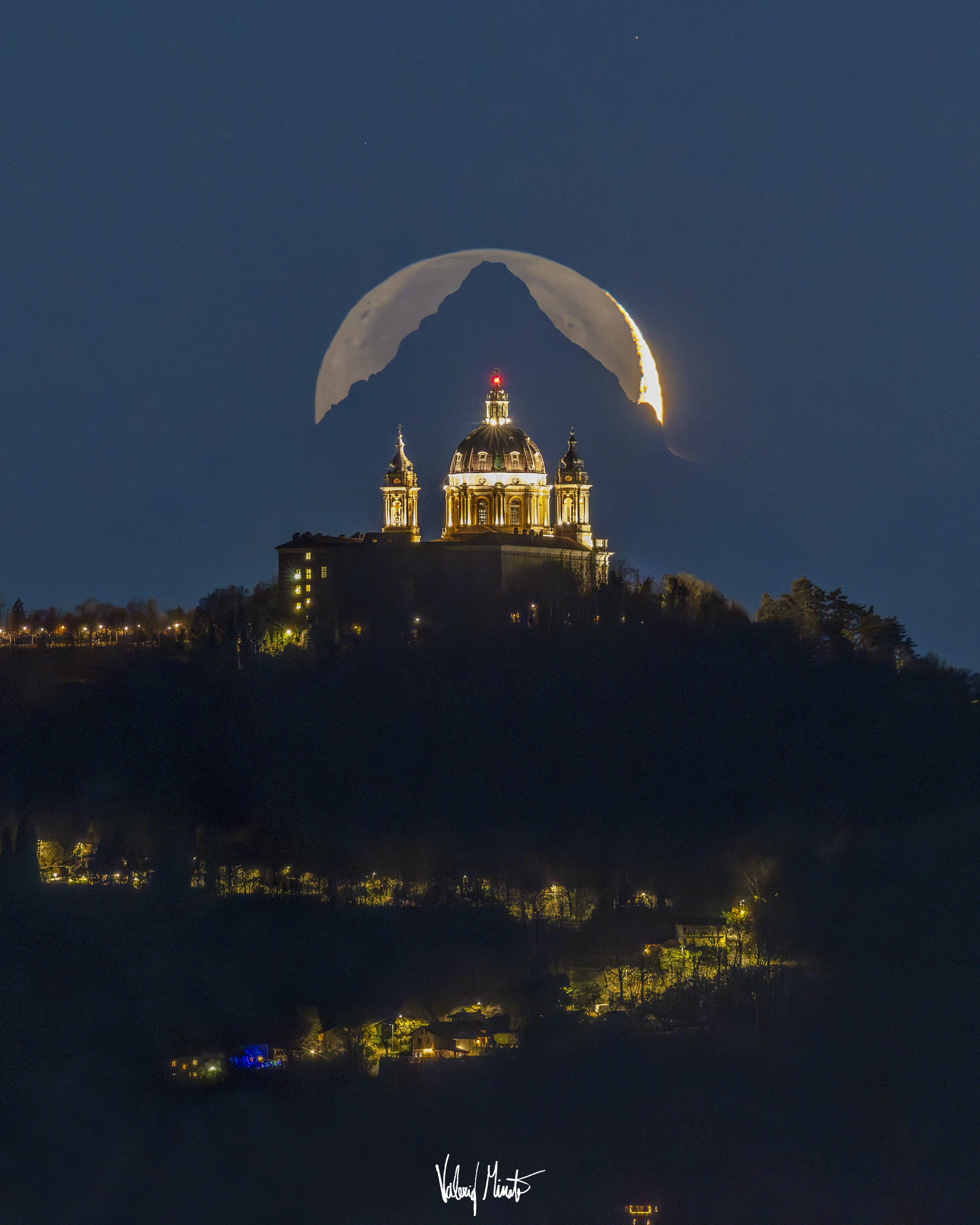
Cathedral, Mountain, Moon
25/12/2023
Single shots like this require planning. The first step is to realize that such an amazing triple-alignment actually takes place. The second step is to find the best location to photograph it. But it was the third step: being there at exactly the right time -- and when the sky was clear -- that was the hardest. Five times over six years the photographer tried and found bad weather. Finally, just ten days ago, the weather was perfect, and a photographic dream was realized. Taken in Piemonte, Italy, the cathedral in the foreground is the Basilica of Superga, the mountain in the middle is Monviso, and, well, you know which moon is in the background. Here, even though the setting Moon was captured in a crescent phase, the exposure was long enough for doubly reflected Earthlight, called the da Vinci glow, to illuminate the entire top of the Moon. Your Sky Surprise: What picture did APOD feature on your birthday? (post 1995)
Copyright: Valerio Minato
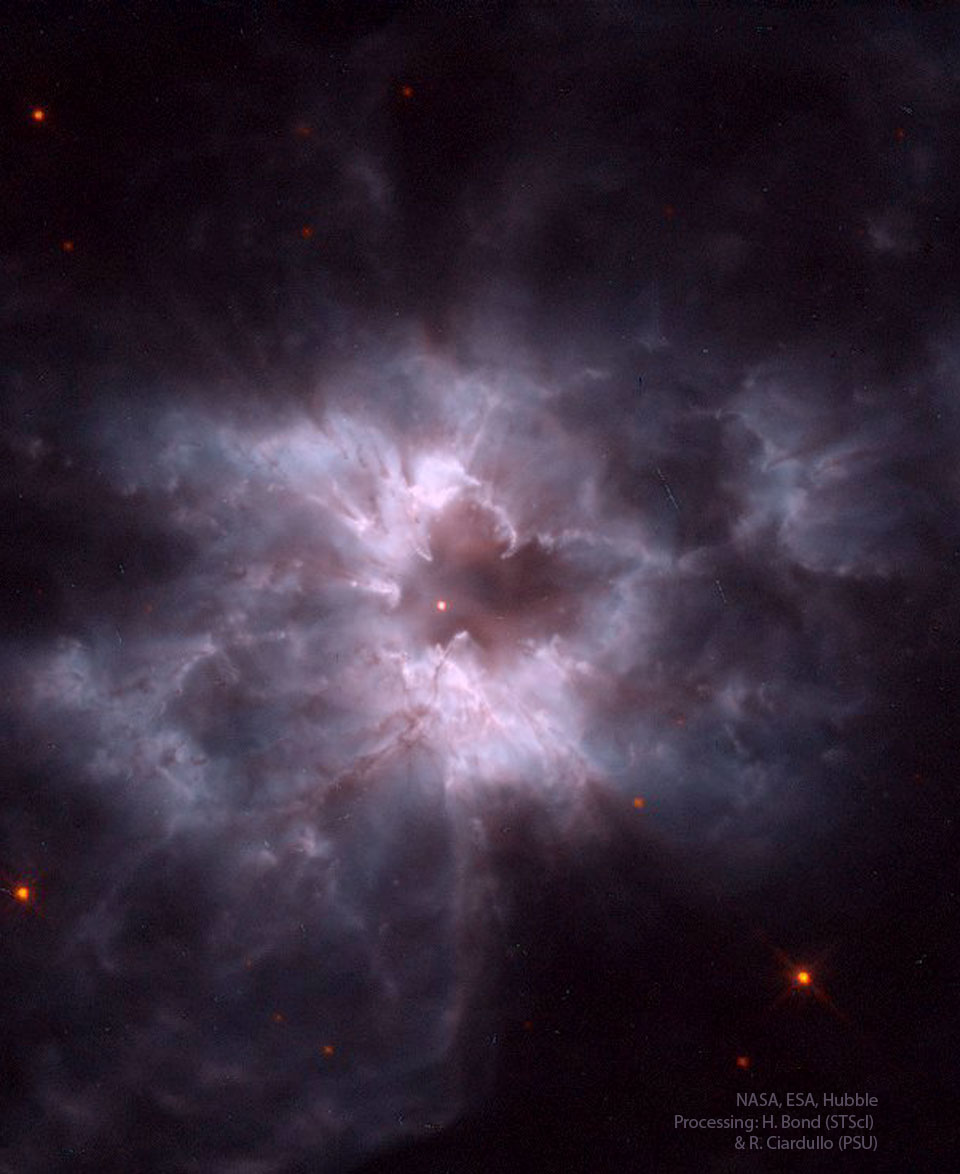
NGC 2440: Cocoon of a New White Dwarf
24/12/2023
What's that in the center? Like a butterfly, a white dwarf star begins its life by casting off a cocoon of gas that enclosed its former self. In this analogy, however, the Sun would be a caterpillar and the ejected shell of gas would become the prettiest cocoon of all. In the featured cocoon, the planetary nebula designated NGC 2440 contains one of the hottest white dwarf stars known. The white dwarf can be seen as the bright orange dot near the image center. Our Sun will eventually become a white dwarf butterfly, but not for another 5 billion years.
Copyright: NASA
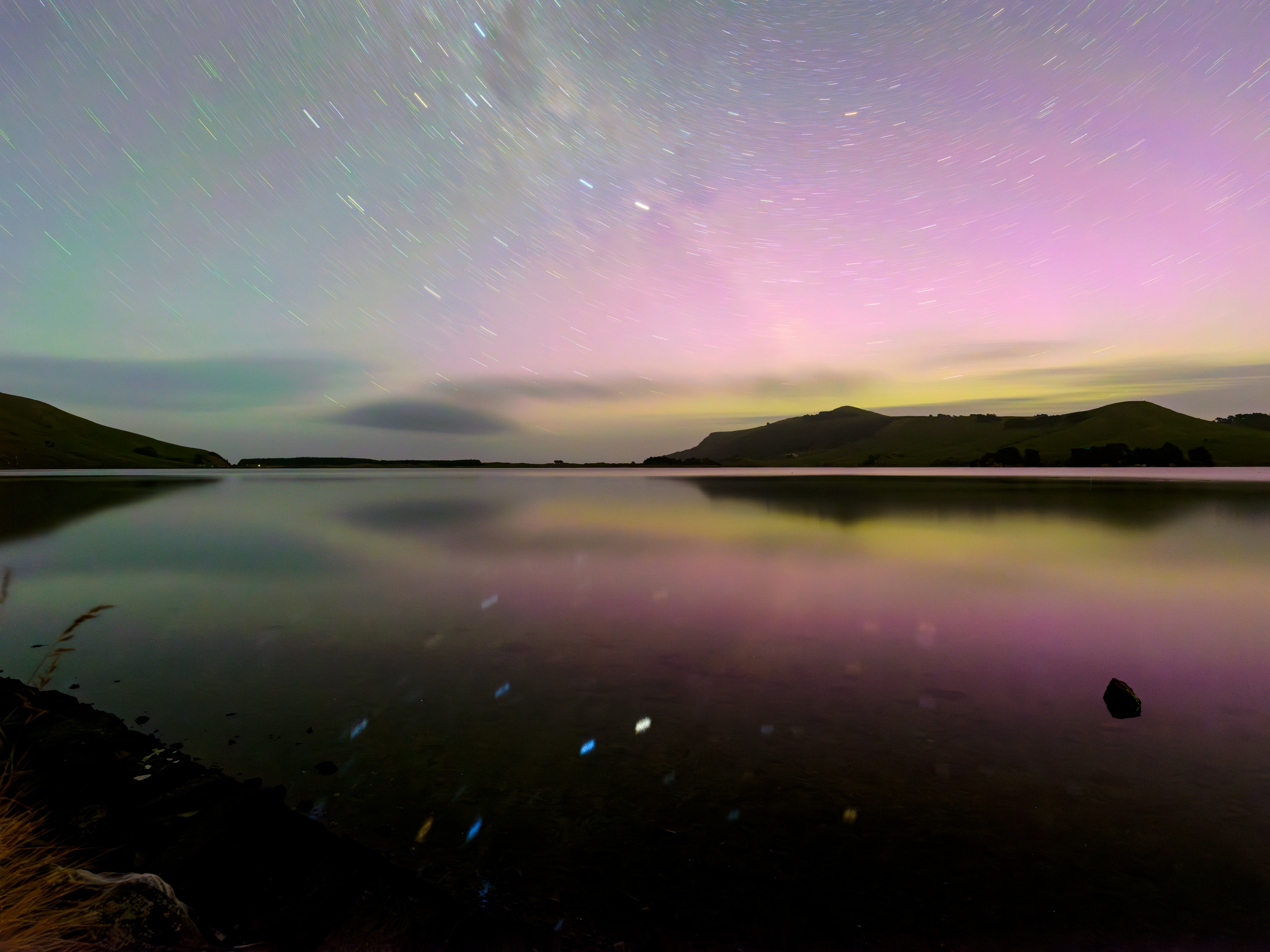
A December Summer Night
23/12/2023
Colours of a serene evening sky are captured in this 8 minute exposure, made near this December's solstice from New Zealand, southern hemisphere, planet Earth. Looking south, star trails form the short concentric arcs around the rotating planet's south celestial pole positioned just off the top of the frame. At top and left of center are trails of the Southern Cross stars and a dark smudge from the Milky Way's Coalsack Nebula. Alpha and Beta Centauri make the brighter yellow and blue tinted trails, reflected below in the waters of Hoopers Inlet in the Pacific coast of the South Island's Otago Peninsula. On that short December summer night, aurora australis also gave luminous, green and reddish hues to the sky above the hills. Aurora shine as atoms and molecules in the upper atmosphere are excited by collisions with energetic particles. An upper atmospheric glow distinct from the aurora, a pale greenish airglow caused by a cascade of chemical reactions excited by sunlight, can be traced in diagonal bands at top left.
Copyright: Ian Griffin
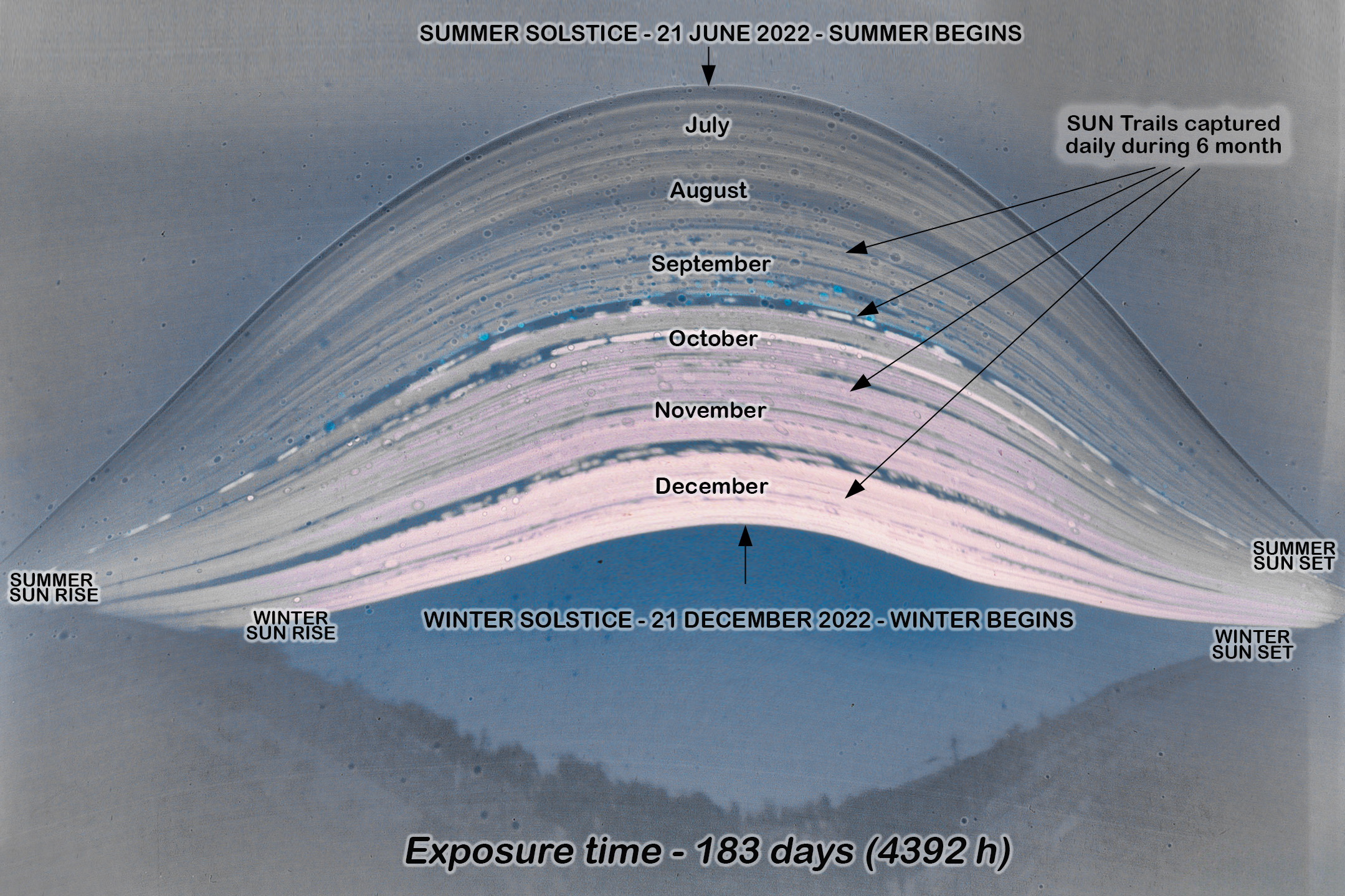
183 Days in the Sun
22/12/2023
A single 183 day exposure with a pinhole camera and photographic paper resulted in this long-duration solargraph. Recorded from solstice to solstice, June 21 to December 21, in 2022, it follows the Sun's daily arcing path through planet Earth's skies from Mertola, Portugal. On June 21, the Sun's highest point and longest arc represents the longest day and the astronomical beginning of summer in the northern hemisphere. The solstice date with the fewest hours of daylight is at the beginning of winter in the north, corresponding to the Sun's shortest and lowest arc in the 2022 solargraph. For 2023, the northern winter solstice was on December 22 at 3:27 UTC. That's December 21 for North America time zones.
Copyright: solargraph
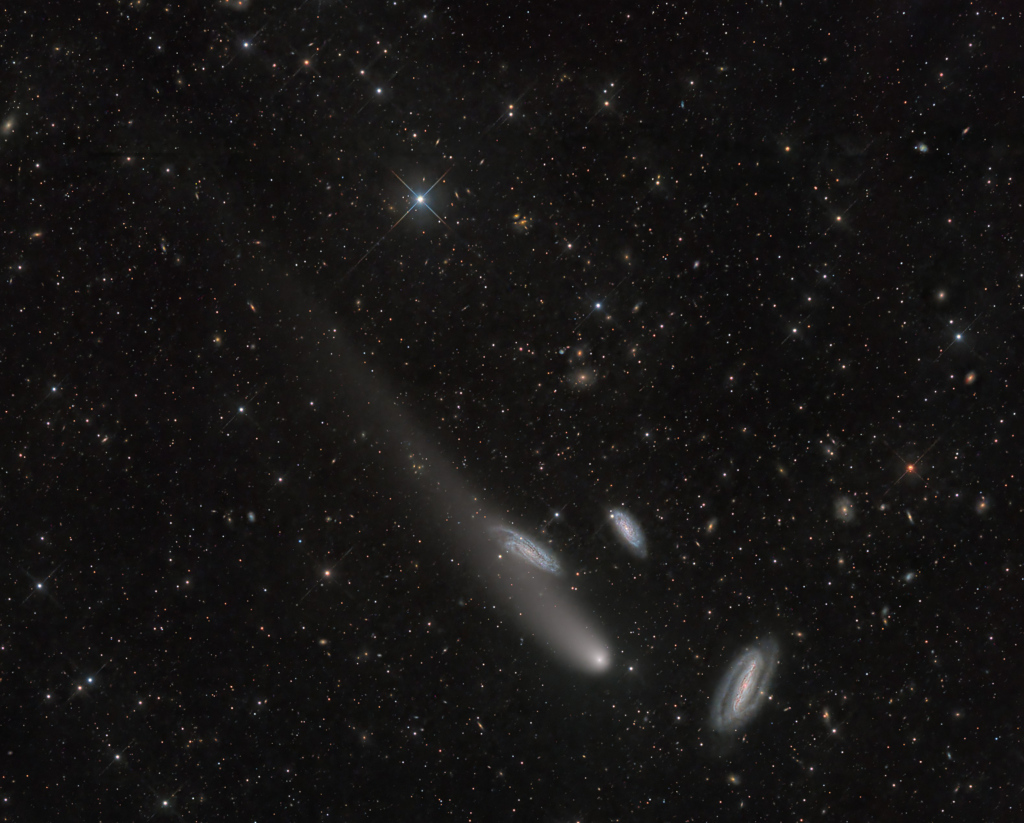
Three Galaxies and a Comet
21/12/2023
Distant galaxies abound in this one degree wide field of view toward the southern constellation Grus (The Crane). But the three spiral galaxies at the lower right are quite striking. In fact, all three galaxies are grouped about 70 million light years away and sometimes known as the Grus Triplet. They share the pretty telescopic frame, recorded on December 13, with the comet designated C/2020 V2 ZTF. Now outbound from the inner Solar System and swinging below the ecliptic plane in a hyperbolic orbit, the comet was about 29 light-minutes from our fair planet in this image. And though this comet ZTF was brighter when it was closest to the Sun last May and closest to Earth in September of 2023, it still shines in telescopes pointed toward southern night skies, remaining almost as bright as the Grus Triplet galaxies.
Copyright: Dan Bartlett
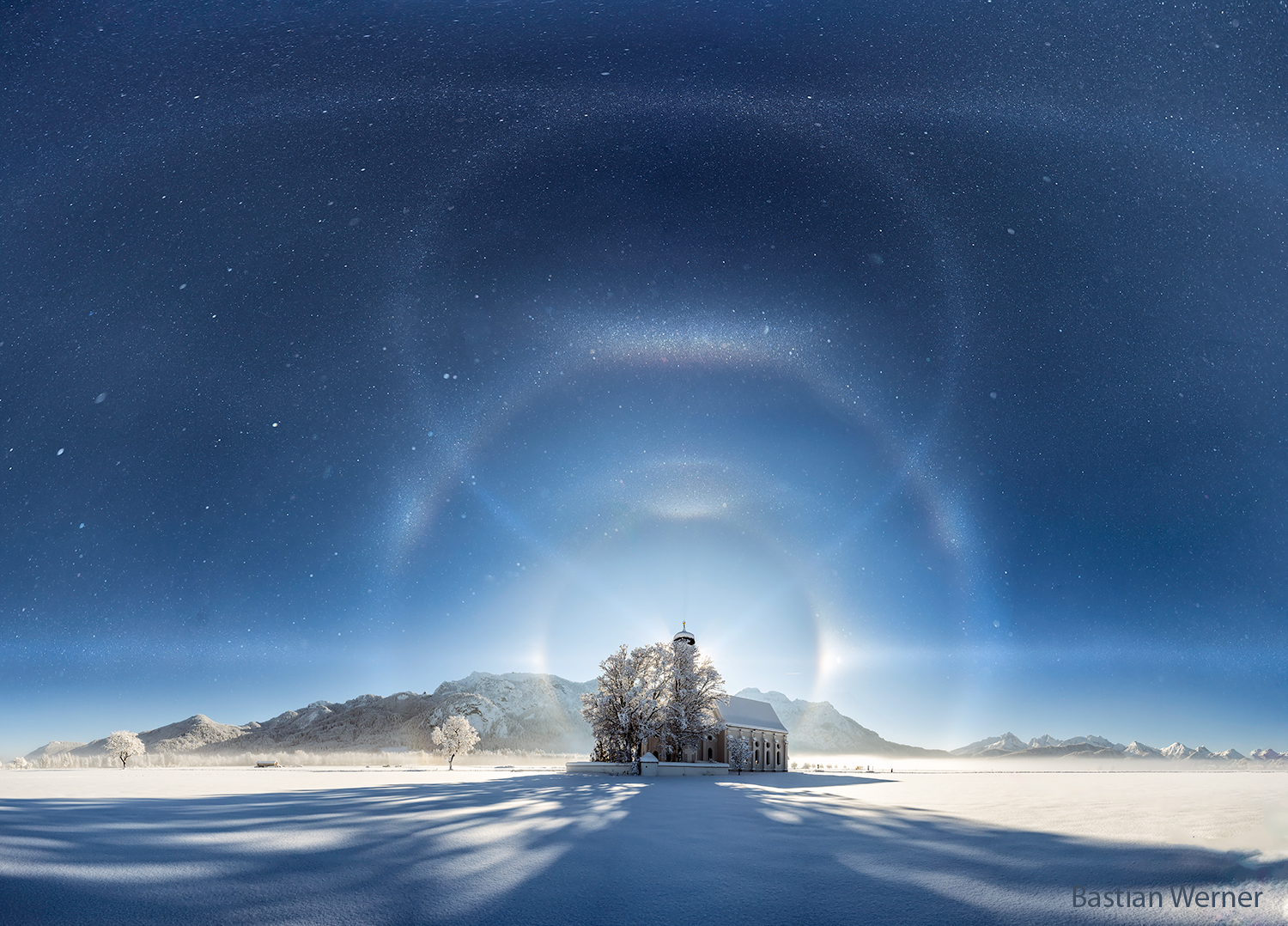
Ice Halos over Bavaria
20/12/2023
What's causing those unusual sky arcs? Ice crystals. While crossing a field of fresh snow near Füssen, Bavaria, Germany, earlier this month, the photographer noticed that he had entered an ice fog. For suspended water to freeze into an ice fog requires quite cold temperatures, and indeed the air temperature on this day was measured at well below zero. The ice fog reflected light from the Sun setting behind St. Coleman Church. The result was one of the greatest spectacles the photographer has ever seen. First, the spots in the featured picture are not background stars but suspended ice and snow. Next, two prominent ice halos are visible: the 22-degree halo and the 46-degree halo. Multiple arcs are also visible, including, from top to bottom, antisolar (subsun), circumzenithal, Parry, tangent, and parhelic (horizontal). Finally, the balloon shaped curve connecting the top arc to the Sun is the rarest of all: it is the heliac arc, created by reflection from the sides of hexagonally shaped ice crystals suspended in a horizontal orientation.
Copyright: Bastian Werner
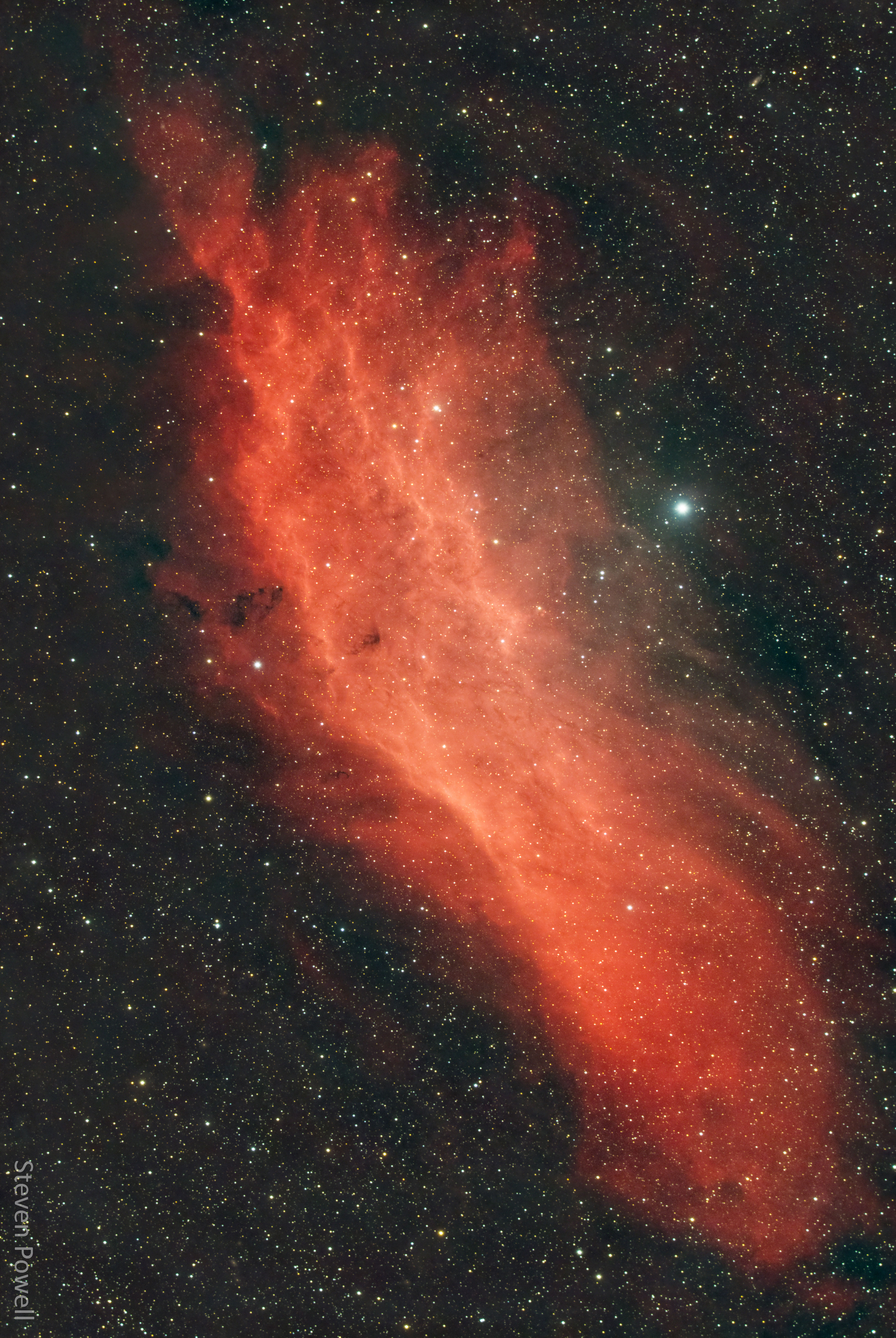
NGC 1499: The California Nebula
19/12/2023
Could Queen Calafia's mythical island exist in space? Perhaps not, but by chance the outline of this molecular space cloud echoes the outline of the state of California, USA. Our Sun has its home within the Milky Way's Orion Arm, only about 1,000 light-years from the California Nebula. Also known as NGC 1499, the classic emission nebula is around 100 light-years long. On the featured image, the most prominent glow of the California Nebula is the red light characteristic of hydrogen atoms recombining with long lost electrons, stripped away (ionized) by energetic starlight. The star most likely providing the energetic starlight that ionizes much of the nebular gas is the bright, hot, bluish Xi Persei just to the right of the nebula. A regular target for astrophotographers, the California Nebula can be spotted with a wide-field telescope under a dark sky toward the constellation of Perseus, not far from the Pleiades. Explore Your Universe: Random APOD Generator
Copyright: Steven Powell
Η Αστρονομική Εικόνα της Ημέρας από τη NASA (NASA Astronomy Picture of the Day) είναι μια δωρεάν υπηρεσία που παρέχει καθημερινά μια εντυπωσιακή εικόνα από το σύμπαν, την λήψη της οποίας έχει πραγματοποιήσει κάποιος από τους αστρονόμους της NASA ή από κάποιον από τους δορυφόρους ή τα τηλεσκόπια που η NASA λειτουργεί. Οι εικόνες που εμφανίζονται καλύπτουν μια ευρεία γκάμα από θέματα, συμπεριλαμβανομένων των αστερισμών, των γαλαξιών, των πλανητικών συστημάτων, των κομητών, των αστρικών σωμάτων και των παρατηρητηρίων. Κάθε εικόνα συνοδεύεται από μια σύντομη εξήγηση και πληροφορίες σχετικά με το τι παρατηρείται στην εικόνα.