Η Αστρονομική Εικόνα της Ημέρας από τη NASA

Cosmic Latte: The Average Color of the Universe
28/09/2026
What color is the universe? More precisely, if the entire sky were smeared out, what color would the final mix be? This whimsical question came up when trying to determine what stars are commonplace in nearby galaxies. The answer, depicted here, is a conditionally perceived shade of beige. In computer parlance: #FFF8E7. To determine this, astronomers computationally averaged the light emitted by one of the larger samples of galaxies analyzed: the 200,000 galaxies of the 2dF Galaxy Redshift Survey. The resulting cosmic spectrum has some emission in all parts of the electromagnetic spectrum, but a single perceived composite color. This color has become much less blue over the past 10 billion years, indicating that redder stars are becoming more prevalent. In a contest to better name the color, notable entries included skyvory, univeige, and the winner: cosmic latte. APOD's email for image submissions has changed. Please see: APOD Submissions Tomorrow: APOD's main NASA site is moving: From apod.nasa.gov to science.nasa.gov/apod
Copyright: NASA
Προηγούμενες Αστρονομικές Εικόνες της Ημέρας από τη NASA
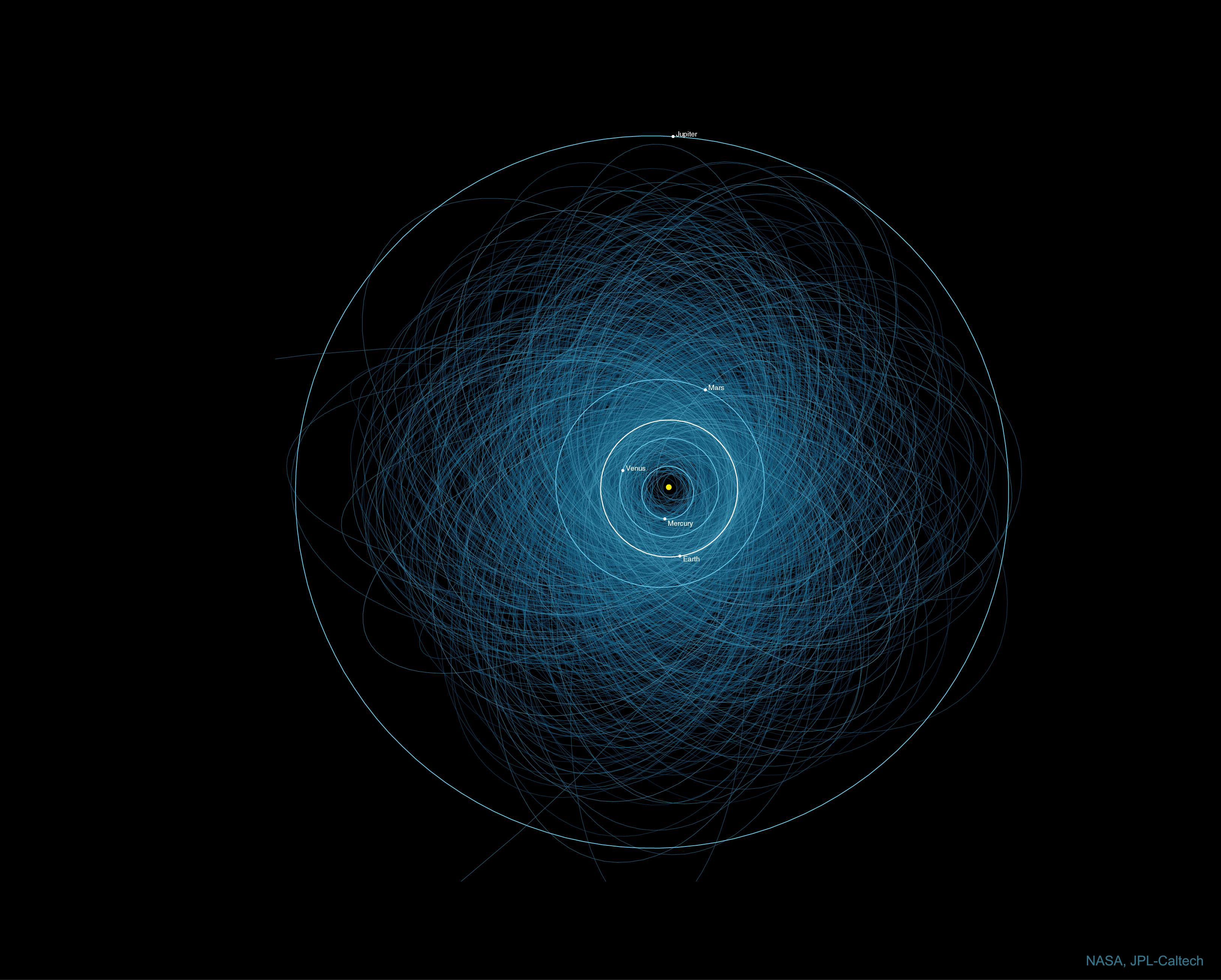
Orbits of Potentially Hazardous Asteroids
30/06/2023
Are asteroids dangerous? Some are, but the likelihood of a dangerous asteroid striking the Earth during any given year is low. Because some past mass extinction events have been linked to asteroid impacts, however, humanity has made it a priority to find and catalog those asteroids that may one day affect life on Earth. Pictured here are the orbits of the over 1,000 known Potentially Hazardous Asteroids (PHAs). These documented tumbling boulders of rock and ice are over 140 meters across and will pass within 7.5 million kilometers of Earth -- about 20 times the distance to the Moon. Although none of them will strike the Earth in the next 100 years -- not all PHAs have been discovered, and past 100 years, many orbits become hard to predict. Were an asteroid of this size to impact the Earth, it could raise dangerous tsunamis, for example. To investigate Earth-saving strategies, NASA successfully tested the Double Asteroid Redirection Test (DART) mission last year. Of course, rocks and ice bits of much smaller size strike the Earth every day, usually pose no danger, and sometimes create memorable fireball and meteor displays. Today is: Asteroid Day
Copyright: NASA
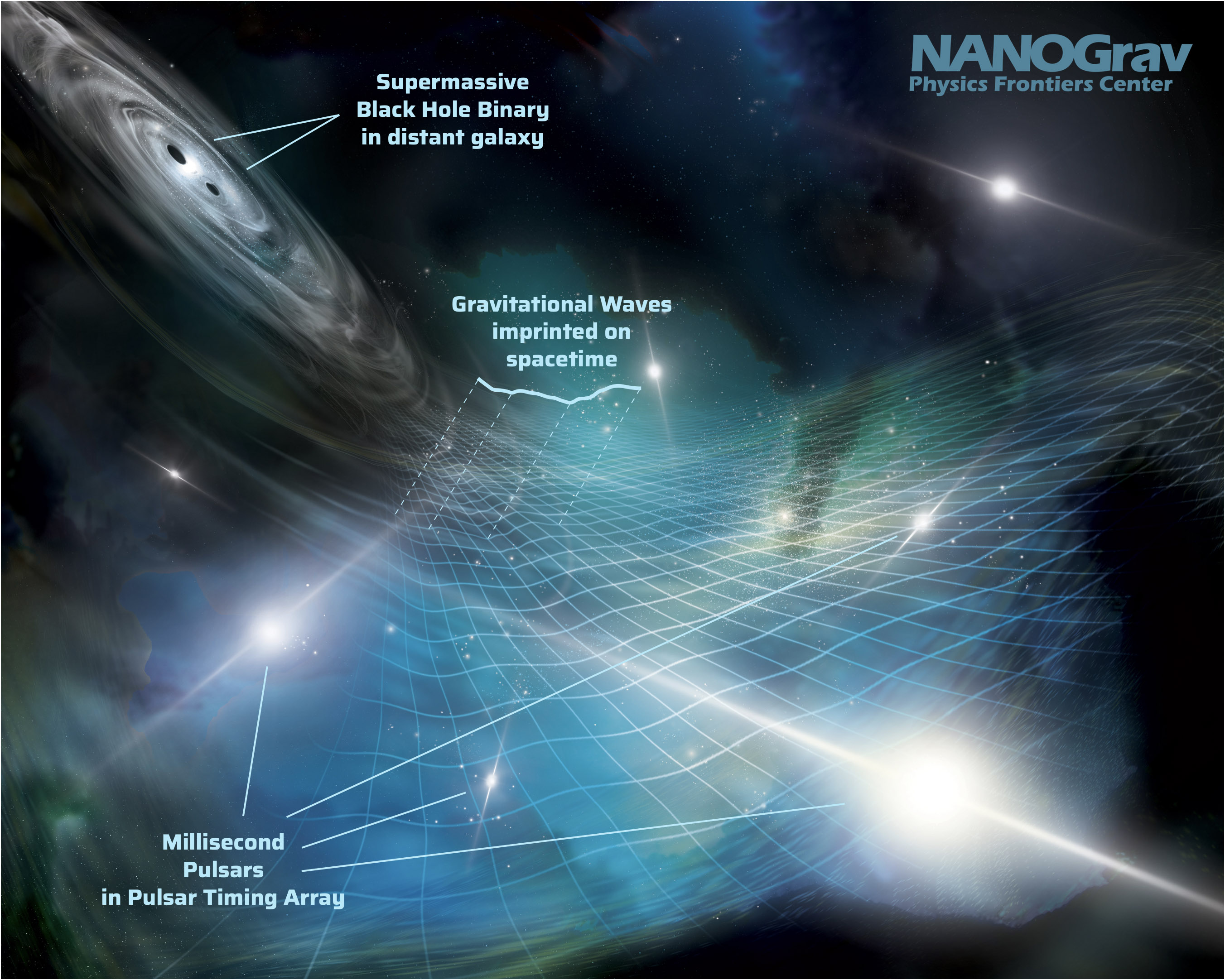
A Message from the Gravitational Universe
29/06/2023
Monitoring 68 pulsars with very large radio telescopes, the North American Nanohertz Observatory for Gravitational Waves (NANOGrav) has uncovered evidence for the gravitational wave (GW) background by carefully measuring slight shifts in the arrival times of pulses. These shifts are correlated between different pulsars in a way that indicates that they are caused by GWs. This GW background is likely due to hundreds of thousands or even millions of supermassive black hole binaries. Teams in Europe, Asia and Australia have also independently reported their results today. Previously, the LIGO and Virgo detectors have detected higher-frequency GWs from the merging of individual pairs of massive orbiting objects, such as stellar-mass black holes. The featured illustration highlights this spacetime-shaking result by depicting two orbiting supermassive black holes and several of the pulsars that would appear to have slight timing shifts. The imprint these GWs make on spacetime itself is illustrated by a distorted grid. Open Science: Browse 3,000+ codes in the Astrophysics Source Code Library
Copyright: NASA
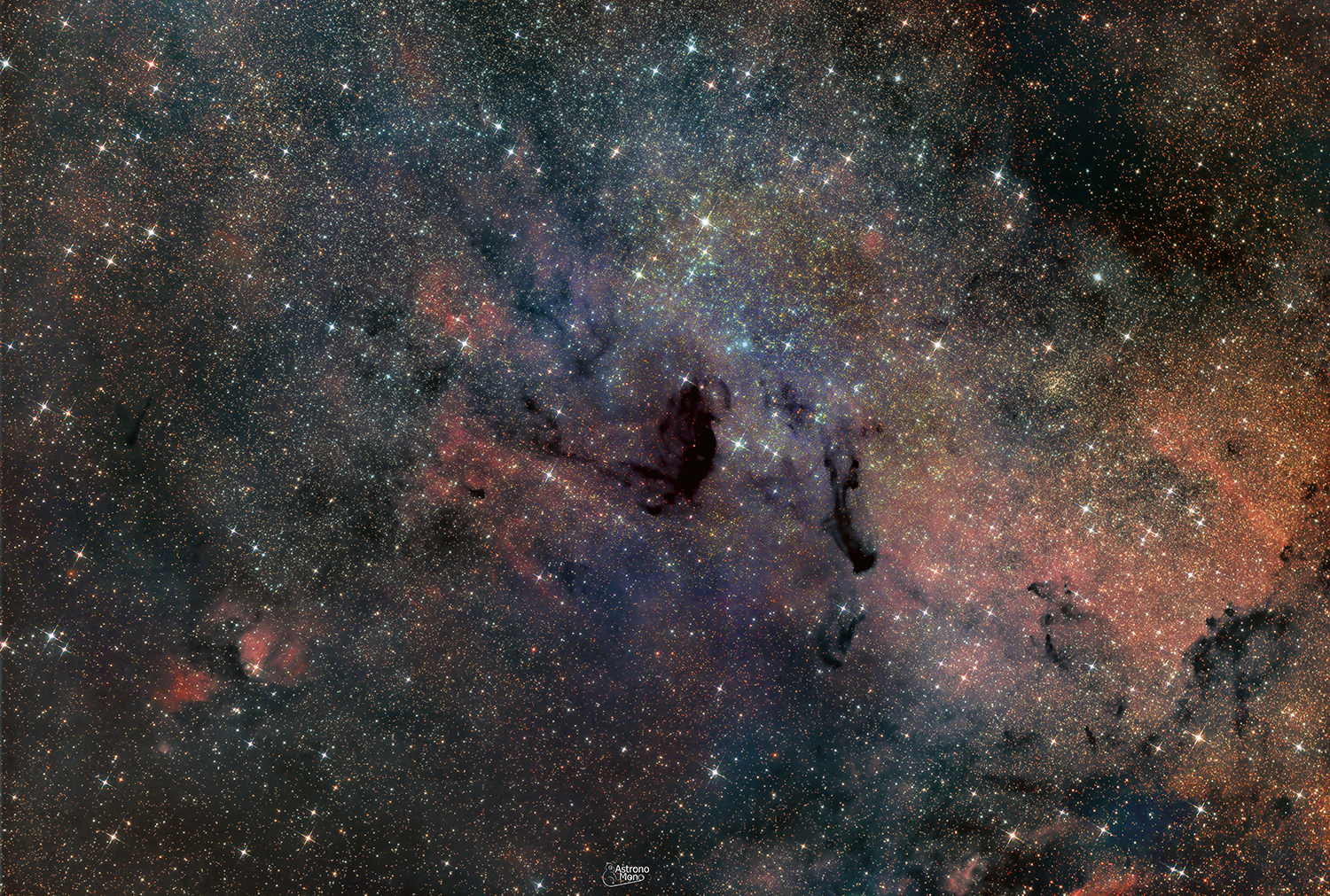
Messier 24: Sagittarius Star Cloud
28/06/2023
Unlike most entries in Charles Messier's famous catalog of deep sky objects, M24 is not a bright galaxy, star cluster, or nebula. It's a gap in nearby, obscuring interstellar dust clouds that allows a view of the distant stars in the Sagittarius spiral arm of our Milky Way galaxy. Direct your gaze through this gap with binoculars or small telescope and you are looking through a window over 300 light-years wide at stars some 10,000 light-years or more from Earth. Sometimes called the Small Sagittarius Star Cloud, M24's luminous stars fill this gorgeous starscape. Covering over 3 degrees or the width of 6 full moons in the constellation Sagittarius, the telescopic field of view includes dark markings B92 and B93 near center, along with other clouds of dust and glowing nebulae toward the center of the Milky Way.
Copyright: Emmanuel Astronomono
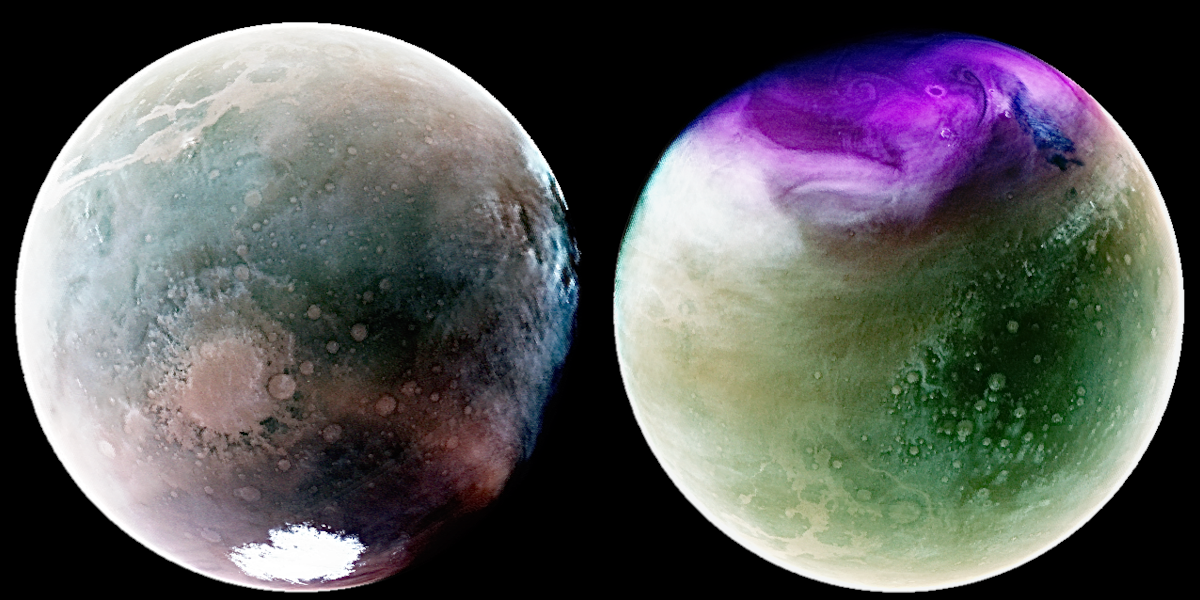
MAVEN's Ultraviolet Mars
27/06/2023
These two global views of Mars were captured at ultraviolet wavelengths, beyond the spectrum visible to human eyes. Recorded by the MAVEN spacecraft's Imaging Ultraviolet Spectrograph instrument in July 2022 (left) and January 2023, three otherwise invisible ultraviolet bands are mapped into red, green, and blue colors. That color scheme presents the Red Planet's surface features in shades of tan and green. Haze and clouds appear white or blue, while high altitude ozone takes on a dramatic purple hue. On the left, Mars' south polar ice cap is in brilliant white at the bottom but shrinking during the southern hemisphere's summer season. On the right, the northern hemisphere's polar region is seen shrouded in clouds and atmospheric ozone. Known to some as the Mars Atmosphere and Volatile EvolutioN spacecraft, MAVEN has been exploring Mars' tenuous upper atmosphere, ionosphere, and its interactions with the Sun and solar wind since 2014.
Copyright: NASA
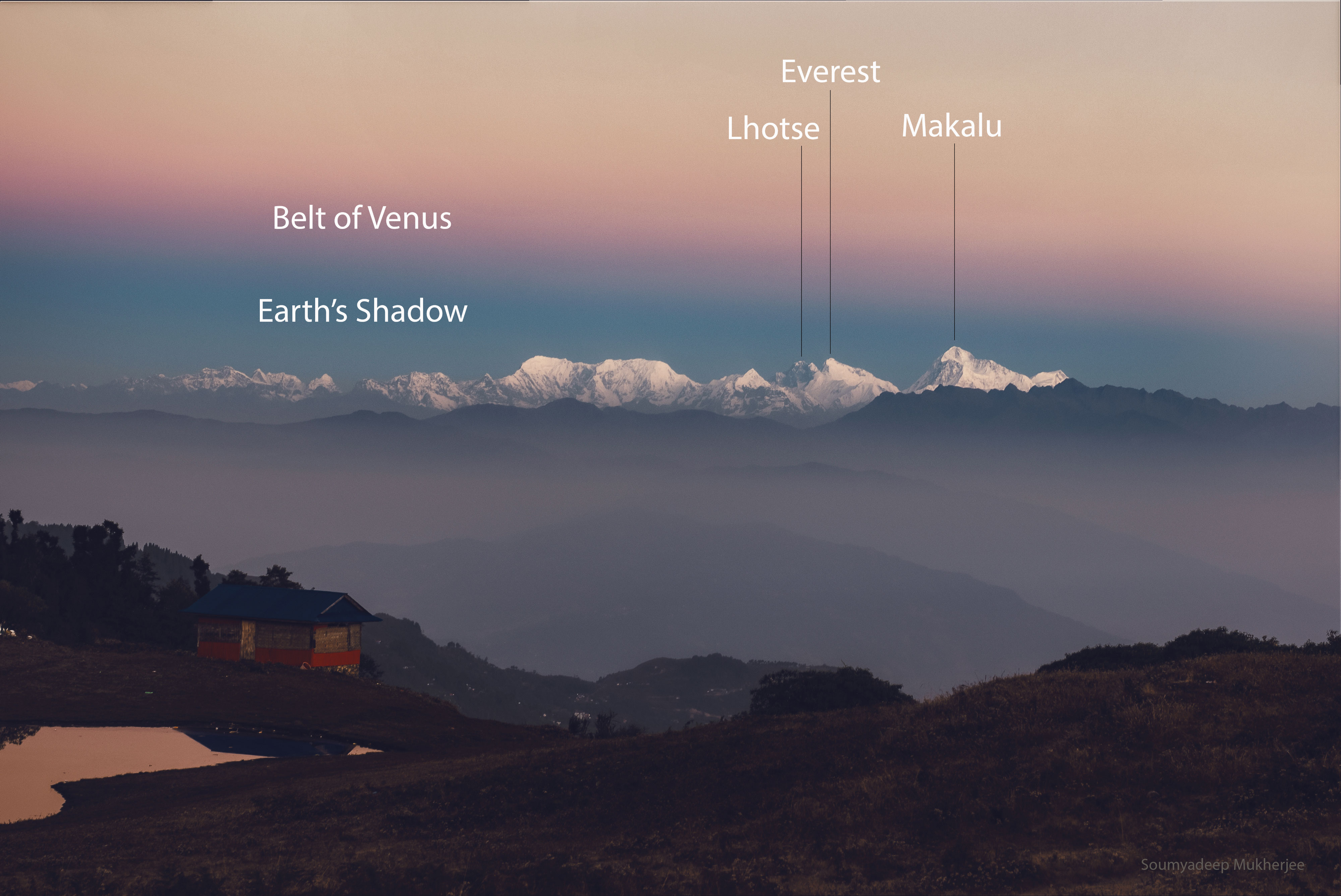
The Belt of Venus over Mount Everest
26/06/2023
You've surely seen it, but you might not have noticed it. During a cloudless twilight, just before sunrise or after sunset, part of the atmosphere above the horizon appears slightly dark and off-color. Called the Belt of Venus, this transitional band between the dark eclipsed sky and the bright day sky can be seen most prominently in the direction opposite the Sun. Straight above, blue sky is normal sunlight reflecting off the atmosphere, while near the horizon the clear sky can appear more orange or red. In the Belt of Venus, the atmosphere reflects more light from the setting (or rising) Sun and so appears more red. Featured here, the Belt of Venus was photographed over several Himalayan mountains including, second from the right, Mount Everest, the tallest mountain on Earth. Although usually not mentioned, the belt is frequently caught by accident in other photographs.
Copyright: Soumyadeep Mukherjee
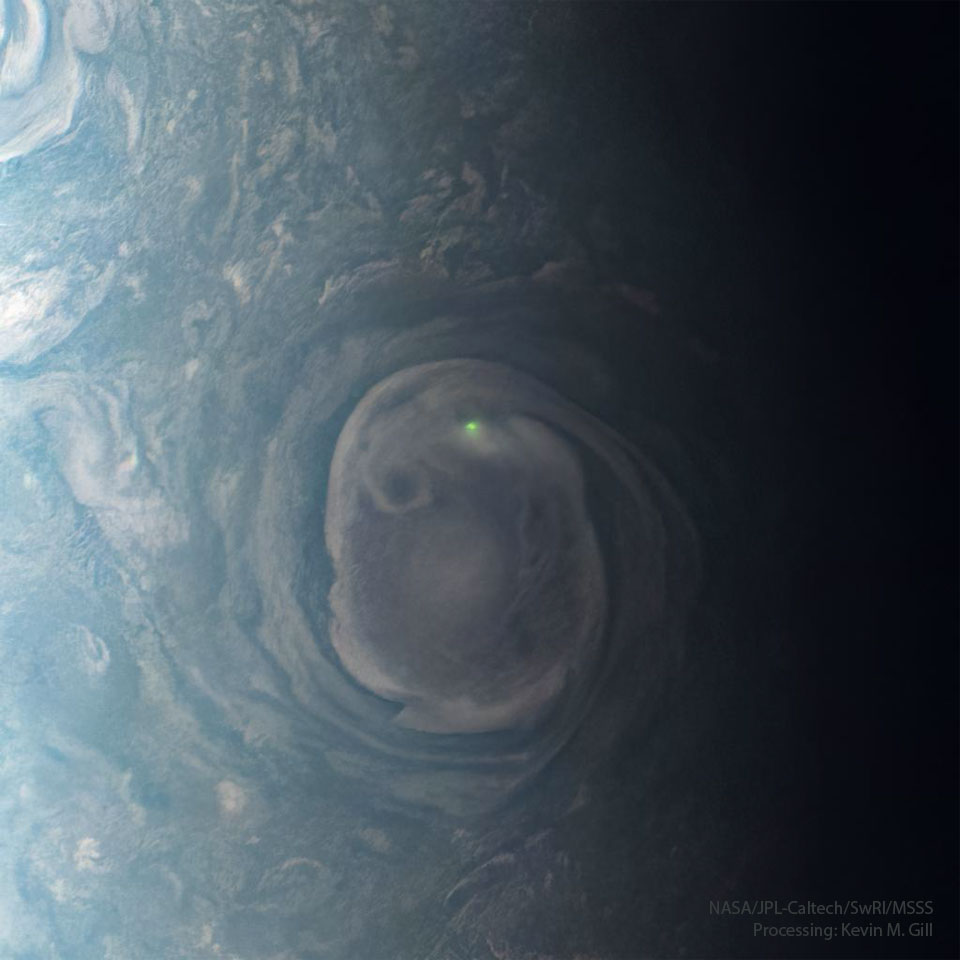
Lightning on Jupiter
25/06/2023
Does lightning occur only on Earth? No. Spacecraft in our Solar System have detected lightning on other planets, including Mars, Jupiter and Saturn, and lightning is likely on Venus, Uranus, and Neptune. Lightning is a sudden rush of electrically charged particles from one location to another. On Earth, drafts of colliding ice and water droplets usually create lightning-generating charge separation, but what happens on Jupiter? Images and data from NASA's Jupiter-orbiting Juno spacecraft bolster previous speculation that Jovian lightning is also created in clouds containing water and ice. In the featured Juno photograph, an optical flash was captured in a large cloud vortex near Jupiter's north pole. During the next few months, Juno will perform several close sweeps over Jupiter's night side, likely allowing the robotic probe to capture more data and images of Jovian lightning.
Copyright: NASA
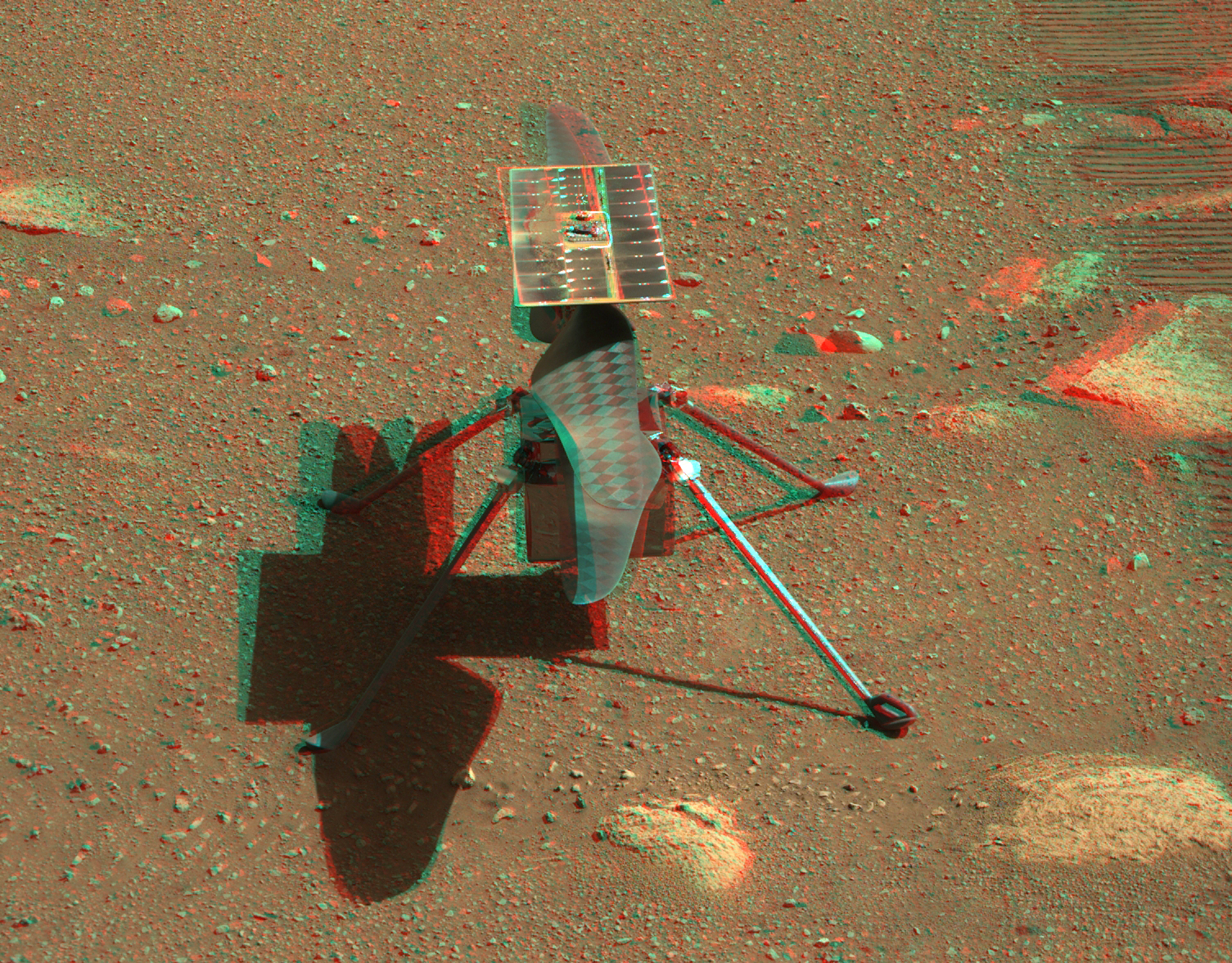
3D Ingenuity
24/06/2023
The multicolor, stereo imaging Mastcam-Z on the Perseverance rover zoomed in to capture this 3D close-up (get out your red/blue glasses) of the Mars Ingenuity helicopter on mission sol 45. That's Earth-date 2021 April 5. Casting a shadow on the Martian surface, Ingenuity is standing alone on its four landing legs next to the rover's wheel tracks. The experimental helicopter's solar panel, charging batteries that keep it warm through the cold Martian nights and power its flight, sits just above Ingenuity's two 1.2 meter (4 foot) long counter-rotating blades. Thirteen sols later, on April 19, Ingenuity became the first aircraft to perform powered, controlled flight on another planet. It has since gone on to complete more than 50 flights through the thin atmosphere of Mars.
Copyright: NASA
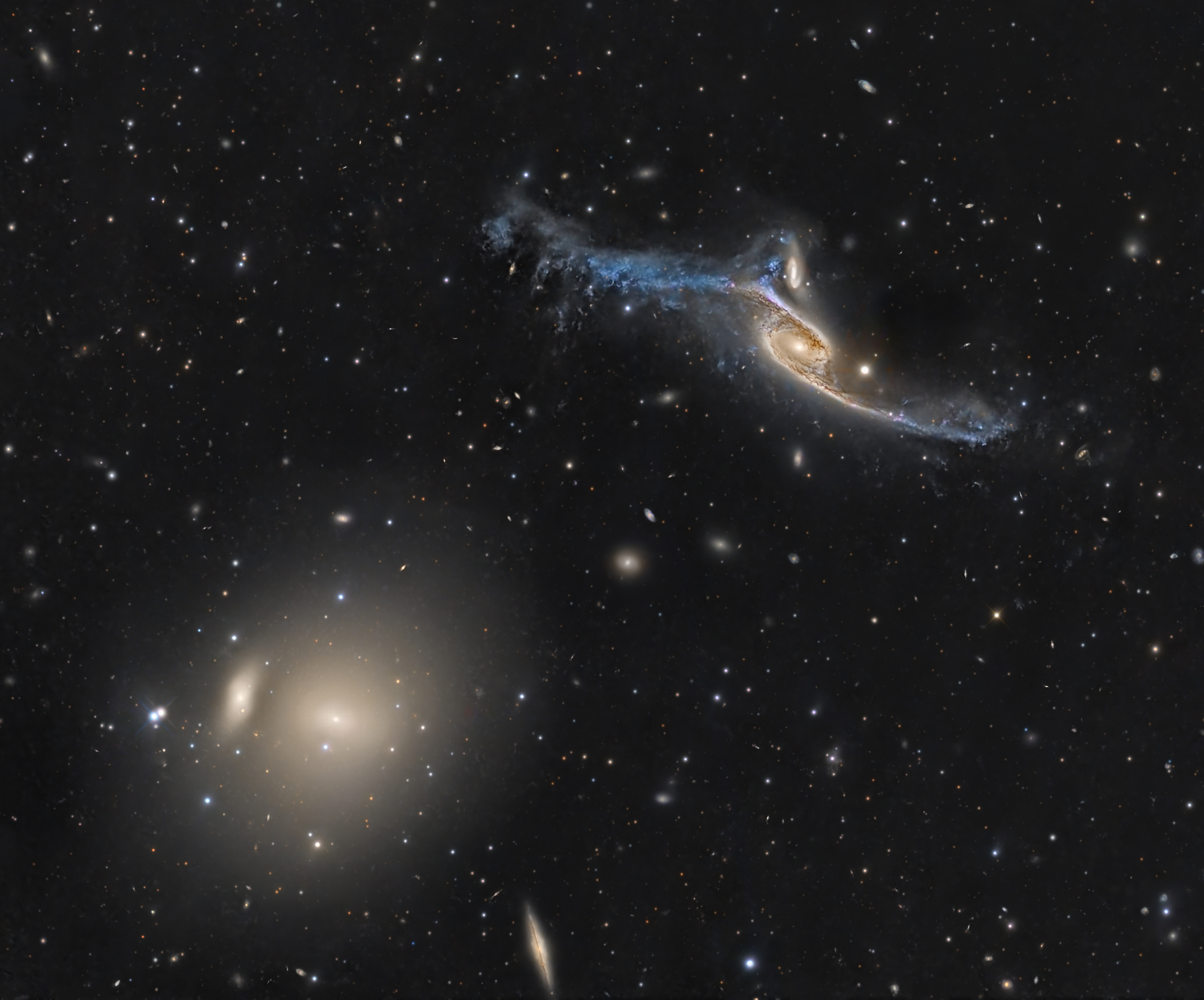
Giant Galaxies in Pavo
23/06/2023
Over 500,000 light years across, NGC 6872 (top right) is a truly enormous barred spiral galaxy, at least 5 times the size of our own very large Milky Way. The appearance of this giant galaxy's distorted and stretched out spiral arms suggests the magnificent wings of a giant bird. Of course its popular moniker is the Condor galaxy. It lies about 200 million light-years distant toward the southern constellation Pavo, the Peacock. Lined with star-forming regions, the distorted spiral arms are due to NGC 6872's gravitational interaction with the nearby smaller galaxy IC 4970, seen just above the giant galaxy's core. The Pavo galaxy group's dominant giant elliptical galaxy, NGC 6876 is below and left of the soaring Condor galaxy.
Copyright: Mike Selby
Η Αστρονομική Εικόνα της Ημέρας από τη NASA (NASA Astronomy Picture of the Day) είναι μια δωρεάν υπηρεσία που παρέχει καθημερινά μια εντυπωσιακή εικόνα από το σύμπαν, την λήψη της οποίας έχει πραγματοποιήσει κάποιος από τους αστρονόμους της NASA ή από κάποιον από τους δορυφόρους ή τα τηλεσκόπια που η NASA λειτουργεί. Οι εικόνες που εμφανίζονται καλύπτουν μια ευρεία γκάμα από θέματα, συμπεριλαμβανομένων των αστερισμών, των γαλαξιών, των πλανητικών συστημάτων, των κομητών, των αστρικών σωμάτων και των παρατηρητηρίων. Κάθε εικόνα συνοδεύεται από μια σύντομη εξήγηση και πληροφορίες σχετικά με το τι παρατηρείται στην εικόνα.