Η Αστρονομική Εικόνα της Ημέρας από τη NASA
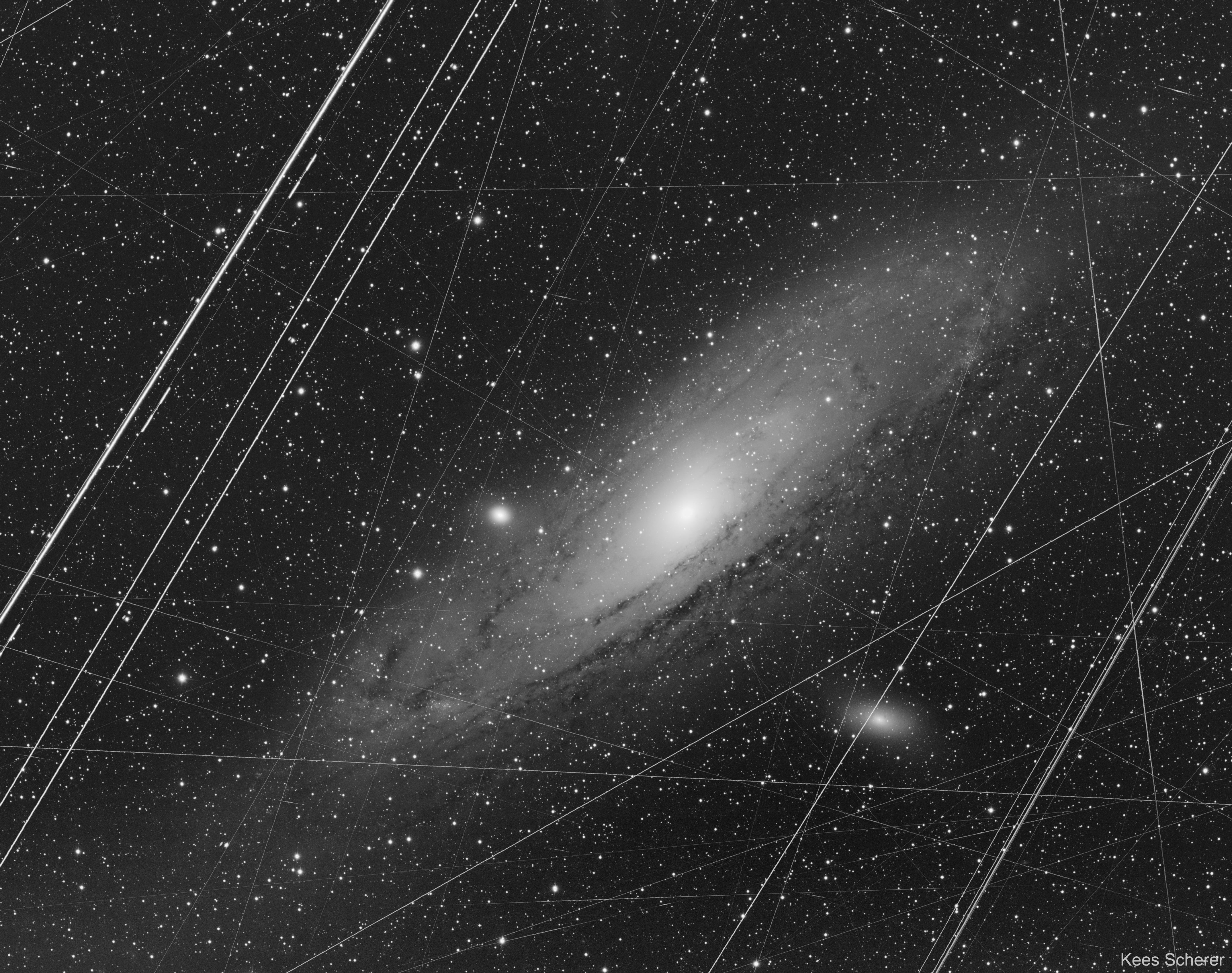
Andromeda before Photoshop
27/09/2026
What does the Andromeda galaxy really look like? The featured image shows how our Milky Way Galaxy's closest major galactic neighbor really appears in a long exposure through Earth's busy skies and with a digital camera that introduces normal imperfections. The picture is a stack of 223 images, each a 300 second exposure, taken from a garden observatory in Portugal during 2019. Obvious image deficiencies include bright parallel airplane trails, long and continuous satellite trails, short cosmic ray streaks, and bad pixels. These imperfections were actually not removed with Photoshop specifically, but rather greatly reduced with a series of computer software packages that included Astro Pixel Processor, DeepSkyStacker, and PixInsight. All of this work was done not to deceive you with a digital fantasy that has little to do with the real likeness of the Andromeda galaxy (M31), but to minimize Earthly artifacts that have nothing to do with the distant galaxy and so better recreate what M31 really does look like. APOD's email for image submissions has changed. Please see: APOD Submissions APOD's main NASA site is moving: From apod.nasa.gov to science.nasa.gov/apod
Copyright: NASA
Προηγούμενες Αστρονομικές Εικόνες της Ημέρας από τη NASA
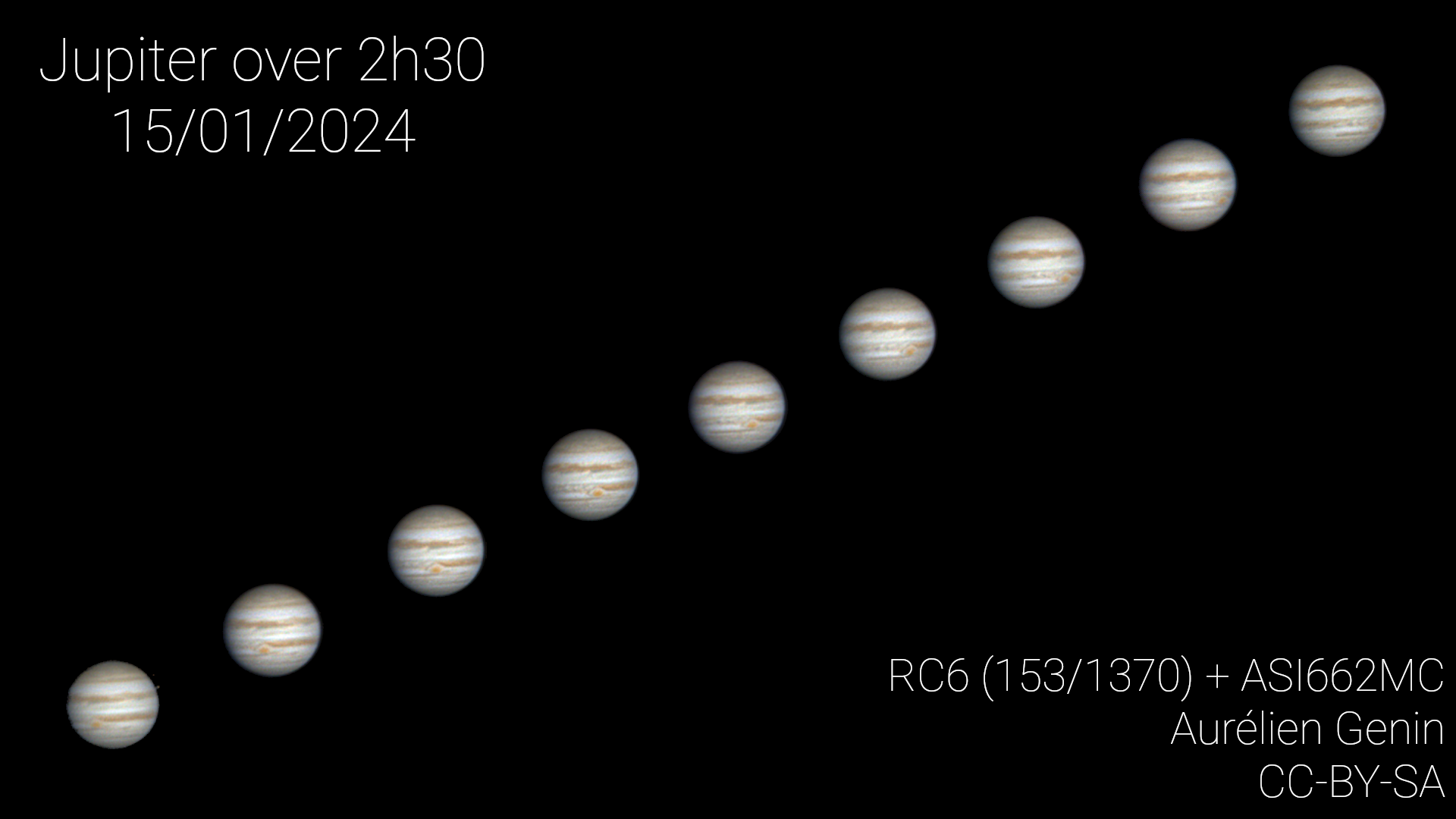
Jupiter over 2 Hours and 30 Minutes
19/01/2024
Jupiter, our Solar System's ruling gas giant, is also the fastest spinning planet, rotating once in less than 10 hours. The gas giant doesn't rotate like a solid body though. A day on Jupiter is about 9 hours and 56 minutes long at the poles, decreasing to 9 hours and 50 minutes near the equator. The giant planet's fast rotation creates strong jet streams, separating its clouds into planet girdling bands of dark belts and bright zones. You can easily follow Jupiter's rapid rotation in this sharp sequence of images from the night of January 15, all taken with a camera and small telescope outside of Paris, France. Located just south of the equator, the giant planet's giant storm system, also known as the Great Red Spot, can be seen moving left to right with the planet's rotation. From lower left to upper right, the sequence spans about 2 hours and 30 minutes.
Copyright: NASA
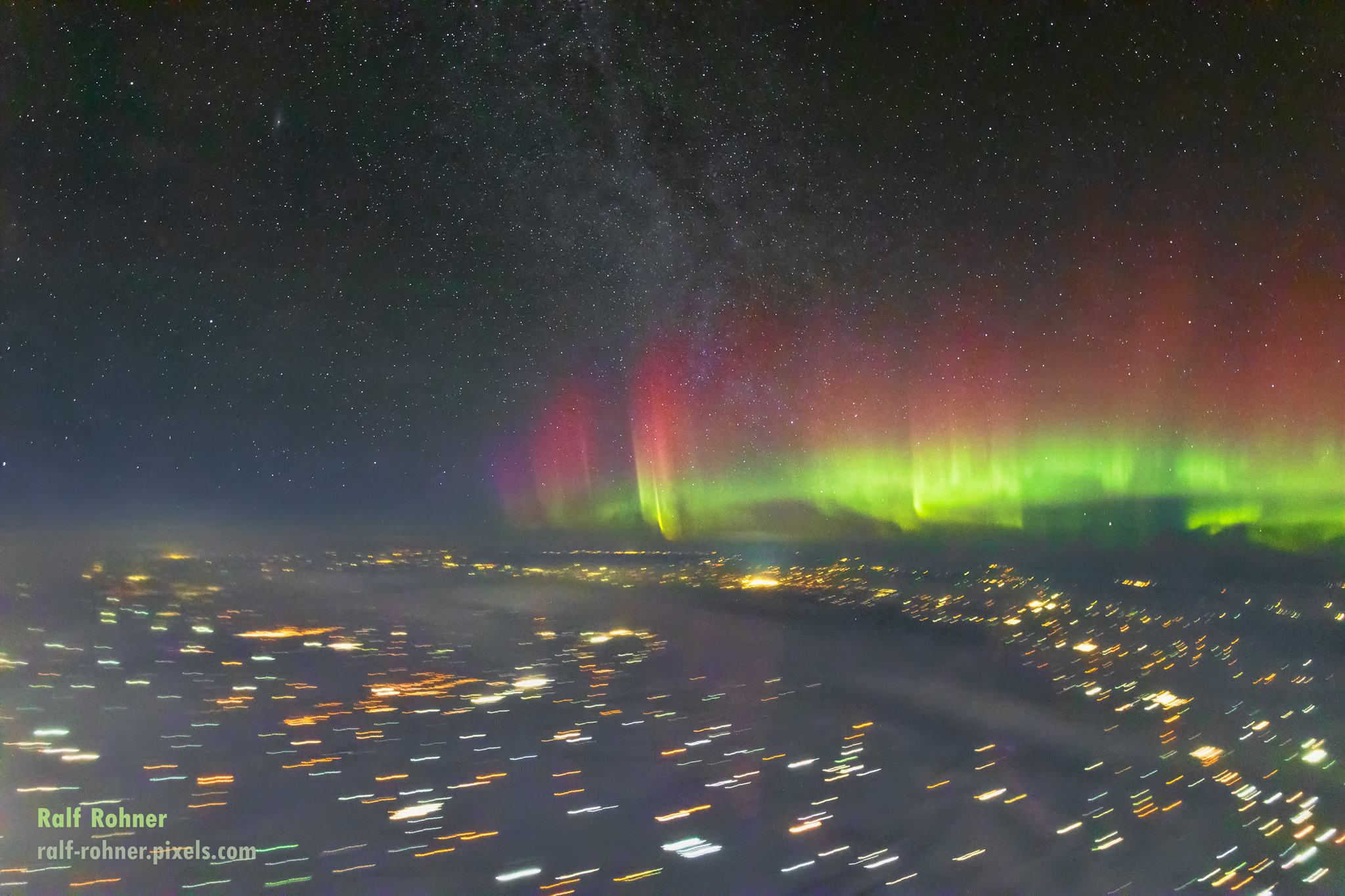
Northern Lights from the Stratosphere
18/01/2024
Northern lights shine in this night skyview from planet Earth's stratosphere, captured on January 15. The single, 5 second exposure was made with a hand-held camera on board an aircraft above Winnipeg, Canada. During the exposure, terrestrial lights below leave colorful trails along the direction of motion of the speeding aircraft. Above the more distant horizon, energetic particles accelerated along Earth's magnetic field at the planet's polar regions excite atomic oxygen to create the shimmering display of Aurora Borealis. The aurora's characteristic greenish hue is generated at altitudes of 100-300 kilometers and red at even higher altitudes and lower atmospheric densities. The luminous glow of faint stars along the plane of our Milky Way galaxy arcs through the night, while the Andromeda galaxy extends this northern skyview to extragalactic space. A diffuse hint of Andromeda, the closest large spiral to the Milky Way, can just be seen to the upper left.
Copyright: Ralf Rohner
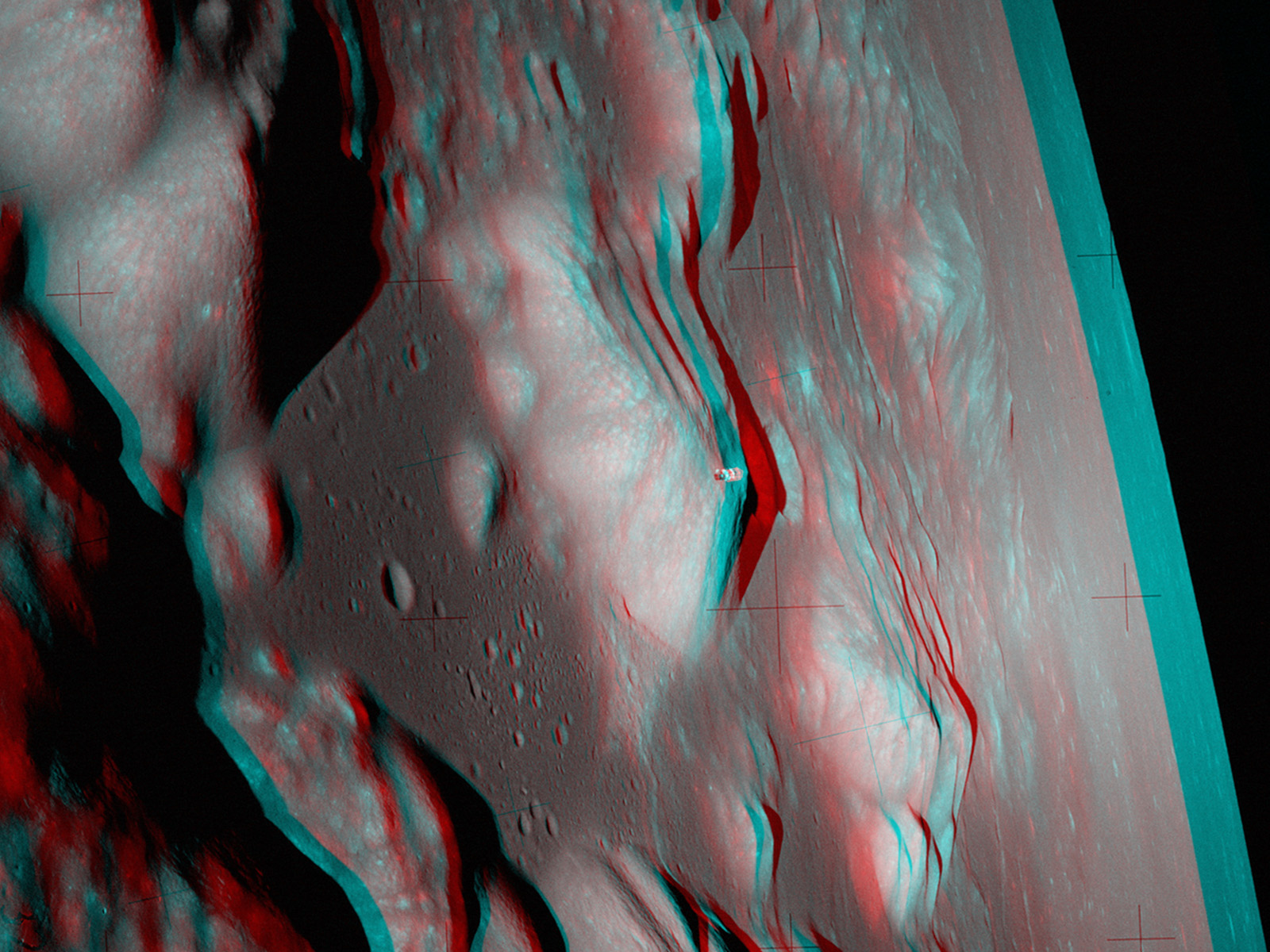
America and the Sea of Serenity
17/01/2024
Get out your red/blue glasses and check out this stereo view of another world. The scene was recorded by Apollo 17 mission commander Eugene Cernan on December 11, 1972, one orbit before descending to land on the Moon. The stereo anaglyph was assembled from two photographs (AS17-147-22465, AS17-147-22466) captured from his vantage point on board the Lunar Module Challenger as he and Dr. Harrison Schmitt flew over Apollo 17's landing site in the Taurus-Littrow Valley. The broad, sunlit face of the mountain dubbed South Massif rises near the center of the frame, above the dark floor of Taurus-Littrow to its left. Piloted by Ron Evans, the Command Module America is visible in orbit in the foreground against the South Massif's peak. Beyond the mountains, toward the lunar limb, lies the Moon's Mare Serenitatis. Four astronauts will venture around the Moon and back again on the Artemis II mission, scheduled for launch no earlier than September 2025.
Copyright: Gene Cernan
The Orion You Can Almost See
16/01/2024
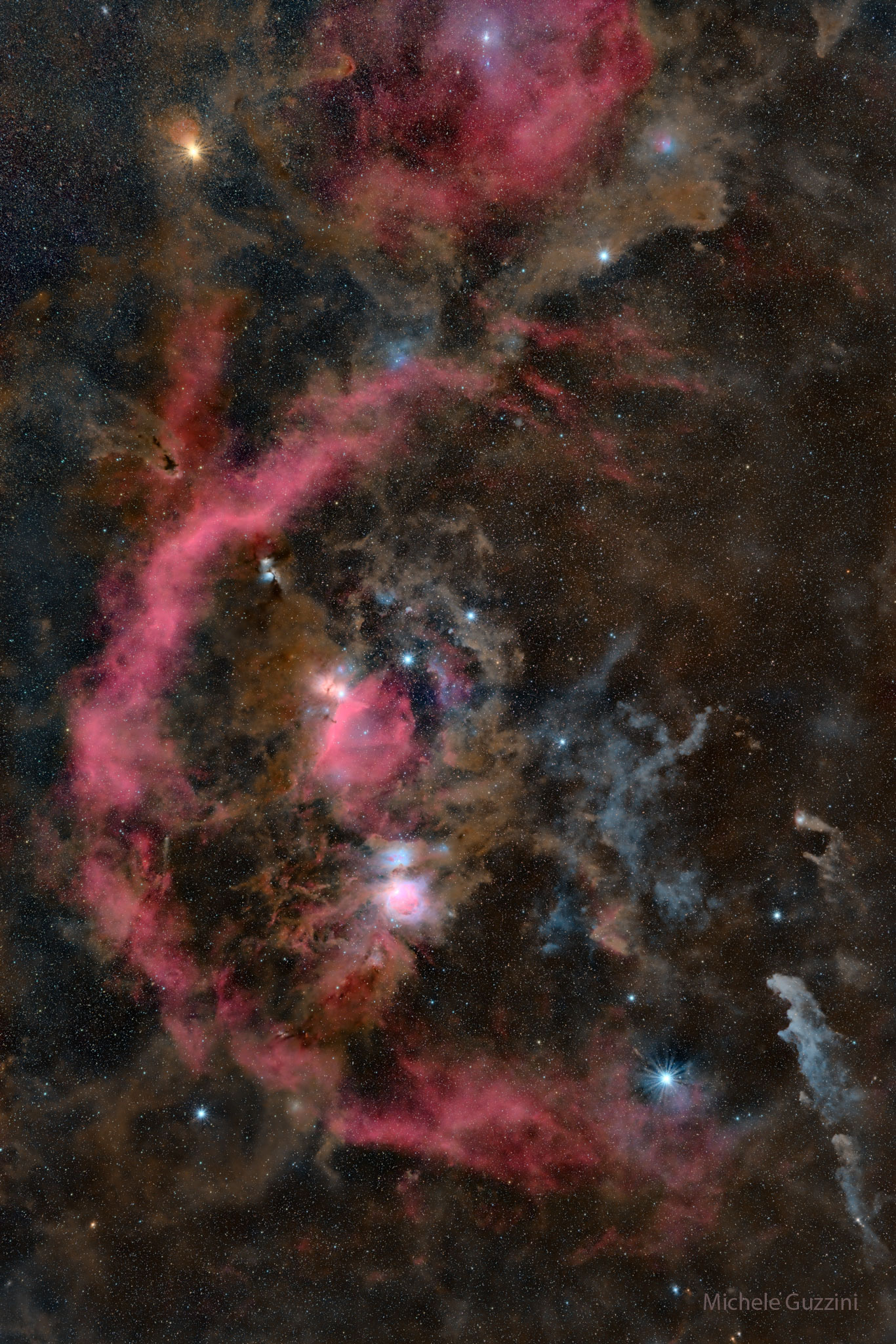
Do you recognize this constellation? Although it is one of the most recognizable star groupings on the sky, this is a more full Orion than you can see -- an Orion only revealed with long exposure digital camera imaging and post- processing. Here the cool red giant Betelgeuse takes on a strong orange tint as the brightest star on the upper left. Orion's hot blue stars are numerous, with supergiant Rigel balancing Betelgeuse on the lower right, and Bellatrix at the upper right. Lined up in Orion's belt are three stars all about 1,500 light-years away, born from the constellation's well-studied interstellar clouds. Just below Orion's belt is a bright but fuzzy patch that might also look familiar -- the stellar nursery known as Orion's Nebula. Finally, just barely visible to the unaided eye but quite striking here is Barnard's Loop -- a huge gaseous emission nebula surrounding Orion's Belt and Nebula discovered over 100 years ago by the pioneering Orion photographer E. E. Barnard.
Copyright: Michele Guzzini
Star Cluster IC 348 from Webb
15/01/2024
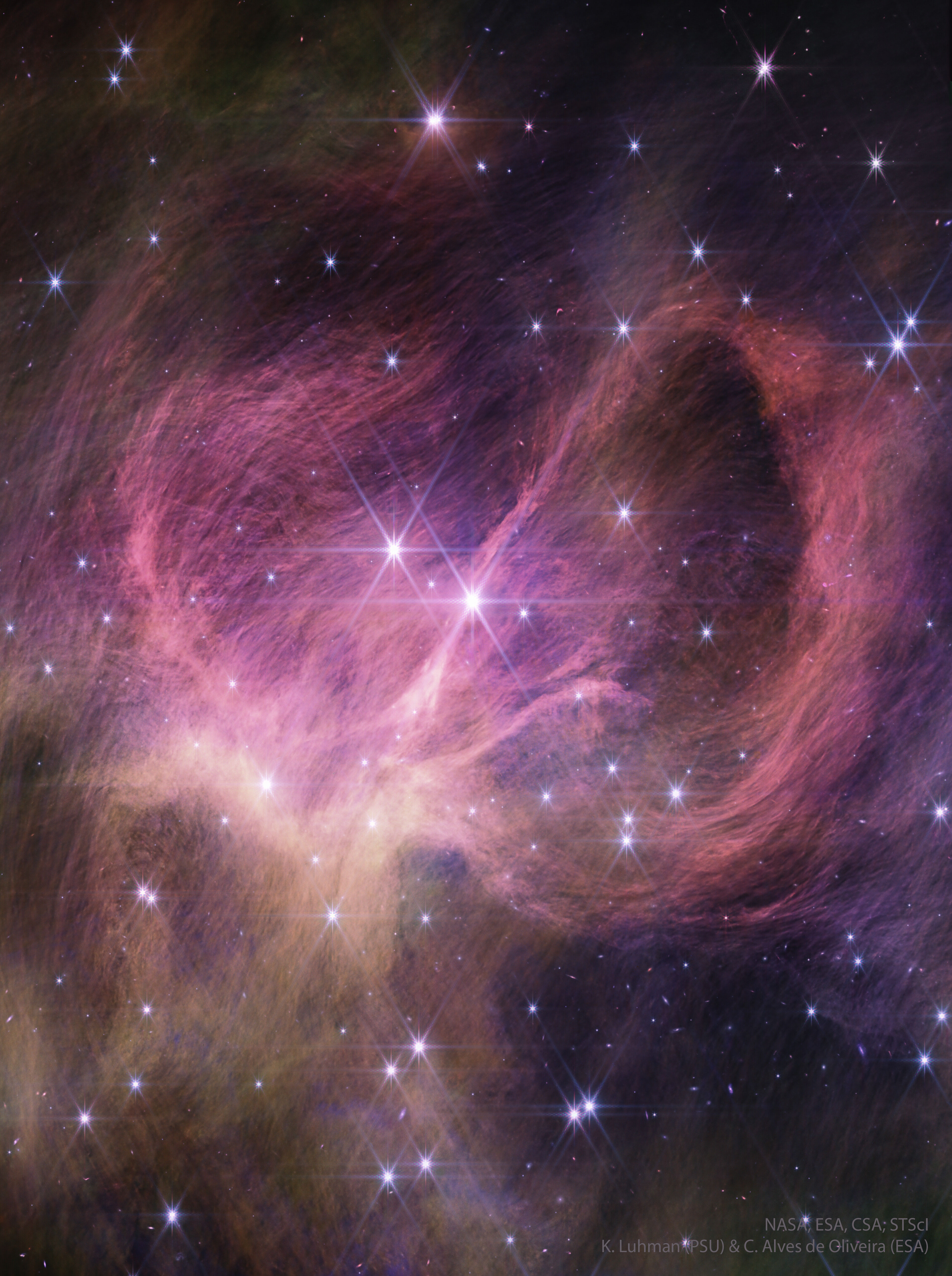
Sometimes, it's the stars that are the hardest to see that are the most interesting. IC 348 is a young star cluster that illuminates surrounding filamentary dust. The stringy and winding dust appears pink in this recently released infrared image from the Webb Space Telescope. In visible light, this dust reflects mostly blue light, giving the surrounding material the familiar blue hue of a reflection nebula. Besides bright stars, several cool objects have been located in IC 348, visible because they glow brighter in infrared light. These objects are hypothesized to be low mass brown dwarfs. Evidence for this includes the detection of an unidentified atmospheric chemical, likely a hydrocarbon, seen previously in the atmosphere of Saturn. These objects appear to have masses slightly greater than known planets, only a few times greater than Jupiter. Together, these indicate that this young star cluster contains something noteworthy -- young planet-mass brown dwarfs that float free, not orbiting any other star.
Copyright: NASA
Dragon Aurora over Iceland
14/01/2024
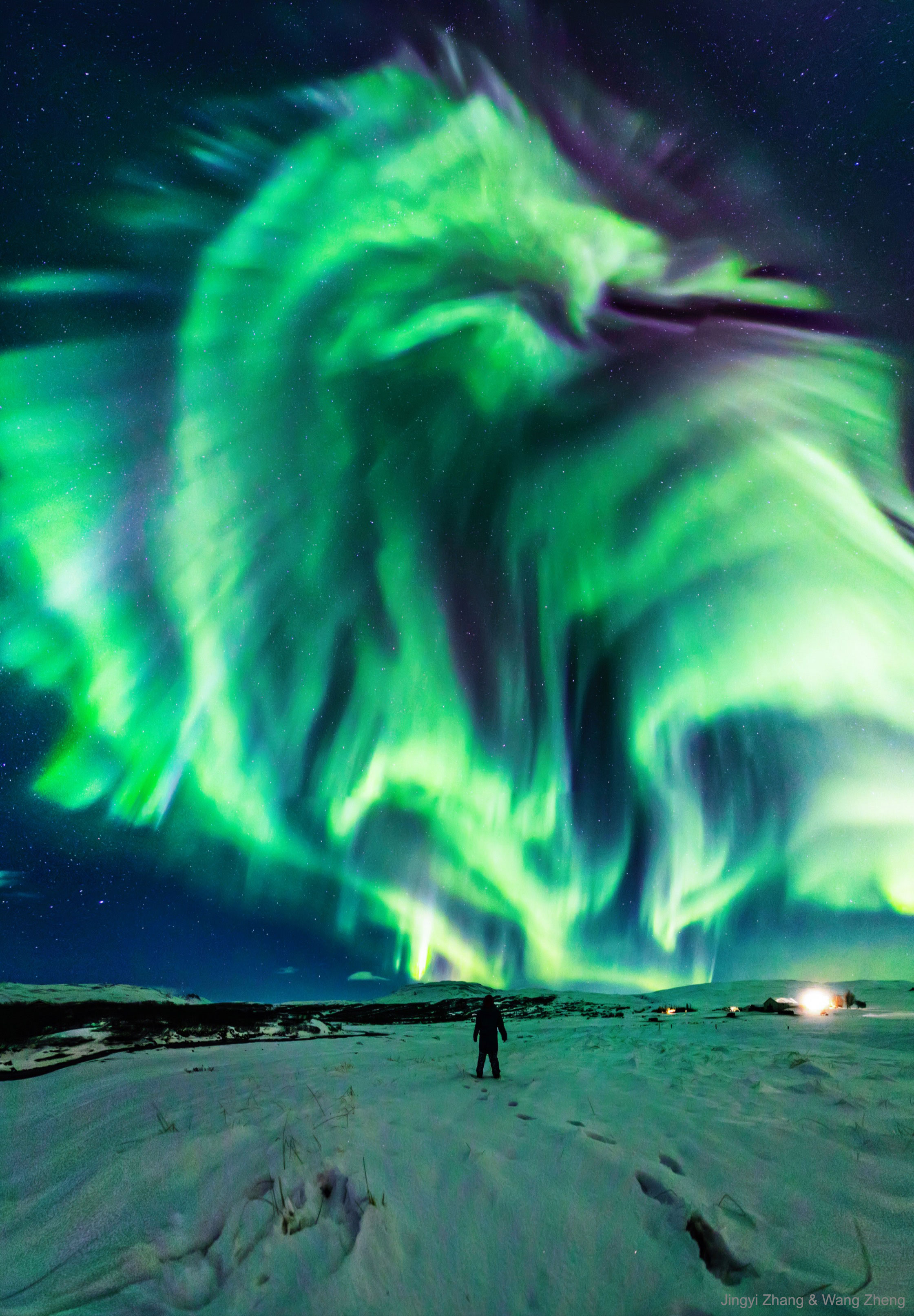
Have you ever seen a dragon in the sky? Although real flying dragons don't exist, a huge dragon-shaped aurora developed in the sky over Iceland in 2019. The aurora was caused by a hole in the Sun's corona that expelled charged particles into a solar wind that followed a changing interplanetary magnetic field to Earth's magnetosphere. As some of those particles then struck Earth's atmosphere, they excited atoms which subsequently emitted light: aurora. This iconic display was so enthralling that the photographer's mother ran out to see it and was captured in the foreground. Our active Sun continues to show an unusually high number of prominences, filaments, sunspots, and large active regions as solar maximum approaches in 2025.
Copyright: Jingyi Zhang & Wang Zheng
Circling the Sun
13/01/2024
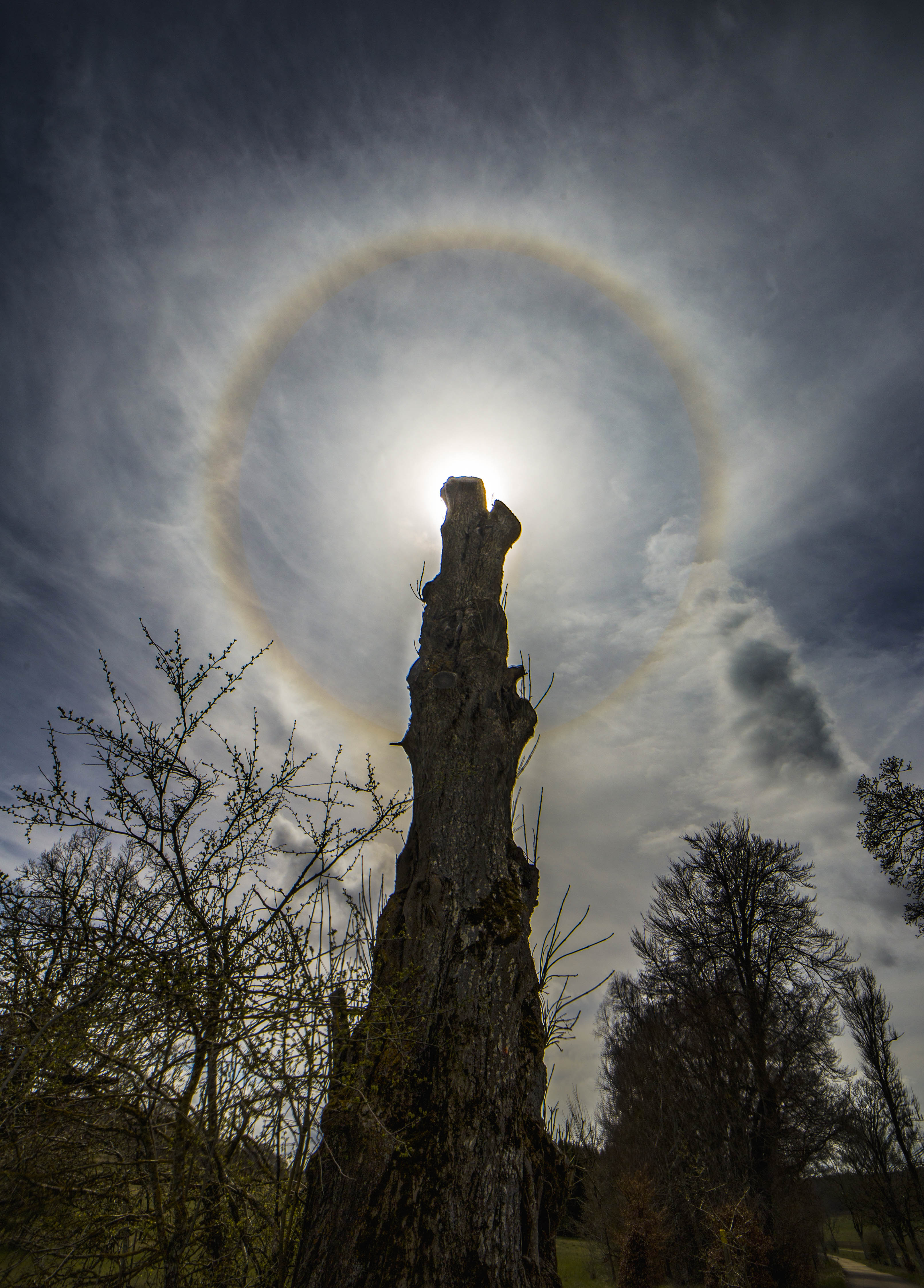
rth's orbit around the Sun is not a circle, it's an ellipse. The point along its elliptical orbit where our fair planet is closest to the Sun is called perihelion. This year, perihelion was on January 2 at 01:00 UTC, with the Earth about 3 million miles closer to the Sun than it was at aphelion (last July 6), the farthest point in its elliptical orbit. Of course, distance from the Sun doesn't determine the seasons, and it doesn't the determine size of Sun halos. Easier to see with the Sun hidden behind a tall tree trunk, this beautiful ice halo forms a 22 degree-wide circle around the Sun, recorded while strolling through the countryside near Heroldstatt, Germany. The Sun halo's 22 degree angular diameter is determined by the six-sided geometry of water ice crystals drifting high in planet Earth's atmosphere.
Copyright: Radoslav Zboran
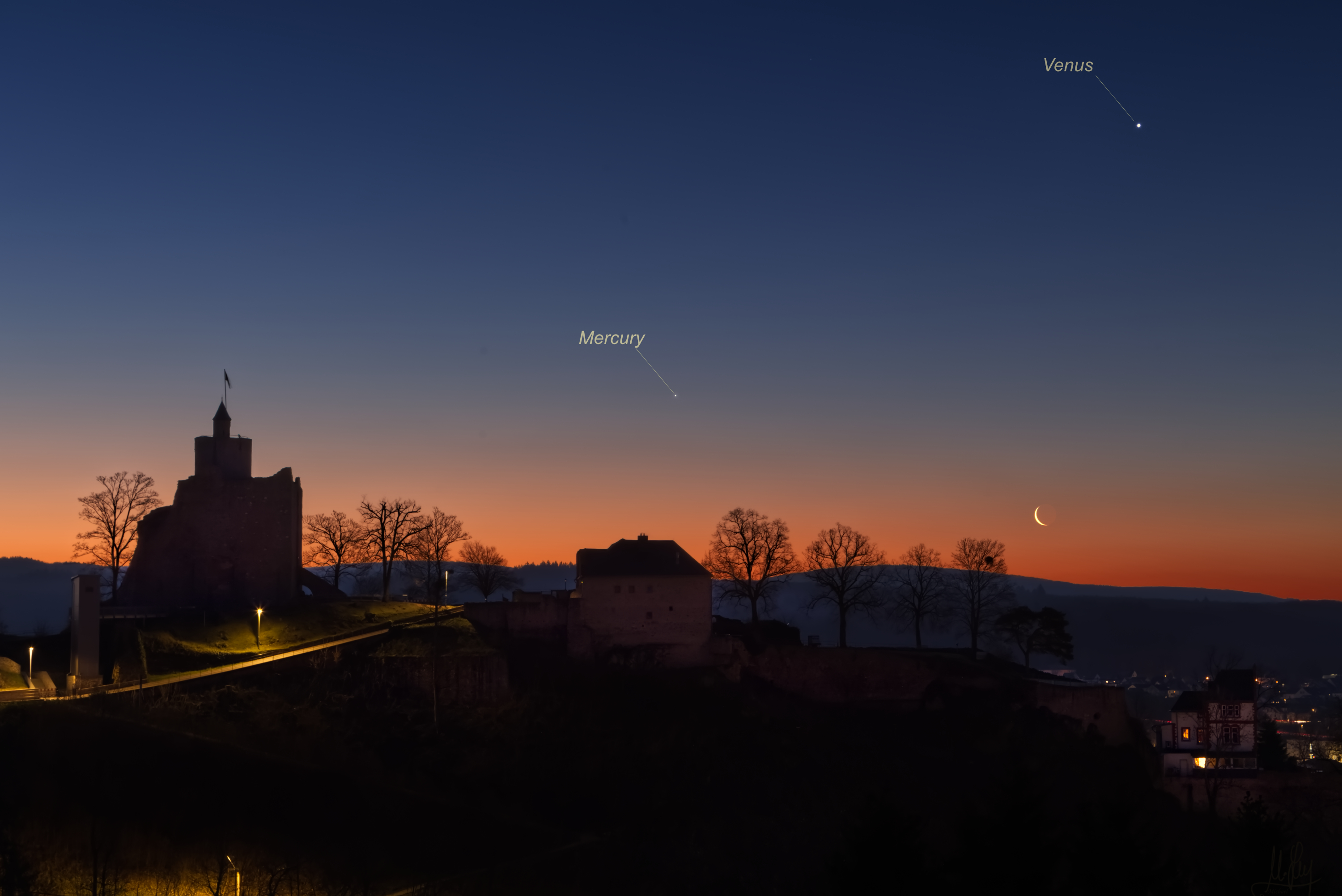
Good Morning Moon
12/01/2024
Yesterday, the Moon was New. But on January 9, early morning risers around planet Earth were treated to the sight of an old Moon, low in the east as the sky grew bright before dawn. Above the city of Saarburg in Rhineland-Palatinate, western Germany, this simple snapshot found the waning Moon's sunlit crescent just before sunrise. But also never wandering far from the Sun in Earth's sky, inner planets Venus and Mercury shared the cold morning skyview. In the foreground are the historic city's tower and castle with ruins from the 10th century.
Copyright: Michael Luy
Η Αστρονομική Εικόνα της Ημέρας από τη NASA (NASA Astronomy Picture of the Day) είναι μια δωρεάν υπηρεσία που παρέχει καθημερινά μια εντυπωσιακή εικόνα από το σύμπαν, την λήψη της οποίας έχει πραγματοποιήσει κάποιος από τους αστρονόμους της NASA ή από κάποιον από τους δορυφόρους ή τα τηλεσκόπια που η NASA λειτουργεί. Οι εικόνες που εμφανίζονται καλύπτουν μια ευρεία γκάμα από θέματα, συμπεριλαμβανομένων των αστερισμών, των γαλαξιών, των πλανητικών συστημάτων, των κομητών, των αστρικών σωμάτων και των παρατηρητηρίων. Κάθε εικόνα συνοδεύεται από μια σύντομη εξήγηση και πληροφορίες σχετικά με το τι παρατηρείται στην εικόνα.